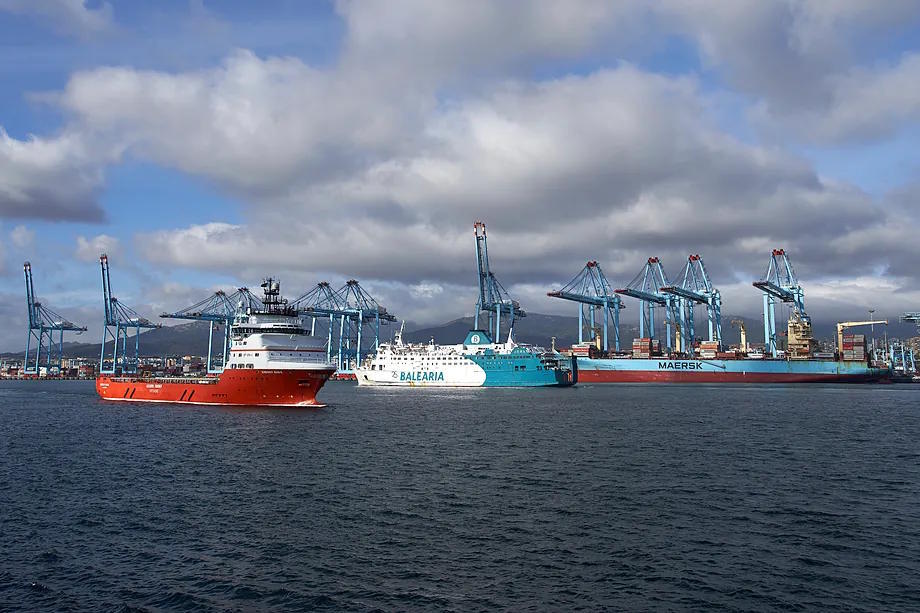
The Federal Maritime Commission (FMC), the independent federal agency that regulates maritime transportation in U.S. foreign trade, has proposed on Wednesday applying a surcharge of $200,000 to each Spanish ship wishing to operate in U.S. ports as well as a series of commercial restrictions on Spanish products such as ceramics, oil, cosmetics, as well as stone articles, sugar, and confectionery. The decision has not been made yet and is in response to the decision to prohibit the use of facilities for ships destined to or originating from Israel with Defense material.
U.S. legislation empowers the FMC to investigate and react to "counteract or adjust" unfavorable conditions for maritime transportation arising from the laws or regulations of another country. And "after investigating reports of restrictive port practices by the Government of Spain," the Commission "has determined that Spain has created unfavorable maritime conditions for U.S.-flagged vessels. Consequently, the FMC proposes corrective measures to counteract these conditions, including charging fees to all Spanish-flagged vessels and restricting the import of certain products."
Government sources explain that they are analyzing the report's conclusions and the possible implications of the proposed measures. "Spain will defend its interests and those of its companies, in coordination with the European Commission and the Member States, considering that this is a matter framed within the trade relations between the European Union and the United States," the same sources state.
Washington's warning emphasizes that the investigation is not only about Spain's sanctions on Israel but about the "reliability of the supply chain," and concludes that in practice, Spain maintains a policy that prevents U.S. ships from docking, causing many to stop calling at national ports and divert, for example, to Tangier.
The agency's analysis does not delve into Spain's reasons, whether they are legal or not, but simply concludes that the conditions for the U.S. are therefore "unfavorable," opening the door to possible fines and sanctions. "These unfavorable conditions have serious consequences for the efficiency and reliability of the international maritime transport supply chain, as well as for the FMC's ability to promote the growth and development of U.S. exports, foster the development of a U.S.-flagged liner fleet capable of meeting national security needs and supporting trade, and backing the U.S. merchant marine," the resolution states.
The process is not new. The investigation was opened in December 2024, triggered by Spain denying port access in November of that year to three U.S. ships from the Maritime Security Program (MSP) for carrying cargo with origin or destination in Israel, applying restrictions on arms trade in the context of the Gaza war. Now, the agency proposes a possible sanction that would require, if implemented, each vessel to pay an additional $200,000. However, it is not a closed process. For now, it is a proposed rule (notice of proposed rulemaking), not a final decision. Sanctions would only take effect if the FMC takes the final step, which would not happen before the end of the year at the earliest.
With today's notification, a 60-day comment period is opened, and likewise, Spain can request a hearing before the Commission. The Spanish government already responded to the opening of the file by arguing that this commission has no jurisdiction, pointing out that it is a diplomatic issue that must be addressed through the Department of State and explaining that it was obliged to take those actions in ports by Spanish and European law. Adding that there is no discrimination against U.S. ships, which can operate in Spanish waters and facilities normally. Unless they carry or bring cargo from Israel.
"Spain submitted a comment in response to the Commission's December 2024 notification, but not to the December 2025 one. In its comment, Spain argued that the Commission does not have the authority to compel it to participate in this procedure, that the Commission lacks jurisdiction over Spain due to its sovereign immunity, and that the appropriate solution is for the Commission to seek a diplomatic solution through the U.S. Secretary of State. In addition, Spain argued that it must comply with Spanish, EU, and international laws that require it to prevent the transit of defense and dual-use goods through its ports, and that it is doing so in a non-discriminatory manner," says the FMC documentation.
However, U.S. officials argue that "Spain's arguments do not address the issues raised by the Commission, and Spain's undisputed sovereignty to act within its borders does not affect the Commission's authority to investigate and regulate unfavorable conditions for U.S. foreign maritime transportation under Chapter 421."
The Commission admits that it cannot compel Spain to participate in this procedure, although it has once again invited it to do so now and in a timely manner. But at the same time, it insists that "the Commission's authority to remedy unfavorable conditions for maritime transportation in foreign trade is the authority to act within the jurisdiction of the United States. The Commission can deny entry to ships in the United States, impose fees on ships arriving in the United States, and take other appropriate measures to adjust or remedy unfavorable maritime conditions. The Commission cannot compel Spain to take any action or repeal any Spanish or EU law or regulation. Likewise, Spain cannot violate U.S. sovereignty by demanding that the Commission take or refrain from taking any action," it concludes.
The Commission's investigation focuses on whether the conditions created by Spain give rise to unfavorable conditions affecting maritime transportation in foreign trade, not on whether Spain was obliged by its own legal system to create those conditions. The text emphasizes that as a matter of foreign policy, it would not be required to open a public consultation, but decides to do so voluntarily. The previous consultation, in December 2024, received no less than 8,000 comments. Many were from Palestinian organizations, for example. But several U.S. congressmen also commented, taking a stance in support of Spain.