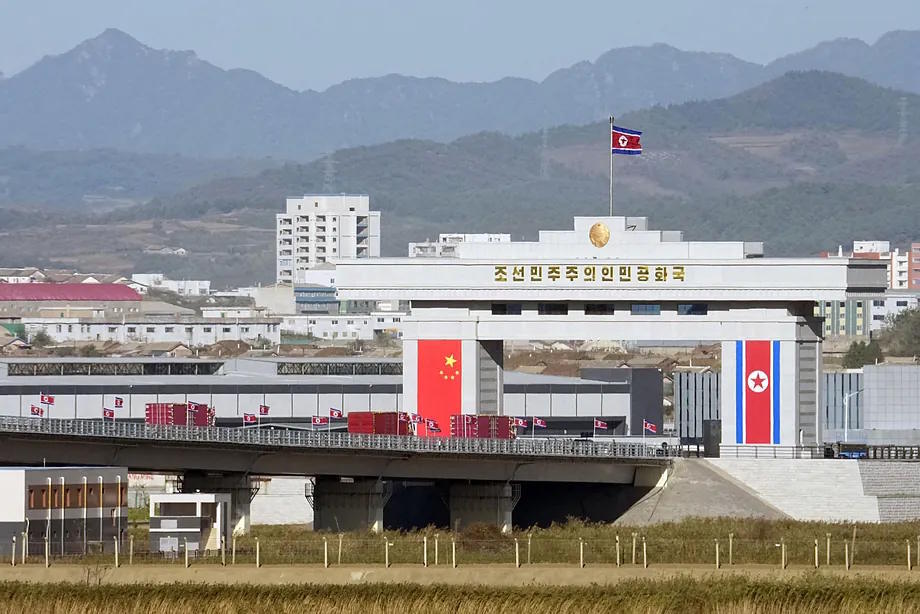
The first North Korean trucks crossed the river adorned with red flags. On the other shore, dozens of Chinese citizens crowded to photograph a scene they had been waiting for 12 years. The vehicles moved slowly on a three-kilometer-long gigantic steel and concrete structure, built to connect two countries that had been unable to agree to open it for over a decade. The bridge was built but led nowhere. Until this Thursday.
China and North Korea have finally inaugurated the New Yalu River Bridge, a four-lane infrastructure that connects Dandong, an industrial city in northeastern China, with Sinuiju, the main commercial gateway of the hermetic regime of Kim Jong-un.
The project was meant to become the major economic artery between Beijing and Pyongyang. Instead, it ended up becoming a monument to the distrust between two old communist allies who need each other as much as they distrust each other.
Chinese engineers completed the bridge in 2014. On the other side of the river, the North Koreans left access roads and customs facilities unfinished. There was never a convincing official explanation for such paralysis. For years, that concrete behemoth remained suspended over the waters of the Yalu as a metaphor for a bilateral relationship trapped between economic dependence, international sanctions, and Kim's political whims.
Now, the bridge has been opened. And the timing is not coincidental. On September 7, North Korea inaugurated another border crossing, this time over the Tumen River, connecting it with Russia. Two bridges in just five weeks. Two commercial corridors to the two major protectors of a dictatorship subjected to harsh international sanctions.
But also two symbols of a new geopolitical reality: while Vladimir Putin strengthens his military alliance with Kim, Xi Jinping tries to regain ground to prevent Moscow from monopolizing influence over its uncomfortable neighbor.
The Russian bridge, one kilometer long with two lanes, connects Khasan, in the far east of Russia, with the North Korean region of Rason. It is the first road link between the two countries, which until now relied on a railway connection for direct land transport.
This infrastructure is named after Yakov Novichenko, a Soviet soldier to whom Pyongyang attributes saving the life of the founder of North Korea, Kim Il-sung, during an attack in 1946. A historical tribute that summarizes the new fraternity between two regimes united by their confrontation with the West.
For decades, the main land link between China and North Korea has been an old bridge built in 1937, during the Japanese occupation of the peninsula. Due to its narrow single-lane roadway, a significant portion of the goods that sustain the North Korean economy has passed through it.
The new connection multiplies logistical capacity and promises to alleviate one of the main bottlenecks of a trade on which the economic survival of the regime depends. It will facilitate the circulation of food, machinery, and other authorized products, although it will not eliminate the international restrictions weighing on Pyongyang.
Tensions between Beijing and Pyongyang
To understand why an infrastructure completed 12 years ago has remained closed until now, one must go back to the most tense moments in the relationship between the Asian neighbors (although they never publicly revealed their distancing).
Beijing, irritated by North Korea's nuclear tests and missile launches, supported the United Nations Security Council sanctions against Kim. Pyongyang responded with a mix of defiance and distance. Then came the pandemic, when the North Koreans sealed their borders.
But the Russian invasion of Ukraine altered the regional balance. Kim found in Putin an ally willing to offer political support, military cooperation, and strategic supplies in exchange for weapons and North Korean soldiers deployed alongside Russian troops. The relationship culminated in June 2024 with the signing of a strategic partnership treaty that includes commitments to mutual military assistance. Moscow, in need of allies to sustain its war, became the main protector of Pyongyang.
This rapprochement did not go unnoticed in Beijing. For decades, China had exercised almost exclusive economic influence over its small communist neighbor. The Asian giant remains its main commercial supporter, but Russia has gained military and diplomatic weight that threatens to alter the traditional distribution of influences on the Korean peninsula.
Xi Jinping has now responded by reviving high-level diplomacy that seemed frozen. In September 2025, Kim traveled to Beijing to attend the grand military parade organized by the Chinese leader, where he coincided with Putin. In June of this year, Xi returned the visit by traveling to Pyongyang, showcasing the reconciliation with his neighbor.
Months earlier, in March, passenger trains between both capitals had resumed after six years of suspension. Air China also resumed its direct flights. The inauguration of the new bridge now completes a sequence of diplomatic, commercial, and political gestures.
Analysts in neighboring South Korea who regularly follow North Korean affairs point out these days that the two new bridges represent an opportunity for Kim to diversify his support without losing control.
China offers the size of its market and an economic capacity that Moscow can hardly match. Russia provides military cooperation especially valuable for a regime that has turned its nuclear arsenal into the main guarantee of survival.