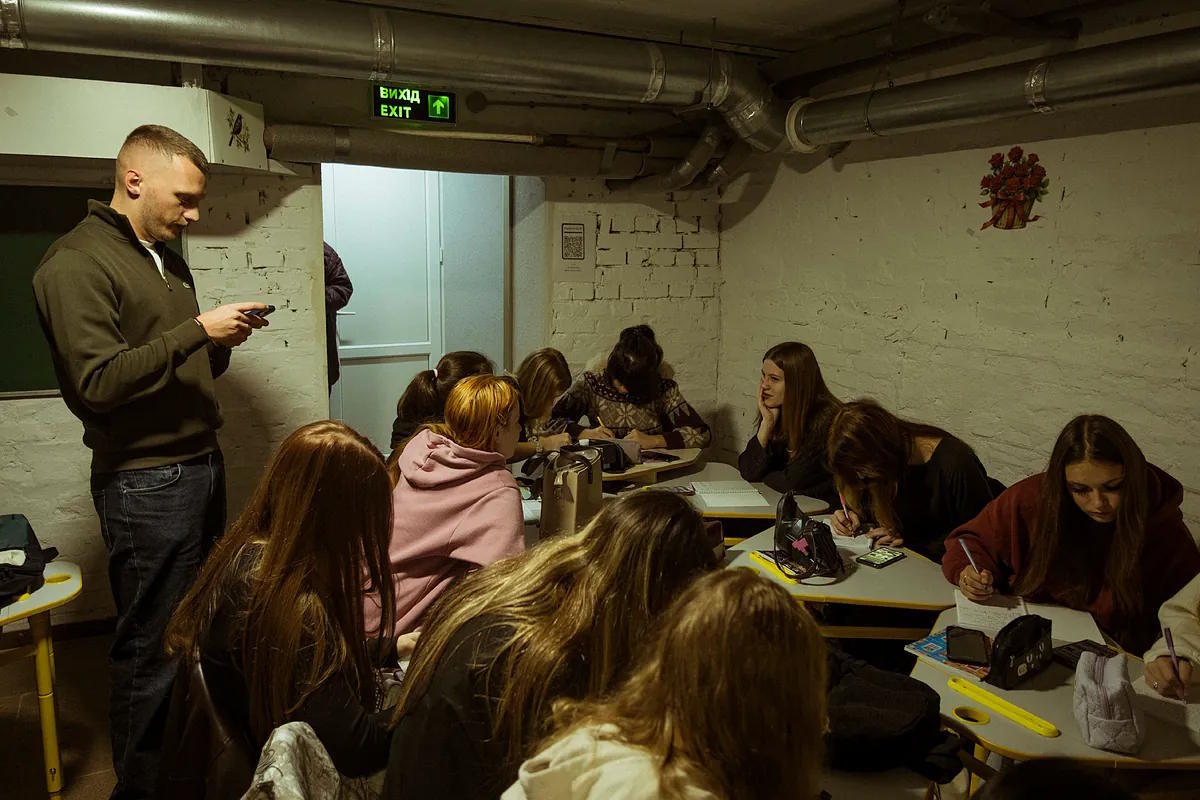
Sirens sound in Kiev. It happens several times a day. The children are trained and do not even wait for the teacher's instructions because they have practiced it dozens of times this school year and know the protocol. In a line and calmly, they all head to the nearby shelter carrying their backpacks with their books. The place, illuminated with white operating room light, welcomes the students, who continue their activities where they left off. War, just another day, does not stop education in Ukraine, although it wears it down, like the rest of society's sectors.
Among the children, we see sleepy faces. Some of them seem completely adapted to the new situation, raising their hands, participating actively, laughing. Others sit with their heads down, almost not interacting with the rest. One of them trembles in class in front of the teacher's questions, as if triggering a trauma. For the youngest, war is all they have known in their lives, although conditions have hardened in recent times. The older ones, who did experience peace, have practically forgotten it.
We are at High School number 176 in Kiev, better known as Miguel de Cervantes, one of the two schools in the Ukrainian capital that maintains Spanish as the first foreign language. Valentina, one of the deputy directors, expresses her mood in perfect Spanish: "There are no words at this point to describe how we feel. Our feelings of weariness and fatigue have exceeded our ability to express them". Katia, the other deputy director, reinforces: "We simply come to work and do our job as a form of resistance, even if it is now without motivation and in an automatic way. We cannot abandon our teaching duties".
Out of the 600 students currently enrolled in the school, only 200 attend classes each day, and they are not always the same because there is a sort of rotation among the older students. The ones who do attend in person daily are the youngest, from six to seven years old. The restriction is determined by the size of the shelter, where those 200 students sit, shoulder to shoulder and even in the hallways, to attend classes or take exams.
"My parents wanted me to study at this school to find work in Spain or Latin America, as everything seems geared towards the Anglo-Saxon market, but Spanish offers many possibilities," says Olexi, a 14-year-old teenager who wants to be a mechanic. "Many jobs will disappear in the future due to artificial intelligence, but not artisanal tasks like repairing a vehicle," he states.
The school also has 50 students who currently live in a European country as refugees but remain connected to the school and receive classes online.
"All schools face the same problems," says the principal, Olena Donchenko. "We design plans to expand the shelters, but the construction is never completed due to lack of funding."
"The truth is that now I am not afraid of drones, because we are underground and it is difficult for something to happen to us here, but the nights are very tough," comments Anna. "Many days we come without sleep, and it is difficult to stay awake and alert. Sometimes we are asked to do homework or study, but it is very challenging to lead this life and at the same time get good grades."
The fear of a confrontation with Russia is already causing many schools in the Baltic countries and Poland to apply similar protocols and practice them with their students. In several countries bordering Russia, the sound of alarms is becoming increasingly common due to drones entering their airspace.
Five consecutive school years marked by war have left Ukrainian education in a critical situation. Since February 2022, 1,859 schools have been damaged and 235 completely destroyed (one out of every six in the country), and if universities and training centers are added, the number of affected educational facilities exceeds 3,600. In border regions with Russia such as Sumy or Kharkiv, almost half of the schools have been hit by bombings.
The response has been to move the classrooms underground: Kharkiv holds classes in about 60 classrooms spread across five metro stations, and Zaporizhia is building 12 bomb-proof underground schools with a capacity for 12,000 students. However, around a third of the country's 12,000 schools operate entirely online or in a hybrid model, and nearly a million children depend solely on distance learning, a modality that becomes directly unviable due to power outages this winter: last year, almost two million children spent the winter without access to heating, electricity, or internet connection.
School principals like those at Miguel de Cervantes affirm that 61% of students attend schools with a shortage of materials and 54% without sufficient digital resources, while almost half of preschool-age children are left out of any early education. The right to learn for Ukrainian children has been under attack for five years, "with consequences that will haunt an entire generation," says the principal.
The real cost of this war in the classrooms is starting to be measurable. The results of PISA 2025, published last month, show that a significant proportion of the 15-year-old Ukrainian youth evaluated - those who have spent the last five school years in a war zone - have not reached the level of competence that would allow them to continue building on their education. These are young people whose complete secondary education has been marked by crisis: first the pandemic, then the invasion. The previous edition of the report had already estimated the loss as the equivalent of almost two years of learning in reading comprehension and up to two and a half years in mathematics and science.
Eight months after the start of the invasion, the accumulated drop was already equivalent to two lost school years, and no one expects that figure to have improved while over a third of the country's students still lack full-time in-person education. Inequality has also soared between territories: the performance gap between students in rural areas and those in large cities reaches 68 points in reading, equivalent to three years of schooling.
There is an even more revealing fact in the fine print of the report: of the 27 Ukrainian regions, 10 were directly excluded from the study due to material impossibility to conduct it in the occupied or attacked regions of Donetsk, Luhansk, Kharkiv, Zaporizhia, Kherson, Sumy, Mykolaiv, Dnipropetrovsk, Crimea, and Sevastopol. In other words, the worst results in the country are precisely those that could not be measured.
In the basement, physics exams are mixed with what the older students are currently doing, in silence, and a Spanish class with children who, following a chant, learn how to greet in our language: "Hola, hola hola, ¿cómo estás? Yo muy bien. ¿Y tú qué tal?". The pronunciation of the children is perfect.
The drone alert subsides, and it is time to leave the shelter and go up to the classrooms, an environment that is increasingly restricted due to the precarious security situation. The students walk through the school corridors, decorated with Spanish flags and Don Quixote illustrations. We also see a photo of King Felipe and Queen Letizia and the lyrics of the Spanish national anthem. But what is the connection between a Ukrainian high school and our language? The school, founded in the Soviet era, had a close relationship with pro-Soviet Cuba. Now, that link with America continues, but undoubtedly the strongest is with present-day Spain.
If Russia were successful in its invasion of Ukraine, conquering the entire territory or installing a puppet leader at the helm of its government, this type of education in Spanish would be in danger. In the already occupied areas, Ukrainian is persecuted by the authorities, as well as any other language other than Russian.