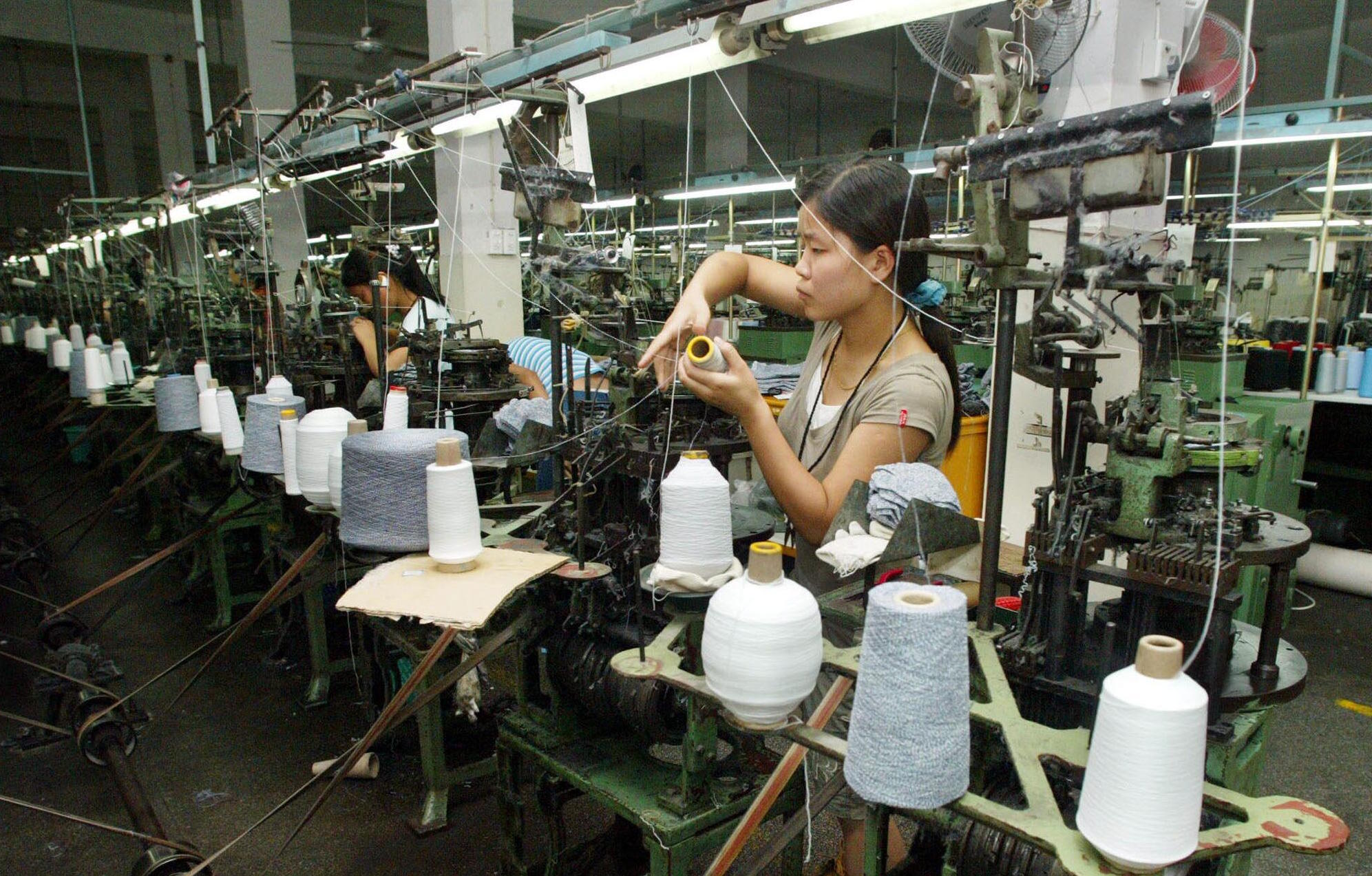
China continues to find the growth it struggles to stimulate domestically outside its borders. While millions of Chinese families continue to cautiously watch their wallets, factories in the Asian giant are working at full capacity to supply the rest of the world. Neither the ongoing trade war with the United States, nor European tariffs, nor the increasing accusations of unfair competition have managed to slow down an exporting machinery that has now found a new vein: the global fever for artificial intelligence.
The world's second-largest economy grew by 4.5% year-on-year during the third quarter of 2026, according to official data released on Monday by the National Bureau of Statistics. The figure exceeds analysts' forecasts and improves on the 4.3% recorded between April and June. In the first nine months of the year, the cumulative growth reaches 4.6%, within the trajectory necessary to meet Beijing's annual target.
Behind this recovery lies an old Chinese recipe: produce a lot, sell cheap, and conquer foreign markets. In September, exports surged by 36.3% year-on-year, reaching $447.180 billion. Imports also increased by 31%, to $313.650 billion, but the difference left a monthly surplus of $133.530 billion, the highest recorded so far this year.
The most revealing data emerges when summing up the first nine months of 2026: China has accumulated a trade surplus of $938.110 billion, 7.2% higher than the same period last year. If it maintains this pace, Beijing will close December surpassing the 2025 record. A figure that illustrates China's extraordinary industrial capacity but also the deep imbalances of an economy that needs to place an increasing portion of what it produces abroad.
The novelty is that this latest export surge does not only come from traditional cheap products that filled Western supermarkets for decades. The global explosion of investments in data centers, AI, and electrical infrastructures is boosting the demand for semiconductors, electronic components, and computer equipment manufactured in China.
According to recent estimates by Financial Times, products related to this technological revolution contributed around 13 percentage points to the growth of exports in September. The value of semiconductor shipments increased by 136%, driven largely by the rising cost of chips.
This new technological fever is added to the push from sectors where Beijing has been building a dominant position for years: electric vehicles, batteries, and industrial equipment continue to expand their international presence.
Not even the United States is slowing down in buying Chinese products. Despite successive rounds of tariffs at the beginning of Donald Trump's presidency and Washington's efforts to reduce its dependence on Beijing, Chinese exports to the U.S. market increased by 39.6% year-on-year in September. The bilateral surplus for that month was around $34.000 billion.
Something similar is happening in Europe. Chinese exports to the European Union increased by 25.25% in September, their highest growth in seven months, while the cumulative increase since January reached 16.4%. All this while Brussels watches with concern how the trade imbalance widens and how its manufacturers, especially those linked to the automotive industry, face competition from Chinese companies capable of producing at lower costs. The EU has already resorted to trade measures against certain electric vehicles and continues to negotiate mechanisms to limit the effects of Chinese industrial overcapacity.
For European leaders, the problem is not only the massive influx of Chinese products but also the difficulty of selling in the opposite direction. Foreign companies have been denouncing regulatory barriers, market access obstacles, and an uneven playing field against competitors benefiting from state support for years.
This external strength contrasts with the persisting difficulties within China. Retail sales grew by just 1.1% year-on-year in September, a slight improvement from August's 0.4%, but insufficient to speak of a solid consumption recovery. Industrial production advanced by 5.5%, while fixed asset investment accumulated a 7.2% decline in the first nine months of the year.
The major setback continues to be in real estate. Real estate investment plummeted by 20.6% between January and September, exacerbating a crisis that has been eroding families' wealth, local government finances, and buyers' confidence for years. For decades, housing was the main refuge for domestic savings. Its depreciation has led many households to prefer saving money rather than spending it, complicating official attempts to turn consumption into the new economic engine.