For five years, Min Aung Hlaing was a general who practically no one wanted to receive. An outcast in the geopolitical arena. The man who led the military coup in Burma in February 2021, imprisoned the de facto leader Aung San Suu Kyi, and crushed the protests that followed the fall of the democratic government was relegated to a small circle of friends. The West tightened sanctions, and its Southeast Asian neighbors closed high-level meetings to the military junta. But now the dictator has found an unexpected opportunity to escape his isolation. He has offered Donald Trump two things that Washington desires: to end the cyber fraud factories operating in Burmese territory and to access its gigantic deposits of rare earths.
The rapprochement has already begun. In September, Michael Vance, a senior official from the Department of State responsible for Intelligence and Research, traveled to the Burmese capital, Naypyidaw, and met with Min Aung Hlaing, who is sanctioned by the US. Officially, the objective was to negotiate the release of Adam Castillo, an American businessman detained months earlier. However, that meeting, the highest-level one between both governments since the coup, opened a diplomatic channel that seemed unthinkable just a few months ago. According to Reuters, the talks recently continued in Tokyo, with a US delegation again led by Vance.
Washington's immediate interest is to combat the digital fraud centers that proliferate in the border regions of Burma. In these huge complexes, criminal organizations retain thousands of workers, many of them trafficking victims, forced to scam foreigners through false investments in cryptocurrencies, romantic scams, and sophisticated financial operations. Americans are among their main victims.
But there is another much more strategic commodity on the table. Under the mountains of northern Burma lie some of the most important deposits of heavy rare earths on the planet, essential minerals for manufacturing electric car engines, wind turbines, smartphones, robots, and advanced military systems. For the Trump Administration, determined to reduce technological dependence on China, these resources have become a matter of national security. According to the independent observatory ISP-Myanmar, Burma was responsible for 16% of the world's rare earth production in 2024, second only to China.
The problem for Min Aung Hlaing is that a large part of these riches is not under his control. The main mines are concentrated in Kachin, a mountainous region bordering China where ethnic guerrillas fighting against his military government have taken control of important mining operations. The rebels manage much of the business and maintain their own commercial relationships with Chinese entrepreneurs.
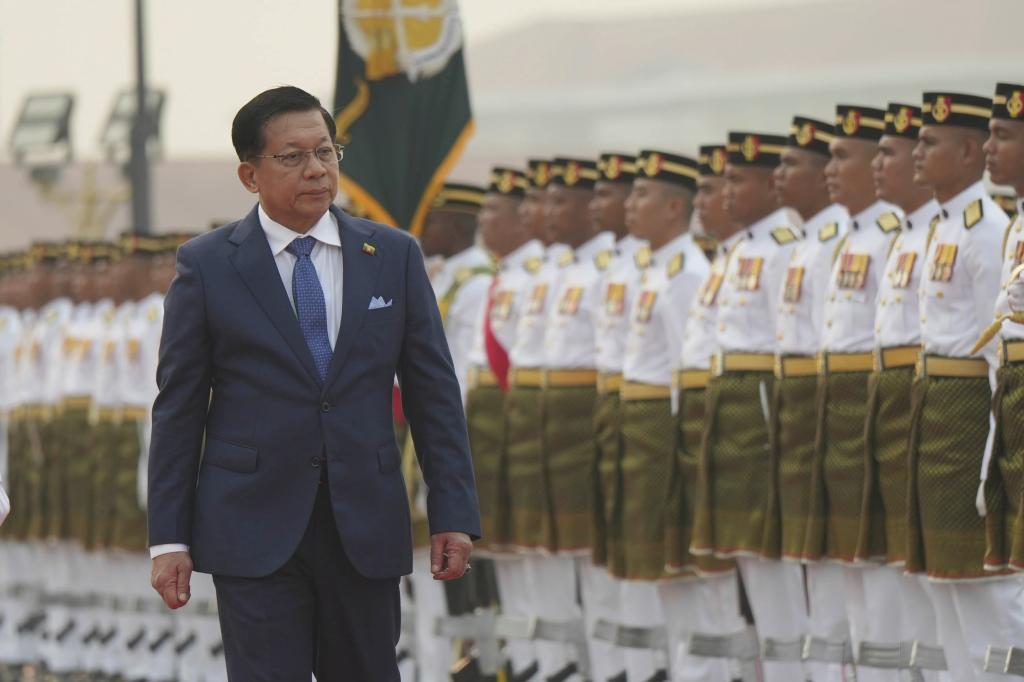
Min Aung Hlaing is not only betting on Washington. Formally appointed president in April after elections denounced as fraudulent by international organizations, the former military chief has embarked on an intense diplomatic offensive seeking political legitimacy. In recent months, he has traveled to Russia, Belarus, China, India, Thailand, and Malaysia.
In Moscow, Vladimir Putin welcomed the Burmese leader in the summer. Both countries have projects to develop a nuclear power plant, port infrastructures, and oil refineries. Russia has also become one of the main arms suppliers to the regime. Its fighter jets have been used in bombings against territories controlled by ethnic guerrillas and pro-democracy resistance.
From Moscow, the dictator traveled to Minsk. There he found the red carpet of Alexander Lukashenko. China, on the other hand, remains Burma's main economic support, although it maintains complex relationships with the guerrillas controlling part of the border.
There are also movements within Southeast Asia. The Malaysian Prime Minister, Anwar Ibrahim, has been the latest to receive Min Aung Hlaing to negotiate the return of Rohingya refugees. ASEAN - the bloc made up of countries in the region - continues to officially exclude the Burmese military junta from its main summits, but some governments advocate for resuming dialogue with the generals.
All this Burmese diplomatic offensive has legal limits. In November 2024, the prosecutor of the International Criminal Court requested an arrest warrant against Min Aung Hlaing for alleged crimes against humanity related to the persecution of the Rohingya minority. An Argentine court also issued an international arrest warrant in a case based on universal jurisdiction. The dictator must carefully choose where he lands.
While accumulating photographs with foreign leaders, the reality within the country belies his normalization discourse. Civil war continues to spread throughout much of Burma, and resistance forces and ethnic minority armies control around 42% of the territory, compared to the 21% in the hands of the military government. According to data collected by the Council on Foreign Relations, the conflict has left over 100,000 dead and 5.2 million displaced.
The National Unity Government, formed by leaders displaced after the coup, seeks to prevent international receptions for the dictator from translating into political recognition. Its Foreign Minister, Zin Mar Aung, has been seeking support in the US, Japan, and other countries for years, but observes how the interest in democracy increasingly competes with commercial priorities.
After five years as a pariah, Min Aung Hlaing has understood that he does not need to convince the world that his regime is democratic. It is enough to demonstrate that he has something to offer. In Trump's new geopolitics, rare earth mines could be worth more than any commitment to hold free elections.