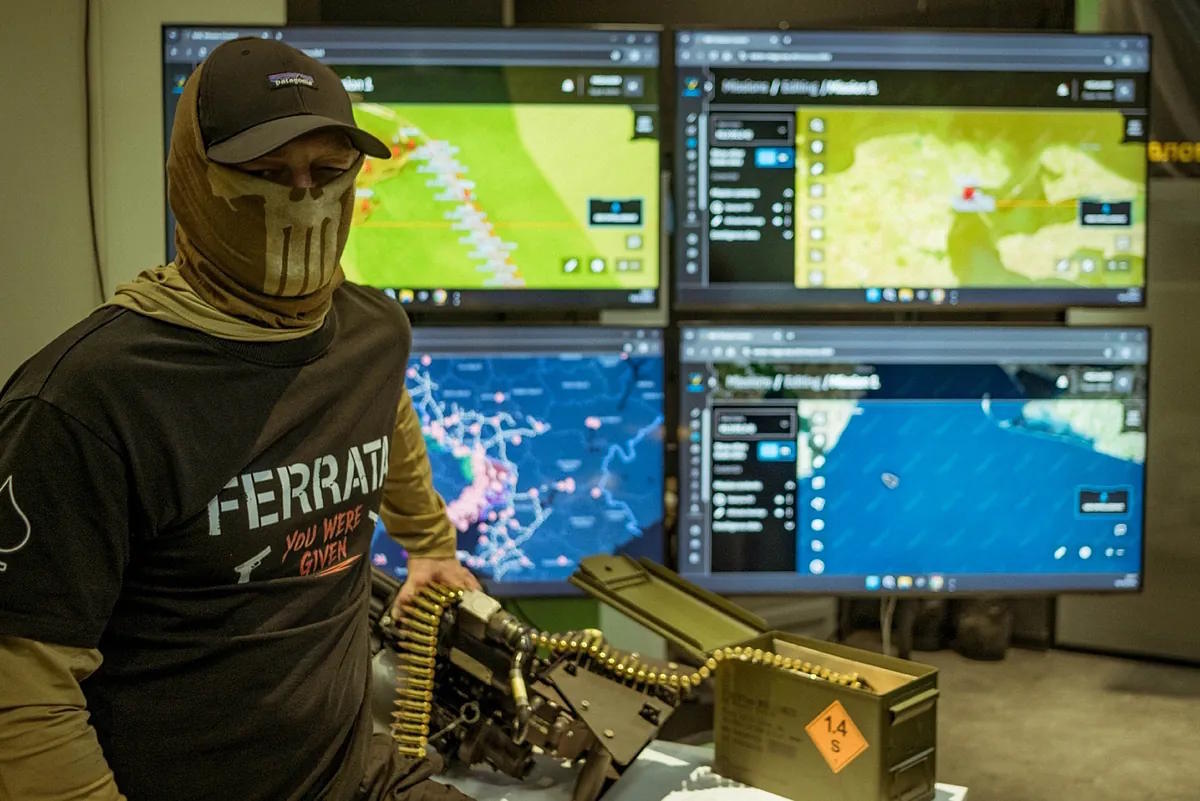
For five years, it was the group no one talked about. While other units of the Ukrainian military Intelligence, the GUR, built their legend through spectacular operations, the Ferrata detachment operated in the Black Sea without a name, without a badge, and without a spokesperson. Its commander welcomes EL MUNDO to a location that cannot be pinpointed and showcases their equipment. The most discreet unit of the GUR has decided to stop being so and reveal all their military advancements.
The place, which looks like a video game room, is actually a laboratory where they teach drones to operate autonomously with artificial intelligence based on thousands of attack videos. Ninth - the war nickname he goes by - starts from the beginning, and the beginning is modest. "At first, we were a small team, a small office", he recalls. A group of military personnel, with experience in maritime operations, tasked with creating unmanned drones in a country that had just lost access to its own sea. But the man who now leads it all initially refused to participate.
"I refused," he says bluntly. "I had previous experience that told me that if I got involved in this, it wouldn't end well." He ended up agreeing, explaining it more as a matter of character than patriotism. "I am very much a perfectionist. If I do something, it's a long process". Coming from special forces, he didn't even have experience as an operator; what he had was time. "Since I have never consumed alcohol or drugs in my life, I have had a lot of time to dedicate myself to interesting and effective things". From that small office, 500 people are now working on unmanned maritime systems. He designed it for himself: "I set it up for me, to use it as a weapon."
Ferrata carries out operations in the Black Sea, but the structure goes beyond that: it includes its own research and development center and a strategic maritime system, Katran, which is not a ship but an architecture. Each unit is linked through a QR code, accepts any camera, and can integrate up to 500 different means under a single command. Why is a unit that made silence its method now emerging from the shadows? "I am building this department as something super interconnected," he explains. "Now I have the vision of how this model will work," and that vision demands scale.
The emergence is accompanied by a whole iconography: a badge they are popularizing, the Sea Legion; a video game; presentations to European partners, and an action movie about the unit (Killhouse) that will premiere in Europe. Recruitment has unusual filters in an army that has been scraping for personnel for five years. One must pass an IQ test and be evaluated on athletic qualities, tactical and combat capabilities. And there is a reversed age limit: "It's difficult for us to hire individuals under 30, because a certain level of experience is required". Women are admitted under the same criteria as men, also as drone pilots. And nationality doesn't matter: "Passport doesn't matter. What matters is the will to win and your behavior in combat".
He mentions a German friend with whom he conducted operations and who was buried in Germany. The day before this interview, he approved the plaque that will be placed in his memory in Kiev, near the German embassy. The technological bet is at the center of everything and the reason why the unit now wants to be seen. The system plans operations with artificial intelligence, incorporating NATO manuals but going, he claims, "much further ahead." Once the area where they will operate is chosen, the program reconstructs the enemy forces present there over the last month and a half, with the coverage radius of each radio-electronic defense. "After a while, that map comes alive." They then look for what they call a window of opportunities, and if there isn't one, they create it: "We have to destroy some anti-aircraft defenses to create one."
The decision remains human: "I am not the one drawing the line. I choose the option that artificial intelligence has already offered." In combat, the cameras of all means merge into a single screen that artificial intelligence tags in real-time: it identifies the type of ship and counts how many people are on board. "We don't fight against something in our camera, but on the map", explains Ninth.
And there is another layer, explaining why this matters right now, with Washington cutting off the flow of satellite intelligence to Kiev and limiting the bandwidth of Starlink: if they cut off the internet, the vessels continue to operate and autonomously choose their priority targets. Everything, he insists, has been built without external support. "We have no foreign support here. We have produced this with our own enthusiasm and desire to win". There was also no technology transfer in the opposite direction: "We were left alone. Abroad, they know nothing about this." What his team has achieved in five years of war is equivalent, he estimates, to what would be done in 15 years of peace. Hence, the emergence from the shadows also has an aspect of offering. "This is absolutely gold for NATO," he states, offering to share it: "It's not a treasure that belongs only to me."
In the afternoon, GUR members show us one of their unmanned vessels on the Dnipro River. The most curious thing happens when it opens its hatches and several drones fly out to attack in all directions. In addition to the 1500-kilometer range of the ship, there is an additional range of about 20 kilometers. And it can carry up to 20 different drones. The future of warfare is upon us.