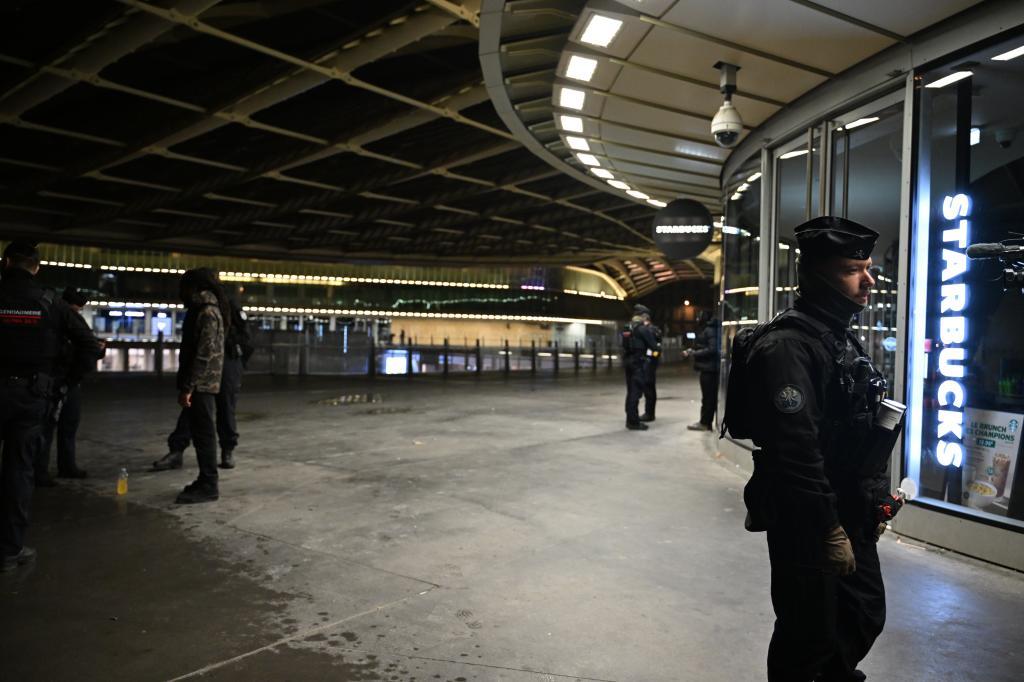
The first French cities have imposed curfews since Monday to address the wave of violence and looting that has shaken the country following the October 17 demonstrations, which resulted in over 2,300 arrests, about 3,000 vandalized businesses, and nearly a thousand injured police officers. The exceptional measure was met with skepticism by political forces as a tacit recognition of the "failure of state authority."
Paris, Lille, Douai, Wattignies, Denain, Nice, and Lyon have been the first to announce restrictions on the free movement of people at night until 6 a.m. in various parts of their cities. Marseille, where up to 30,000 acts of looting were recorded, went even further and anticipated the prohibition of demonstrations between 12:00 p.m. and 8:00 p.m.
Prime Minister Sébastien Lecornu granted prefects carte blanche on Monday to impose "partial and localized" curfews throughout the country. In Paris, the local prefecture reached an agreement with the city council to implement the measure in a large area around Place de la République and the Les Halles district, where over 30 looting incidents occurred on Sunday night.
Lecornu took the opportunity during his brief press conference to accuse "the far-left movement of organizing profound disorder in the country leading up to the presidential elections" in April and May 2027. "There is a whole nebula of organizations that can be activated to question the schedule and even the holding of the electoral appointment," he warned.
In a new challenge to the government, the yellow vests called for a new demonstration in Paris on October 24. The CGT trade union criticized "the chaos strategy deployed by the government in the face of the country's serious situation" and called on "all workers to continue mobilizing peacefully."
High school students, on the other hand, returned to action on Monday by blocking the Louvre Museum under the slogan "Culture in Struggle". "With schools closed for two weeks due to holidays, our goal has changed," declared a student identifying as Barthol. "Throughout the week, we will likely see disruptions in cultural institutions until our demands are finally heard."
Emmanuel Macron meanwhile embarked on a tour of the Middle East amid harsh criticism for the tepidness of his message to the nation and his new absence in the midst of the explosive situation in the country. Before leaving, the president rejected the resignation of Interior Minister Laurent Nuñez, who assumed "full responsibility" for the failures in containing the wave of fires, destruction, and looting that has shaken the country.
Macron decided to keep Nuñez in his position due to the need for "continuous command of security forces in the current context." "I offered my resignation because I am responsible for everything that happened," admitted Laurent Nuñez himself on Monday in statements to France Inter. "The question now is how to ensure that this does not happen again."
"Our forecast regarding participation in the demonstrations (which ultimately reached 550,000 people) was two and a half times lower than reality," acknowledged the Interior Minister. "The deployment was disproportionate to the volume of participants. But also, the number of troublemakers, looters, and far-left militants caused the situations to degenerate."
Nuñez, who was scheduled to visit Marseille on Monday, admitted "the loss of control by the police in some cities" and took responsibility for "the lack of foresight regarding the available forces." The National Assembly will open an investigation into the failures in the chain of command and the deployment of police forces on October 17.
Paris Mayor Calls for "Urgent Response"
The socialist mayor of Paris, Emmanuel Grégoire, also demanded "an urgent political response" during citizen support gatherings held on Monday in several French cities. "There is no political perspective for a constructive way out of a movement that has become entrenched," stated Grégoire. "Dialogue must take precedence over violence."
"If there are troublemakers, it is because there are social movements, and what we are seeing is a degradation of that movement, facilitated by the government's attitude," added Grégorie. "When I hear the prime minister say that the high school student movement is the work of La France Insoumise, it seems like an insult to that movement. They were not the ones who caused the damage: a very clear line must be drawn between those who demonstrated peacefully on October 17 and those who came with the intention of causing damage."
"What happened in Paris last weekend highlights a major failure of the state," emphasized the mayor, who visited some of the 30 looted businesses on Sunday night in Paris and promised the creation of a compensation fund for the affected parties.
"What is clear, however, is that we are in a critical situation due to many factors, from the precariousness of public education to the price of fuel and the cost of living," Grégoire concluded. "That's why I believe it is necessary to create a political platform for the prime minister to commit to negotiating with all parties."
The Association of Mayors of France (AMF) issued a statement on Monday condemning "dangerous, armed, and premeditated acts" since October 17 and calling for "a change in the intervention doctrine of law enforcement." "We are facing an attack on the most valuable thing we have: civil peace and fundamental public freedoms," emphasized the mayors. "Today we feel outraged."