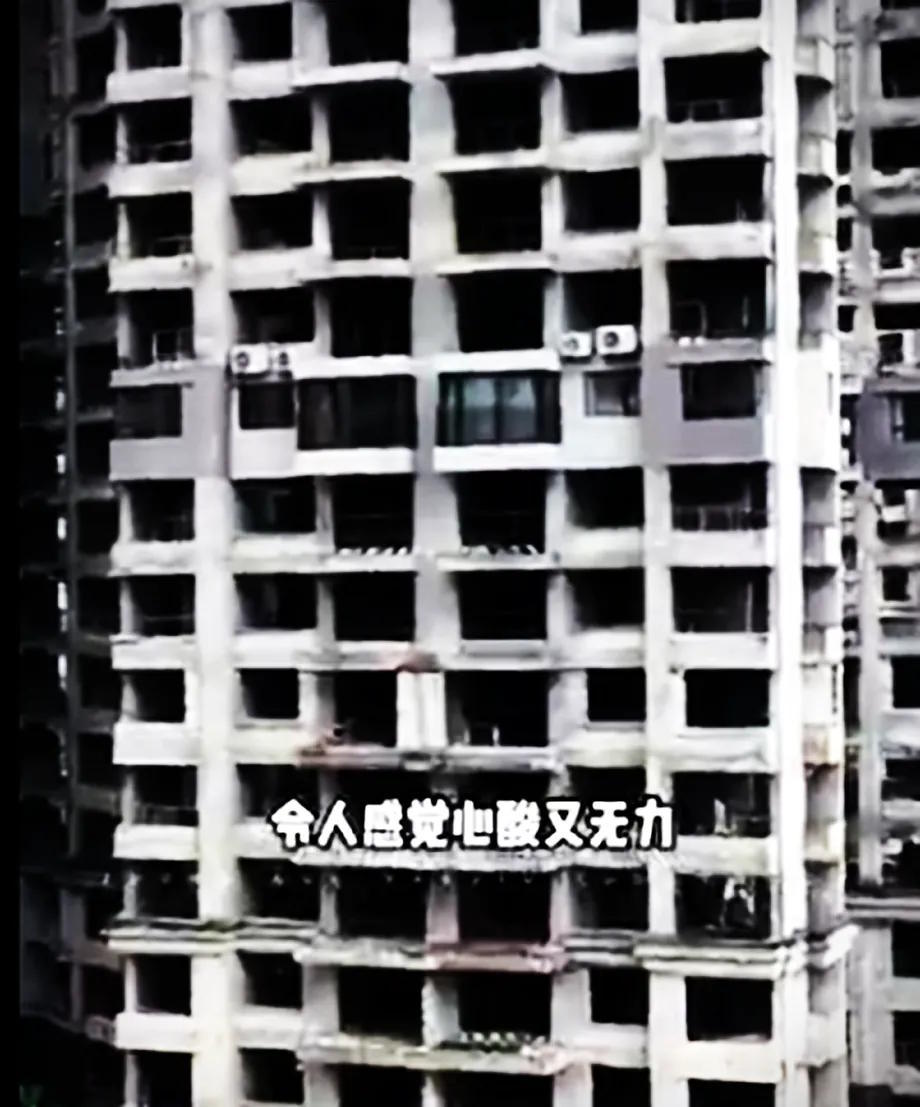
In the midst of a concrete mass, with dozens of dark windows and the upper floors lost in darkness, there is a small light on. It is the only sign of life in an unfinished skyscraper where the workers disappeared years ago. Behind that window lives a family that grew tired of waiting while still paying the mortgage. The developer never finished their home, so the owners decided to make it habitable on their own, improvising water and electricity connections and moving in. Every day they have to climb more than 20 floors on stairs that still belong to a construction site.
The video has become one of the saddest symbols of the Chinese real estate crisis in recent days. The images have gone viral on social media, accompanied by comments of outrage and solidarity. Many internet users wonder how many families are going through similar situations without anyone knowing their stories.
In China, there is a term for these concrete skeletons that dot the urban landscape: lanweilou, which literally means "decaying buildings". They are developments whose construction was halted after developers ran out of money. There are skyscrapers with finished facades but no facilities, bare towers surrounded by rusty cranes, and entire residential complexes where weeds have replaced the promised gardens. Buyers paid in advance for homes they will likely never be able to inhabit.
In Chengdu, in the southwest of the country, Qi Qi decided she was not going to keep waiting. She was 28 years old when she shared her story with the Chinese media Sixth Tone. In 2023, she bought a 57-square-meter apartment for 500,000 yuan, about 60,000 euros at the exchange rate of that time. It was practically all she could afford after years of working as a shop assistant. The home was supposed to be delivered in January 2024. But the workers disappeared, and the building was left unfinished.
Qi Qi was paying a monthly mortgage of 2,500 yuan and another 1,500 for rent. When she bought the apartment, her salary was around 4,000 yuan. That equation was unsustainable. So, in 2025, she moved to an apartment without electricity, running water, or gas. She carried her belongings to the third floor by the light of a flashlight. The hallway was covered in dust, and the elevator was not working. Her home, freshly painted in light colors, contrasted with the abandonment of the rest of the building.
This story was not an exception. Thousands of families in the same situation have tried to negotiate with developers and seek legal recourse. There have even been protests in several cities, most of which were censored in the local press. It was a desperate rebellion: those who had invested their savings to escape renting ended up living in worse conditions than many precarious homes.
The origin of the disaster lies in the model that fueled the Chinese real estate miracle for decades. Developers sold properties off-plan and used those revenues to finance new projects. In 2021, around 87% of new homes were sold before completion. The business worked as long as prices rose and buyers kept coming. Companies accumulated land and debts, local administrations made billions selling land-use rights, and families considered real estate their safest investment.
But in 2020, when the Chinese government saw that the bubble was still inflating and that the burst could be uncontrollable, it tightened restrictions on developer borrowing. The following year, the Evergrande crisis erupted, the real estate giant that had built its empire on a mountain of debt. Other companies also ended up trapped by financial problems. Falling sales reduced revenues, and numerous projects ran out of funds.
The crisis also hit confidence in a country where owning a home remains a fundamental condition for many marriages. Even a mortgage boycott movement erupted: buyers of stalled developments threatened to stop paying their loans. Authorities responded by promoting financing mechanisms to complete projects and contain a problem that threatened to spread to the banking system.
But the hole is far from being closed. According to a Reuters survey published last August, analysts expected real estate investment to fall by 20% in 2026, and housing prices to drop by 3.4%. Sales by area fell by 12.1% year-on-year during the first eight months of the year. Beijing has tried to support the sector with aid, credit facilities, and programs to complete stalled developments while seeking to reduce dependence on the old pre-sale model.
In late summer, authorities announced a reform to promote the sale of completed homes, strengthen oversight of money paid in advance by buyers, and prevent new families from getting trapped in undelivered buildings. The problem is that no regulatory change can instantly erase the concrete skeletons accumulated over the years.
In the world's second-largest economy, capable of building entire cities in record time, some families have to finish their own homes after having paid for them. The light seen from the street does not signal that the construction is complete. It is the sign of someone who, after years of waiting for the keys to their future, has decided to live among the ruins of a promise.