The officer shields the sun's rays with his hand to look up at the sky. "It seems clear now, but the situation can change in minutes." We decide to believe the words of this military man because being optimistic is the only way to carry out this type of reporting in this phase of the Russian invasion of Ukraine.
Our journey will not last more than 40 minutes, but it can feel very long. We put on our bulletproof vests and helmets, connect the drone detector (a gadget the size of a pocket book that beeps when it detects a drone frequency and even allows us to see what the drone sees on its screen), and unfasten our seat belts. If we spot a drone coming towards our vehicle, we will have only a few seconds to run away. Our Ukrainian driver chooses a rock playlist so that fear does not completely take over us. At the last checkpoint on the road, completely covered by nets, another military man questions us.
- Sviatogirsk. Is it safe to travel there?
In the following kilometers, speeding along an empty road, scattered with burned cars on the shoulder, with holes in the protective nets in some sections and looking up at the sky, we wonder what exactly "more or less" means. We turn onto a secondary road covered with trees and see a car coming from the opposite direction. We breathe a sigh of relief. If there are cars moving, it means there are no drones perched on the road, waiting for vehicles to pass by to activate and attack.
In the final part of the journey, the trees disappear, and we find ourselves completely exposed and visible from the sky, but the drone detector does not pick up any frequency. In reality, that does not mean the danger does not exist: fiber optic cable drones are not detectable by these devices and are common here. Therefore, we do not let our guard down until we reach the destination. We hide the vehicle under some trees and decide to walk without vests and helmets to avoid drawing attention, like any other civilians.
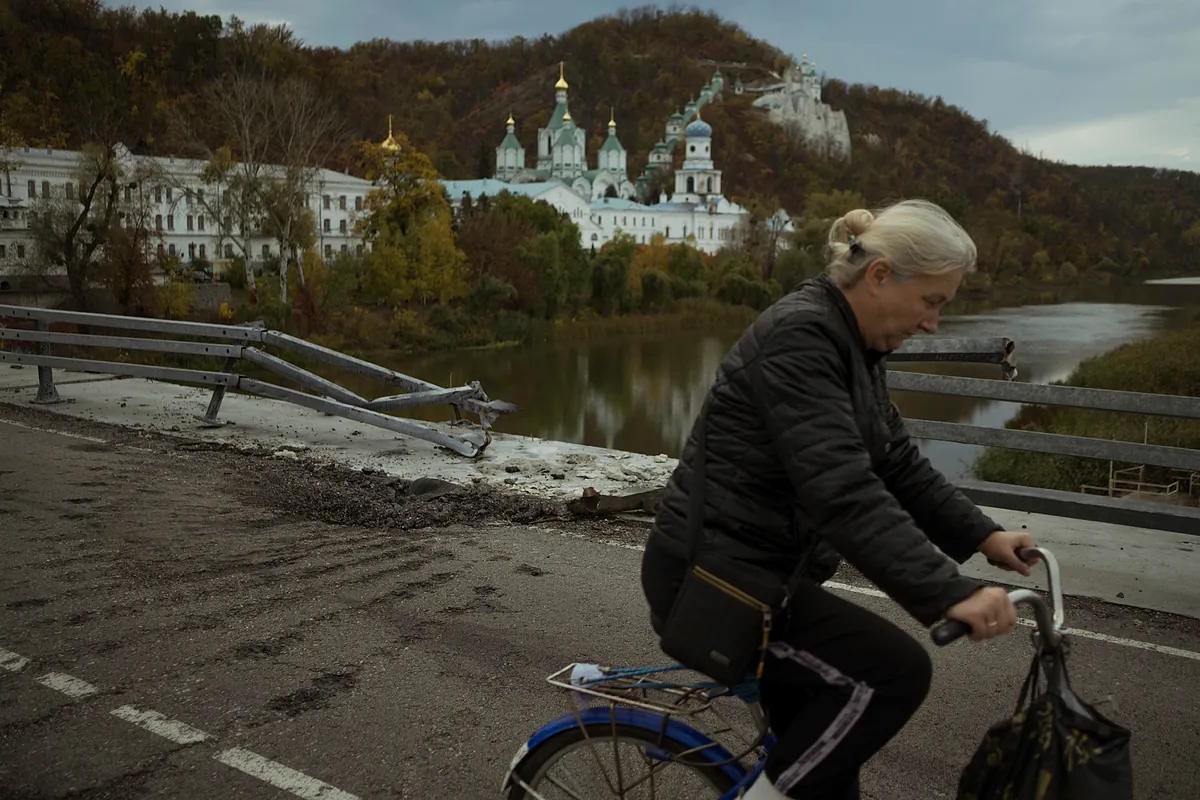
We reach the top of the hill, next to the large white and Soviet statue of Artem, the war name of Fyodor Sergeyev (1883-1921), one of the most prominent Bolsheviks, a personal friend of Stalin, and a key figure in the narrative that promotes Donbass as part of the Russian world. From the top, we can see the lush valley colored with the autumn tones of its trees and cut by the Siversky-Donetsk River. On our side stands the imposing Lavra monastery, carved into the rock itself, a sacred place for Orthodox Christians. They call it "the holy mountain."
On September 1st, Putin solemnly announced that Russia had taken this town, Sviatogirsk. In reality, it was never the case, and this type of announcement, common for the Russian autocrat, highlights the stark difference between what his generals tell him and what actually happens on the battlefield. The same goes for the city of Kupiansk, Dobropillia, Druzkivka... The Kremlin speaks of great victories and unstoppable advances, but none of it is true. As we descend the hill towards the monastery, we see several isolated civilians, mostly women, standing in the middle of the road looking towards the horizon with their phones in hand. There is coverage up there, but it fades as we descend the mountain. When we try to talk to two of them, they turn away.
We reach the monastery gates and continue across its bridge. Something big, perhaps a missile, tried to bring it down, but only tore off the railings and left a hole in the asphalt. There are no Russian soldiers anywhere. The nearest one is now about 23 kilometers away, but that does not mean there are no enemies nearby.
At the other end of the bridge, the drone detector starts beeping, and an image appears on the screen. It's the river and the bridge. The same one we are on. Then we hear it: a dronekamikaze or FPV (first-person view) is looking for a victim with its terrifying buzz. The cortisol and adrenaline start rushing, and our pulse accelerates to the maximum. Fear makes us want to run towards a nearby destroyed building, but it's too far, so we find ourselves near the remains of a burned kiosk, listening as the drone approaches with its explosive warhead ready for us. If it sees us at this moment, we would be an easy target for it. Two birds with one stone.
The danger with these drones is that movement attracts the attention of the pilot looking through its camera, so we remain still and hidden, watching as the drone frequency percentage increases on the detector, 50%, 55%, 60%, 70%... Then we hear a very close explosion echoing through the valley. Boom. Another drone has just attacked in the city. Not even 30 seconds pass when we hear the second detonation, confirming that the Russians have indeed sent a swarm of these terrifying devices. But the drone above us decides to search for targets in another area and moves away towards the other shore.
It's time to cross back over the bridge to the opposite shore and try to enter the Lavra monastery. A Russian guided bomb explodes a few kilometers away, and the ground shakes beneath our feet as if we were experiencing a small earthquake. Then a man dressed in black approaches us.
- We are fleeing from a drone but wanted to see the monastery. Can someone show it to us?
- Of course. A monk who speaks English will come.
The English-speaking monk is Sergii, dressed in the black habit of his Orthodox order and the classic long beard. We walk through the compound, whose buildings bear the scars of war due to artillery shots that sprayed shrapnel all over its facade. Five crosses in a garden indicate the five brothers who have died since 2022 due to the attacks. With an ancient key, he opens the doors to the caves, and we begin to climb through narrow and labyrinthine corridors illuminated only by a candle, in a surreal journey that momentarily makes us forget the fear of encountering the drone. Sergii explains the violent history faced by the founders of his church, their early days in these chambers inside the mountain, the patriarchs of the order as golden icons, chapels carved in stone. The sound of war and destruction outside contrasts with the peace inside this sacred enclosure. This is the surrealism of conflict zones.
The monastery, one of the most valuable and impressive monumental complexes in Ukraine, has been associated in recent years with a political controversy. It belongs to the Moscow Patriarchate, whose patriarch is Kirill, a religious figure loyal to Vladimir Putin's regime and close to his views. Many Ukrainians today reject this church for its ties to the Kremlin and accuse many of its members of being informants first for the KGB in the Soviet era and later for the FSB in new Russia. "These priests spread pro-Russian propaganda from the pulpit for years, leading to the conflict in Donbass in 2014," a well-known Ukrainian historian will later tell us.
- Do you wish for Ukraine to win the war?
- We are neutral.
This is all we will say about the war surrounding us. During the last visit of the day to one of the elevated chapels of the monastery, outdoors, another FPV drone passes very close to us, causing some concern on our part. The monk, however, remains unfazed.
- Aren't you afraid, Sergií?
- These drones pass by here all day, and I am already used to them. God protects me.
- But does He also protect me?
- God is with all of us.
I accept his approach, and we head to our car. We have to leave before nightfall when it becomes even more dangerous, as the drones' night vision makes them even more dangerous predators. On our way back up the hill, we see the same women again, in the same place, taking notes on their mobile phones... Perhaps there are no Russian soldiers in the area, and Putin's claim is false, but Ukraine is fighting in a gray area where not everyone is entirely loyal.