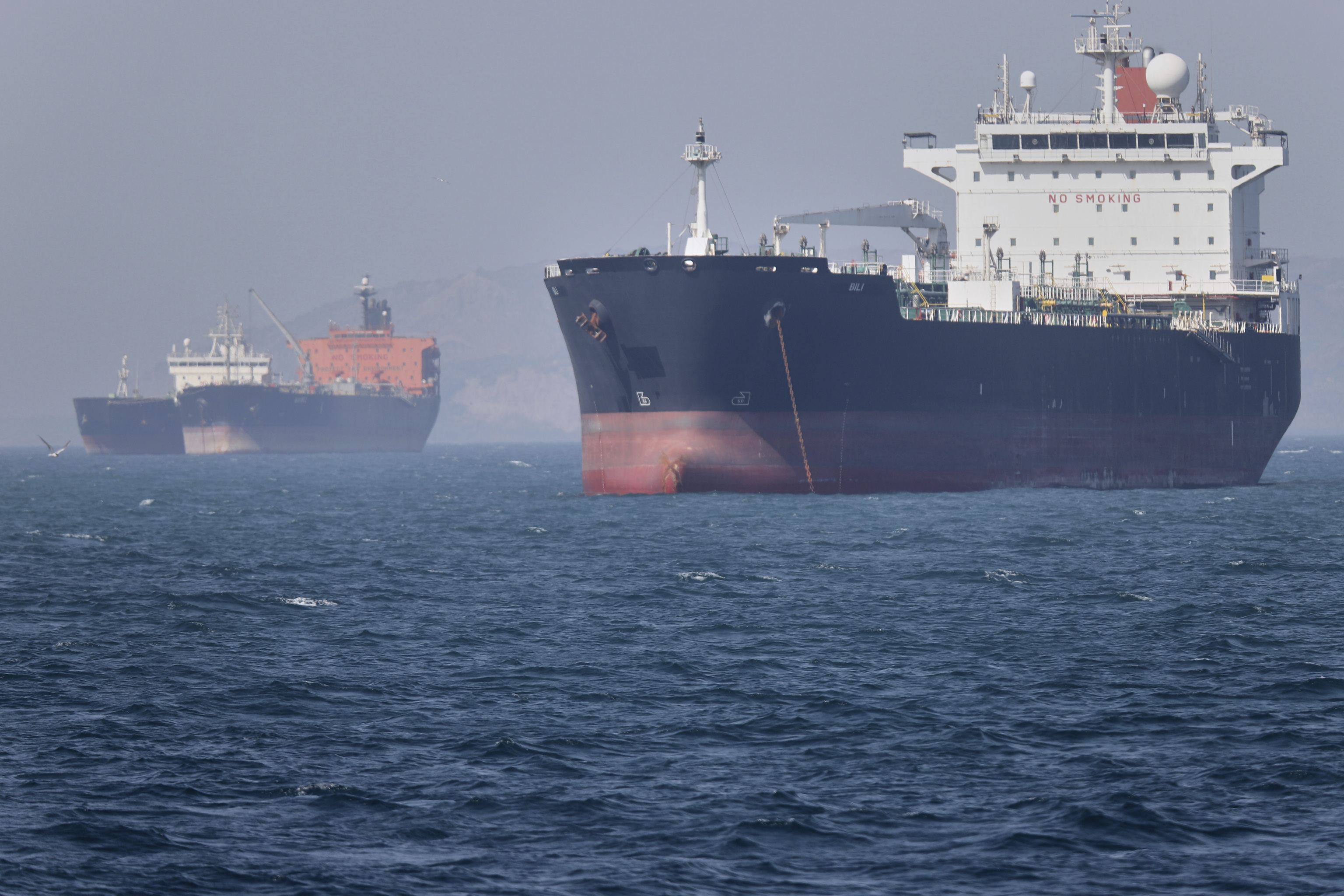
The Middle East is exporting more oil than before Israel and the United States launched the war against Iran on February 28. Some of it goes through pipelines. Another part is transported by truck, as in the case of Iraq, which exports through Syria. But the Strait of Hormuz is opening up. Through this waterway, 70% of the oil and derivatives that transited before the bombings are now passing. The Strait is a key element in the return of Persian Gulf oil to the world. Last week, the Middle East exported 24.6 million barrels per day, which is 1.3 million more than the pre-war level. Without the partial reopening of Hormuz, this would have been impossible.
The reason behind this is one of the most complex air-naval operations in decades, carried out by the United States Navy, which provides air and naval protection to a fleet of 80 ghost tankers, of medium and small size, crossing the Strait at night, with all their identification systems turned off, and even with the crew's mobile phones disconnected to avoid detection by Iran's security forces.
These are shuttle tankers (in English, shuttle tanker, which literally means "round trip"). They are called this because their voyages are very short. They depart from ports on the southern shore of the Gulf and turn off or disconnect their AIS systems (the English acronym for Automatic Identification System), which provides satellite information on basic issues such as their position, type of ship, flag, name, cargo, and crew. Sometimes they engage in spoofing, that is, falsifying that system to generate false information about their position.
"In the Hormuz and Arabian Sea region, there is so much spoofing that it is impossible to know how many ships there are and where they are," explains Gonzalo Saiz Erausquin, a researcher specializing in ghost fleets at the British defense think tank Royal United Services (RUSI), in a phone interview. But ships do more to hide their presence. Their crews, for example, must turn off their mobile phones. All to avoid revealing their position to Iran.
It is an extremely risky experience. The Strait is crossed at night, and with all these devices deactivated, the ships rely on radar and visual observation of the coastline of the United Arab Emirates and Oman to navigate amid darkness sometimes illuminated by the explosions of ships hit by Iranian missiles or that have struck anti-ship mines that Iran has scattered in the region's waters. According to the company Winward, which specializes in ship tracking, on October 11 alone, five tankers and a container ship were hit in the Strait of Hormuz and its surrounding region.
To incentivize crews, shipowners have multiplied salaries. According to the Financial Times, a captain's bonus for entering the Persian Gulf, loading oil, and taking it to SOH (the English acronym for "South of Hormuz," which is how the Gulf of Oman outside that landlocked area is referred to) is $50,000 (€45,000). This is in addition to a salary of $100,000 (€90,000). Under normal circumstances, captains of these ships earn 10% of that amount: $15,000 per month.
The salary increase extends to the entire crew. While the lowest wages on these types of ships used to range between $1,500 and $2,000 per month, the figures for crossing Hormuz can reach between $6,000 and $9,000, although the amount of the bonuses depends on the time the ship spends in the highest-risk region. The South Korean shipping company Sinokor, which owns the most supertankers in the world, offered six months' salary to those who completed the journey from Iraq — which has no pipelines and therefore depends on Hormuz to market its oil — to SOH and returned to the Gulf, according to the specialized publication NextShip. For sailors, this means putting a price on their own lives. An anonymous captain quoted by the U.S. newspaper The Wall Street Journal recalled how, after one of these voyages, half of the crew decided not to renew their contracts.
But the odyssey does not end after Hormuz. Once in the Arabian Sea, the ships sail for one or two days to position themselves, more or less, off the coasts of the emirate of Fujairah — one of the members of the United Arab Emirates — and the city of Sohar, in Oman. There, at sea, they transfer the oil to other tankers.
The tankers making the Hormuz crossing are usually VLCCs (the English acronym for Very Large Crude Carriers), as this maximizes the amount of cargo they can transport. Once they pass, they transfer the cargo to other ships, including VLCCs, Suezmax and Aframax tankers, which are smaller. A VLCC carries around 320 million liters of crude oil, equivalent to all of Spain's oil consumption in 36 hours. Suezmax tankers — named for being the largest ships that can transit the Suez Canal — carry half that amount.
Once the oil transfer is completed at sea, which usually takes between 12 and 24 hours, the shuttle returns quickly to the Gulf to reload, while the other tanker heads to its destination port, usually in the industrialized world, especially in Asia. The entire operation is a technological and military triumph for the U.S. Navy, as both Fujairah and Sohar were heavily bombed by Iran in March and April, and at its narrowest point, the Strait of Hormuz is only 39 kilometers wide.
This system of oil transfer, obfuscation of positioning systems, and use by different navies is, paradoxically, "the same system used by the Iranians themselves to evade U.S. sanctions and by Russia to continue exporting oil after the invasion of Ukraine," explains Saiz Erausquin.
And that is one of the problems with this strategy: there are not enough tankers. Commodity trading giant Vitol has already warned that the global fleet of VLCCs is insufficient for this system. Added to this are the costs of freight and insurance, which have multiplied by between 10 and 50 times. Some reports indicate that the journey from the port within the Persian Gulf to the transshipment location and back can cost $50 million, depending on the type of ship. Although operating costs return to normal levels when oil shipments leave the war zone, the impact of escaping Hormuz affects total transportation costs.
According to a report by the International Energy Agency (IEA) published on Wednesday, transporting a barrel of crude oil from the Persian Gulf to Asia costs $37. This is five times the price under normal circumstances. Since the oil market is globally integrated, although prices may fluctuate depending on different oil varieties, this increase in the cost of Arabian crude affects gasoline pump prices worldwide in a similar manner.
This is practically unsustainable, and it explains why the price of oil and its derivatives do not drop despite the resumption of traffic. Simply moving these cargoes is too expensive for fuel prices to decrease. In this sense, "neither Iran has the capacity to fully control the Strait nor the United States to keep it open under normal circumstances," explains the RUSI researcher.
The chaos is so great that some Iranian ships manage to evade the U.S. blockade. According to Winward data, 8% of the oil leaving the Persian Gulf last week was linked to Iran. This is a meager consolation for the country, which has also seen the oil stored on ships already consumed. But that does not mean the war is over. Tehran is willing to maintain pressure as long as it pushes oil prices up. The war for the Strait of Hormuz seems to have turned into a trench war, in which neither of the two sides appears to be in a position to win in the short term.