At 63, Carmen fell in love again. The man she had met in an animal rights group on Facebook presented himself as an Argentine engineer, divorced, and 59 years old. For three months, he asked her daily what she had for breakfast, remembered the anniversary of her husband's death, and promised her that he would soon visit her in Spain. He got the woman to start imagining a new life as a couple. Then came the emergency: the man had an accident on the oil platform in Chile where he worked and needed urgent surgery. His bank account, he claimed, was blocked due to a conflict with the company, insurance, and the hospital.
Carmen first sent 6,000 euros. Then, another 32,000 for a second surgery, medications, and transfer to another center. When she began to suspect that it could all be a scam, the virtual lover disappeared. With him vanished her Facebook account and the money she had lent him.
The one writing those messages was not an Argentine engineer, but an Ethiopian locked in a building in Laos. He too had met someone on social media who promised to change his life: an intermediary, supposedly a compatriot, who offered him a business opportunity in Southeast Asia. Upon arrival, three Chinese men took his passport and sat him in front of a computer under threats. He had to learn to court strangers, gain their trust, and choose the moment to ask them for money. A supervisor reviewed the conversations. If he did not achieve enough transfers, he was punished with beatings.
To follow the trail of this chain of deception, Crónica travels to Bokeo, in northern Laos. Here is the Special Economic Zone of the Golden Triangle, a region that for decades was an opium emporium and where mafias have built another industry: a promise of love turns into a bank transfer; a job offer, into an indefinite sentence. Along the Mekong River, next to the borders of Thailand and Myanmar, casinos, hotels, and office blocks host a business that feeds on victims on both sides of the screen.
The entrance to the enclave leads to a city built to the measure of Chinese capital. Wide boulevards, office towers, and signs in Mandarin make up a strange landscape in one of the poorest countries in Asia. Here, almost everything is paid in yuan. Upon landing, the gigantic crown placed on the roof of the Kings Romans casino does not go unnoticed, a building with cream-colored facades, turquoise domes, and abundant golden finishes. Palm trees surround an architecture that accumulates Greco-Roman statues next to a park with canals imitating Venice. A catalog of settings to dress the Mekong riverbank with prosperity.
The promoter of all this is Zhao Wei, a Chinese gambling magnate accused by the United States of leading a transnational criminal organization. Washington sanctioned him in 2018 along with his network, attributing to them money laundering, bribes, and trafficking of drugs, people, and wildlife. The Treasury Department places Kings Romans at the center of these activities. In 2023, the United Kingdom also sanctioned Zhao for his ties to trafficking, child sexual exploitation, and forced labor in scam centers.
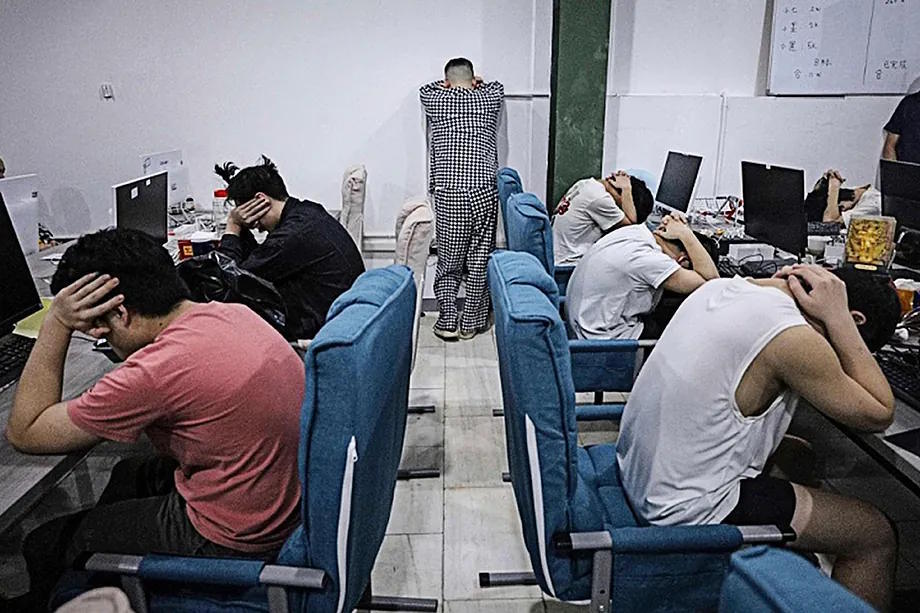
Outside the fortified perimeter of the casino, buildings surrounded by barbed wire are crowded together. Some have bars on the windows. From the street, the gaze stumbles repeatedly on iron: the bars divide the openings of the facades into small rectangles that repeat from one floor to another. The appearance of an office block; the barriers of a prison. Survivors' testimonies describe the interior of these centers: computer rooms where the so-called "cyber-slaves" spend endless days scamming victims like Carmen on the other side of the world.
Most of the workforce executing the scams comes from various corners of Asia and Africa attracted by jobs that never existed. "I was offered a job as a commercial agent to bring cheap products and counterfeits to my country. But it was all a trap. As soon as I arrived in Laos, a group of Chinese and Vietnamese took my passport and transferred me to the Golden Triangle." This is a victim from Uganda whom we will identify as Paul. He was rescued along with about twenty people earlier this year, after a raid by the Laotian police in one of the centers.
"In my plant, we were dedicated to romantic scams and identity theft. We used AI and translators to be able to carry out the scams in multiple languages," he says. According to his account, approximately half of his colleagues also arrived through false offers and were forcibly confined. Others knew they were going to work as scammers but were unaware of the exploitation conditions that awaited them. Accepting to participate in the fraud did not guarantee them the ability to leave.
Like Paul's case, estimates gathered in a recent report by the UN Human Rights Office place at 300,000 people from 66 countries who have participated in these operations in Southeast Asia. Some complexes in the Golden Triangle concentrate thousands of workers.
"I saw how people were beaten and given electric shocks. I realized that I had to learn to scam to survive," said a woman from Bangladesh who was trapped in one of these networks. Another, from Thailand, explained that their bosses demanded obtaining 300,000 baht (around 8,500 euros at the exchange rate) every day through deception to avoid punishment or being sold to another company. A victim from Sri Lanka stated that those who did not meet monthly targets were submerged for hours in water containers.
"The most complex aspect is that the criminal organization turns the victim into an instrument of the crime itself; thus, later on, they can use that forced participation to make it difficult to identify them as victims," explains Carmen Jordá, lead researcher at TecSec, a company specialized in cybersecurity technologies. The captive who manages to escape may encounter another barrier: proving that the crimes they committed were under duress from their captors.
Recruitment is not limited to people without resources or education. The networks seek technological knowledge, languages, and profiles capable of sustaining increasingly sophisticated deceptions. "They offer supposed jobs in technology companies, with good salaries and conditions. They travel thinking they are going to join a normal company, and when they arrive, their passports are taken away, and they are kept locked up," says Patricia Hernández Hidalgo, a Ph.D. in Law, Criminology professor, and director of the Master's in Cybercrime at the Universitat Oberta de Catalunya.
"They are forced to work scamming victims from other countries, using multiple phones simultaneously and enduring workdays that can reach 17 or 19 hours," she adds. Mastery of a language opens up a market. Artificial intelligence allows for its expansion.
"AI further facilitates this scam model because it allows for perfecting and generating more narratives, images, and other necessary content to maintain the deception and build the victim's trust," explains Hernández Hidalgo. "We are no longer necessarily facing a crude scam where it is evident that something does not fit. They can construct a very plausible identity and story." Technology helps manufacture both the engineer someone falls in love with and the police officer they believe they must obey.
SHAME HALTS 79% OF REPORTS
Shame, the expert continues, helps keep fraud out of statistics. A report on scams published by the international organizations GASA and Feedzai in 2024 estimated that 79% of victims did not report to authorities. "Shame acts as an inhibitor," emphasizes Hernández Hidalgo. "Some people even find it difficult to explain to family or friends because they feel they should have detected the deception or that they are responsible for what happened. This block can be even greater when they have shared photos or sexual content with who they believed was their partner: some end up hiding what happened even from their closest circle."
Regarding the money trail, it doesn't necessarily have to go directly to a bank in Laos. The first transfer can end up in a European account controlled by a mule: someone who provides their data or access to their account to move other people's funds.
"To reconstruct a specific route, each movement must be followed; the address of the first beneficiary barely opens the investigation. Then shell companies, financial intermediaries, and crypto assets can come into play," summarize police sources, the same ones who reveal the case of Carmen, the woman who ended up sending 38,000 euros to the fake Argentine engineer.
The challenge lies in investigating organizations that combine fraud, trafficking, and money laundering, attributing responsibilities and recognizing those who have committed crimes under coercion. And getting cooperation to cross borders. "Ultimately, this requires other countries to have the same willingness to combat this phenomenon, which unfortunately does not always happen," they warn.
THE MAFIAS MOVE
Police pressure can empty a building without ending the business. Matt Friedman, CEO of The Mekong Club, an organization based in Hong Kong dedicated to combating modern slavery, explains to this newspaper that raids in the Golden Triangle are pushing networks towards other territories. "They now operate in several new provinces in central Laos and in the capital, Vientiane". Friedman explains that centers are looking for more isolated or less visible locations. Organizers retain contacts, tools, and financial channels; captives can be moved.
In Vientiane, communist flags and Buddhist towers coexist with another Chinese promise of modernization. Laos needs investment, foreign currency, and infrastructure, while carrying a debt that limits its room for maneuver. The estimated size of the underground business helps understand what is at stake: around $10.9 billion annually in fraud, according to estimates collected by the United States Institute of Peace. A comparison based on UN and World Bank data places these revenues at equivalent to 68.5% of Laos' GDP, compared to 30.2% for Cambodia and 23% for Myanmar. Hence the current popularity of the term "state-scam": crime ceases to be a guest and takes root in the institutions that should pursue it.
The map extends beyond borders. During a previous visit to the Thai bank opposite Myanmar, a boatman mentioned transporting Chinese citizens to Myawaddy, known for its casinos and now another epicenter of cyber scams. "Sometimes I take four Chinese and only one returns because the rest have been kidnapped and locked up in one of those centers," he claimed.
Among the complexes in that area stands out KK Park. In October 2025, the Burmese army announced an operation there and the arrest of over 2,000 people. However, the raids have not eliminated an industry that finds refuge in border territories controlled by armed groups. The war triggered after the military coup in February 2021 has multiplied spaces where networks can negotiate protection and continue operating.
In Kokang, another Burmese region bordering China, the power of these organizations was exposed with the downfall of the Ming clan. In January 2026, Chinese authorities executed 11 people linked to their criminal network, including family members. According to Chinese justice, the organization had set up fraud and gambling complexes where individuals recruited through false offers were held and forced to scam under threats and torture.
The chain can start with a job offer in Africa and end with a money request on a Spanish phone. Between these extremes, mafias manage the hope of some and the fear of others. Carmen was promised a life as a couple. The African man who wrote to her, a prosperous business. For the owners of cyber-slave factories, both promises were part of the same profit account.