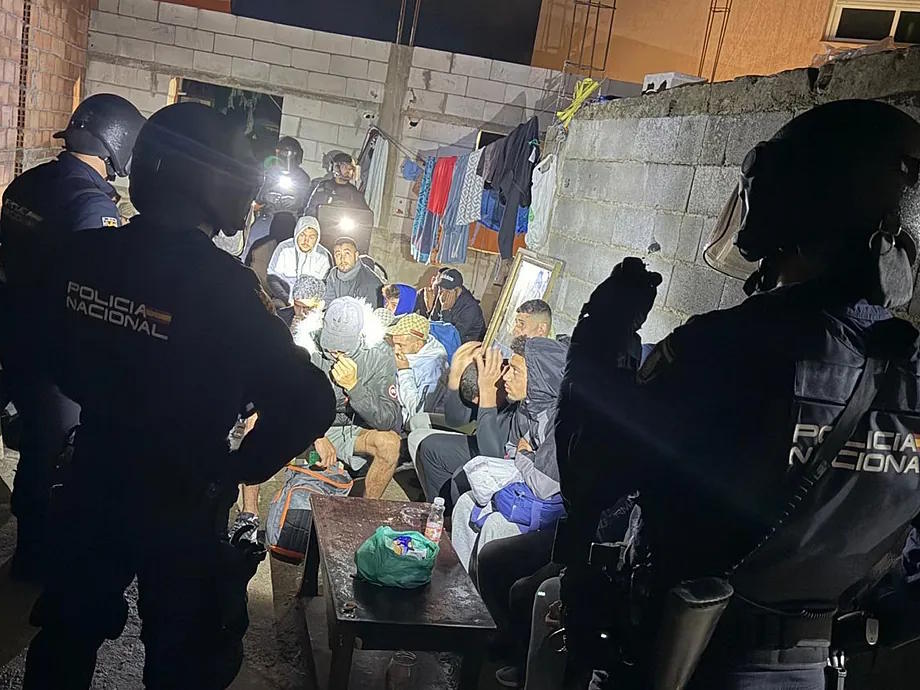
Not only did he accommodate 74 immigrants in his house who arrived on July 30 and 31 in Ceuta during the massive assault on the El Tarajal border. He also enslaved them, putting them to work in construction under his control, intimidating them with the dog that guarded the property, and even slept in his room, safe from the unsanitary conditions of the rest of the house, sharing a bed with one of the immigrants.
By the way, he did not charge her anything, at least not economically. The rest of the Maghrebis who were living in this house in the El Príncipe neighborhood paid between 10 and 20 euros per night. He, the Muslim Ceutan owner of the house, already arrested and in provisional detention, made "more than 1,000 euros in profit per night", according to police sources. By the way, the house had a single bathroom for the migrants. Without a shower.
A large police operation raided a two-story building in the El Príncipe neighborhood, one of the toughest in the autonomous city of Ceuta last Tuesday. The officers broke down the door as if it were a drug den, although inside there were only unprotected people, who "can no longer sleep outdoors because the weather does not allow it, but they have to fend for themselves for their main goal, which is to avoid triage [by the authorities] and try to cross to the Peninsula by any means," explain police sources.
The operation marked the culmination of the work of the agents from the Central Unit for Illegal Immigration Networks and Document Fraud (UCRIF), which is part of the General Commissariat for Foreigners and Borders of the National Police. The police had been monitoring the house for a long time in a very complicated environment to carry it out because El Príncipe, like other neighborhoods in Ceuta, is a very difficult environment for surveillance, for "tronchas."
"But the reality is that there is no corner of Ceuta that we are not observing down to the last detail," explain these sources, responsible for fighting, from a police standpoint, to ensure that the law continues to prevail even with the possibilities for crime that the existence of between 10,000 and 12,000 immigrants with little control in the city, out of 83,000 registered citizens.
In the house, with two floors and several barracks on the small property, an "unsanitary, horrible" underworld occupied by 74 people, who "spent most of the day wandering around the city until midnight or one in the morning," when they returned to the place to sleep poorly.
Those who slept in the house were charged 20 euros per night. Those in the barracks, not completely enclosed and therefore exposed to the cold, were charged 10 euros.
However, there was a way not to pay. "Several worked in construction sites that he controlled, where they were given only a sandwich as payment, and they were charged less for the night". The existence of these practices, which led to his indictment for exploiting minors and for a crime against workers' rights, emerged from the statements of several minors, some of whom were injured by bites from the owner's dog.
The officers, with the corresponding judicial order and working "shoulder to shoulder with the Prosecutor's Office," made the entry around 7:00 in the morning, "in the middle of sleep," and the scene they found was harrowing: the rooms covered with blankets and sacks, the migrants sleeping in the same clothes they had been wearing for weeks while roaming the city in search of food, and the owner in his room with his concubine.
The immigrants' statements revealed the constant "intimidation" by the owner, who did not hesitate to threaten them, and the investigations showed that the detainee was trying to set up an infrastructure to profit by sending them to the Peninsula, the El Dorado for the Maghrebis from the Tarajal assault who live in the limbo that Ceuta has become.
In the UCRIF's objective, "all those who may try to commit crimes by taking advantage of the fact that these people are here undocumented and with an unclear future." The same goes for Ceutans who seek to make money with them, whether by accommodating them or employing them in the underground economy, like those who rent them documents to try to cross to the Peninsula legally, by ferry: 10 days ago, 40 immigrants were arrested trying to do so with 'rented' documents, for thousands of euros, by another five Ceutans also arrested.