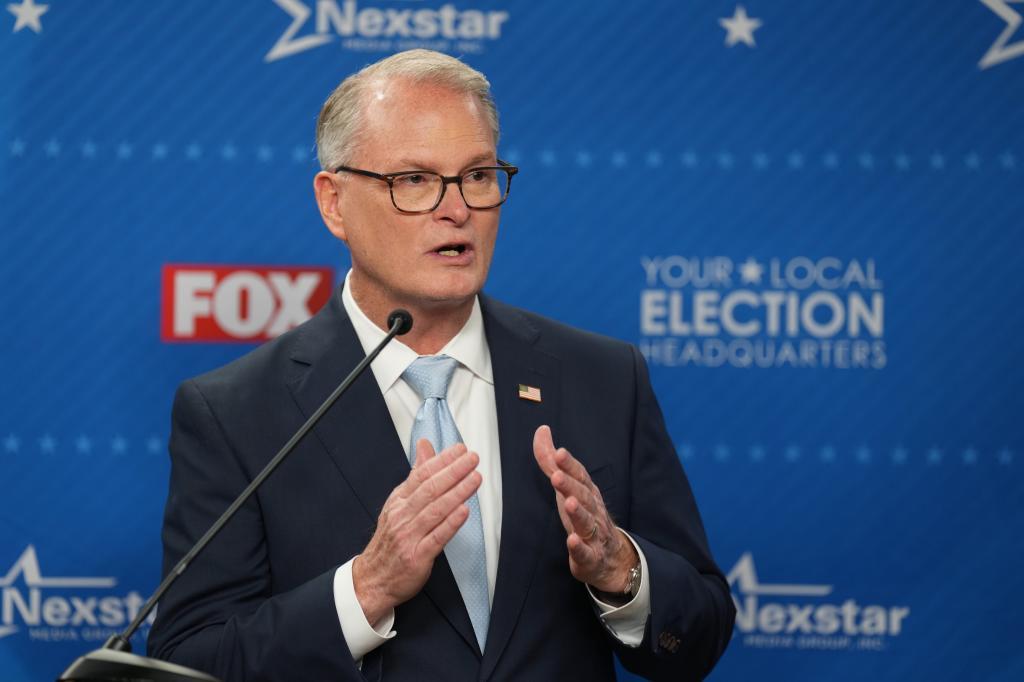
"I was eight months pregnant when I was arrested because I couldn't make a $50 payment to Roger Marshall. The healthcare system is broken, but not for him." The first thing that plays on the car radio every morning in Johnson County is the voice of Meischa, one of the 700 patients whom the then doctor, now Republican senator from Kansas, denounced to collect overdue fees. More than 80 were arrested, some ended up in prison, and many saw their salaries and bank accounts seized after being unable to cope with the 18% interest that the clinic charged for installment payments, even if the amount owed was just $100. Marshall, a veteran gynecologist, was often the only option for women in a rural area of the State where medical insurance is not common. Thanks to his work, he accumulated a fortune of nearly $10 million before entering politics.
Also, what a visitor sees when leaving Kansas City or on the outskirts of Topeka are the huge billboards of his rival, Adam Hamilton, Democratic candidate and senior pastor of a congregation founded in 1990 and now with about 25,000 followers. Someone who had never thought about getting into politics, who says he doesn't want to spend half of his time in Washington, but who at the beginning of the year, disheartened by Trumpism and its faithful pawn in the Midwest, decided to take the leap. His yellow posters are on both sides of the roads, invariably focused on Healthcare, on how "395,000 Kansans do not have access to Medicare", and on how his opponent's votes in Congress have increased insurance costs and complicated access to social assistance programs.
Martha, one of the volunteers who has organized a townhall, one of those events of unfiltered public questions so popular in the US (except for Dr. Marshall, who has not held one for 600 days after the last one backfired) at the Shawnee Mission Unitarian Universalist Church in the town of Lanexa, explains that 90% of the undecided and unregistered voters who attend Boots on the Ground events, an association born after the 2024 elections to strengthen civil society, do so to ask about healthcare issues. Or to share their stories. "As you can see, the vast majority are already of a certain age," she adds as the main hall of the church gradually fills with enthusiastic retirees.
The protagonist this Monday afternoon is Michael, an older man who has driven over 250 kilometers from Wichita. He is disappointed because Pastor Hamilton could not attend, but still he elaborates, on the verge of tears, recounting the last few very precarious months of his father, a World War II veteran. He seeks comfort but above all seeks someone to tell him that the system can change.
Interesting Political Laboratory
Kansas has unexpectedly become one of the most interesting laboratories in American politics. Donald Trump won in 2024 by a 16-point margin over Kamala Harris. The state has not chosen a Democratic senator since 1932 and it seemed like a walkover. Yet, in a few months, Pastor Adam Hamilton has turned the story around, and the polls, and is technically tied with Trump's favorite. "I would say we are witnessing a miracle, but with this candidate, it doesn't seem appropriate," Martha says with a smile.
Hamilton, a calm, moderate, centrist man, has opted for a campaign focused on values and very local. He doesn't like confrontation, he's not aggressive. Nor does he talk much about his party, and when he does, it's to emphasize that being a Democrat in Kansas is very different from being one in New York or Los Angeles. "I'm not someone who favors the Socialist Party. I'm someone who stands in the middle," he replied on Wednesday night in an interesting face-to-face, focused much more on substance than personal attacks, although there were some.
"If there is one word that Adam Hamilton likes, it is undoubtedly joy," explains a spokesperson for his Church, recounting how the pastor struggled to make the leap and how he did it relying on scriptures. "In Matthew 14:22-23, Jesus says we must leave the boat, and that's what Adam and his wife felt they had to do, leave the boat to help in other ways," adds his employee.
The mention of joy is so important in the congregation's worldview that often the religious services of his Church, the largest Methodist congregation in the US, begin precisely with a modernized version of the Hymn to Joy, with the lyrics by Henry Van Dyke, with a full orchestra and a choir of 100 people. In the parking lot of Lanexa, thousands of cars crowd on weekends at dawn, and a swarm of families, dressed for Sunday, sing hymns for the over 10,000 attendees, in person or online.
The church, founded by Hamilton in 1990 in a funeral home chapel, has nine locations and around 25,000 members. Its annual budget exceeds $35 million, and it has assets worth $180 million, including the new and impressive chapel, inaugurated at the end of August with a campaign stop. In the hallways, posters of workshops, Bible reading seminars, excursions, and Halloween activities. Methodists only go to church once a week, but they participate in activities constantly, forming a united community. For some, in the midst of a conservative wave, it's too liberal, causing them to lose members.
"Adam has formed a congregation where people sit together, shoulder to shoulder, regardless of whether they are Republicans, Democrats, or Independents. They are united by values, a vision of community, the desire to help, and a commitment to a moral code. Adam has spent a lot of time accompanying people in their most difficult moments, whether officiating funerals, supporting parents who have lost a child, or assisting couples going through divorce; very tough emotional situations. Therefore, he not only understands what people are going through but also possesses incredible empathy. And I can't imagine a better time in this country to have someone with a moral code, empathy, intelligence, and strategic vision," explains Kathleen Sebelius to EL MUNDO, former governor of the State and former minister in the Obama Administration.
The idea that guided the project in its beginnings, explained one weekday afternoon with the facilities empty, was different from that of a parish that simply waits for people to come out of tradition. Hamilton wanted to reach those who perhaps considered themselves spiritual, had theological and ethical doubts, or had simply stopped attending church. To do this, he implemented an explicit marketing and outreach strategy to non-practitioners, with phone calls and mass mailings to introduce the new congregation throughout the area. Methods that he has replicated in his Senate campaign. In each speech, he says his goal is to build bridges, create community, and reach everyone, especially disbelieving progressives, disappointed Republicans, and independents (up to a third of the total in the State) and the undecided.
Hamilton is not a superstar, but he has 35 years of experience in public speaking and persuading people; he knows how to quickly identify what works and what doesn't. "His greatest strength is that he listens—he truly knows how to listen. To be a pastor in Kansas, you have to listen and possess empathy; those are skills every politician should have," notes Robert, one of the volunteers from Lanexa. Furthermore, while Kansas is a large state, one in four registered voters resides in Johnson County.
"Brains, heart, courage. Brains, heart, courage. Brains, heart, courage." Although it is not his official campaign slogan, people leaving Adam Hamilton's rallies often repeat these three words like a mantra. The idea emerged almost by chance, according to the candidate's team, but it works—it works very well.
The last time Kansas elected a Democratic senator, Herbert Hoover was president, a house cost less than $3,000, and a gallon of gasoline was 18 cents. Nearly a century later—with fuel prices at record highs, growing concerns over healthcare and education, and a profound crisis of values—the state that saw the birth of Bob Dole and the upbringing of Dwight Eisenhower (a state that also overwhelmingly supported Donald Trump in 2024) is asking itself whether it is time for a fundamental change. It is doing so, however, in its own way: by backing a religious figure who could hardly be suspected of being a leftist—despite criticism from the White House—and by constantly appealing to "decency" while seeking out role models.
During his first head-to-head debate of this election cycle, the Democratic candidate went viral by invoking a powerful reference—one that resonates deeply in this part of the country: *The Wizard of Oz*. L. Frank Baum's story, published in 1900, is honored with a dedicated museum in the town of Liberal, and it was after a visit there that the candidate discovered the perfect metaphor he had been looking for. "Do you remember the Scarecrow, the Tin Man, and the Cowardly Lion? They needed a brain, a heart, and courage. And you have to laugh, because that is exactly what is wrong in Washington. We have sent many people there who have lost their minds. They no longer use critical thinking to solve problems. They don't think for themselves; they just do what their president or their party tells them to do. That is not good for Kansas. (...) They need to have a brain and listen to their constituents. And when they do, they will need a heart, because people are suffering. Politicians cannot keep voting for measures that, for example, strip health insurance from 51,000 people in the state of Kansas, or leave 18,000 children without food assistance. Finally, they must have the courage to stand up to the president and their party—even if it means being intimidated, harassed, or challenged in a primary election. Because they need to be able to say: 'This is not right.'"
This idea resurfaces daily in Hamilton's remarks, just as it once appeared in his sermons. Sixty years ago, high school teacher Henry Littlefield gained fame by arguing that *The Wizard of Oz* was not merely a story about crisis, poverty, and hope, but a parable of populism and an allegory for American politics in the late 19th century. The yellow brick road represented the gold standard. The shoes—silver in the book, rather than the ruby slippers from the 1939 film—symbolized the populist proposal to mint metals other than gold. Dorothy represented the ordinary citizen; the Scarecrow, the farmers; and the Tin Man, the industrial workers. The Cowardly Lion served as an alter ego for William Jennings Bryan, the populist Democratic candidate whose presidential bid failed in 1896. In this interpretation, the Wizard represents political power concealing its own weakness, while the Emerald City, naturally, stands for Washington.
Trump's Unpopularity
Today, those same symbols reappear. There are cowards and the brave, farmers and laborers—ordinary people grappling with clear-cut issues like wages, housing, and healthcare. Meanwhile, populist leaders remain fixated on their own personal obsessions and the accumulation of wealth. On Monday, as Hamilton rested his voice in preparation for an upcoming debate, his opponent, Senator Roger Marshall, welcomed Donald Trump—the first visit by a sitting president in 20 years. This underscores a deep concern regarding the polls and a dramatic shift in a short span of time: in 2024, Republicans held a 16-point lead, but now the race is a dead heat. Trump's approval rating sits at a mere 37%, while his disapproval rating stands at a staggering 60%. The president and Marshall took part in a rally where little to nothing was said about Kansas or the concerns of its residents; instead, the focus was heavily on the Democrats, Michigan, the borders, transgender issues, Islam, and jihadism—with a dose of antisemitism thrown in. The senator insisted that this currently represents the greatest threat to the country and its people. This likely explains why polls appear to favor his opponent. "Roger should stop acting as a spokesperson for the president," the pastor repeats daily.
Polls reflect the unpopularity of Trump's second-term agenda among voters—particularly in the traditionally Republican states of the Midwest, which have been disproportionately affected by rising fuel prices and tariffs. Last Monday, Trump announced a "harvest fuel relief" program, promising to compensate farmers for the cost of diesel and gasoline—prices that, in recent weeks, have climbed above six dollars a gallon in Kansas.
It is clear that citizens are disappointed, saddened, and furious; many cannot fathom why the senator devotes more energy to defending the president than to serving his own state. As many as five attendees were ejected from the rally for protesting. Six of Kansas's eight former governors—including two Republicans—are supporting the pastor in this election, while the other two conservatives have declined to back their fellow Republican. "Yes, gas prices are high, but there are things in Kansas that matter more than money," Marshall remarked just yesterday. "It's like with my wife—I might disagree with her. Of course, my wife is always right, whereas President Trump isn't always," he joked. "But I think it's great to have a relationship where I can call him on the phone and talk to him about the pros and cons of what he's considering," she concluded, after defending all of his policies—from tariffs to the conflict with Iran—with the exception of the ICE raids. At least those that have terrorized southern Kansas.