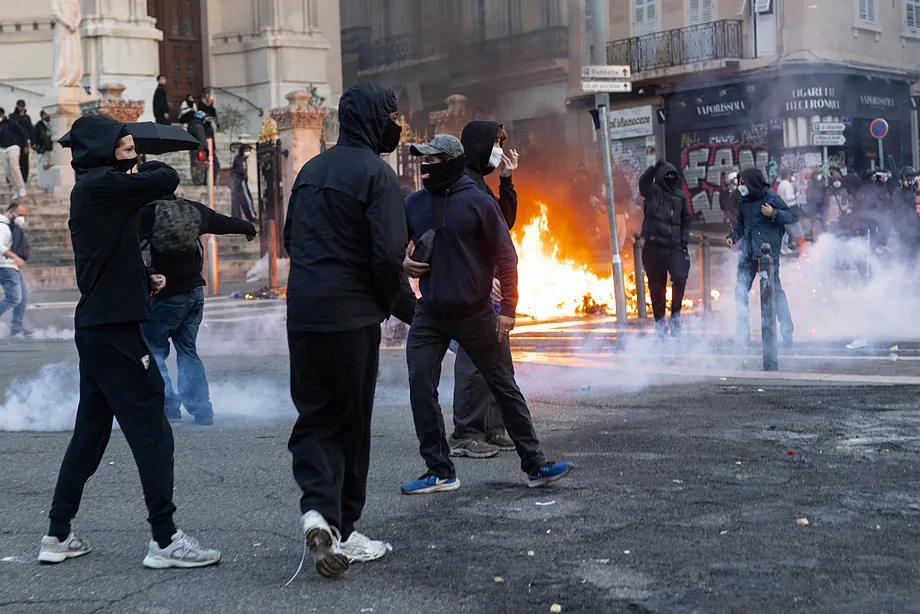
Young people with bloodshot eyes struggle to catch their breath through their gas masks. They can barely breathe. "ACAB! ACAB!" (All Cops Are Bastards), they shout over and over as they hurl large cobblestones at the CRS, the French police's riot-control units.
The front line of the protest is taken over by the so-called Black Blocs. EL MUNDO goes inside this radical movement during the unrest in Marseille on October 24, where thousands of people are demonstrating against the rising cost of living, education reforms, and the deterioration of public services. But as the hours pass, those grievances are buried beneath the wave of violence unleashed by the clashes.
The movements of the Black Blocs appear to follow a carefully rehearsed choreography. There is no visible leader giving orders. Yet the level of coordination is hard to ignore. As the main body of the demonstration moves along Marseille's major thoroughfares, small groups of 10 to 15 masked protesters break away from the crowd and disappear into nearby side streets. They communicate by phone, disperse, and then reappear wherever clashes are intensifying.
Some arrive carrying large bags filled with glass bottles. Others drag materials from nearby construction sites that are soon turned into projectiles. Upon reaching the front lines, they distribute their supplies among the most violent demonstrators. Within seconds, a shower of shattered glass erupts.
Amid the exchange, one of these reporters, covering the unrest from inside the crowds, is struck on the shoulder by a bottle. The young man who threw it, dressed entirely in black and with his face covered, immediately apologizes. He did not mean to hit the journalist. His target, he makes clear through gestures, was the police officers alone.
The scene is surreal, yet it captures the violence unfolding on Marseille's streets. The masked protesters surge forward a few yards, hurl their projectiles, and then fall back to make way for the next wave. A macabre dance of charges, blows, and retreats amid the smoke from burning barricades.
On one side: stones, glass bottles, flares, and firecrackers. On the other: rubber bullets, tear gas canisters, and police charges. Caught in the middle is a city gripped by rioting and a wave of violence spreading across France. Neither side appears willing to back down. Marseille has become the scene of a full-scale street battle.
Dressed in black, wearing balaclavas, protective gloves, and gas masks, these young people make up the most anti-establishment and violent faction of the demonstration. The Black Blocs are linked to anarchist, anti-capitalist, and anti-fascist movements. They represent a form of urban guerrilla activism that has been present for decades and is once again gaining prominence in protests across Europe.
They move through the crowd throughout the demonstration "and come together when it reaches its peak," explains Ruddy Manna, a police officer and communications representative for the UNSA police union. "The Black Bloc is not a group but a tactic used to carry out coordinated attacks against law enforcement," Manna adds.
Authorities place these individuals within the far-left spectrum, describing them as "people from marginalized neighborhoods who come into the city center to loot it."
According to police estimates, they can form groups of up to 300 people. "They even change clothes to blend into the crowd."
On the other side of the confrontation, the CRS carry out a choreography of their own. In response to the violence, Manna says the police strategy is to "make life difficult for them and deter them." But police sources acknowledge a problem: "If we escalate the severity of the methods we use too much, we could be suspended from duty."
The officers cover the full width of the streets, operating in pairs. Flames rise between the two sides as chants echo through the streets: "Tout le monde déteste la police" ("Everybody hates the police"). The pattern repeats itself for hours. A constant struggle for control of the streets.
As night falls, the clashes shift to a different setting. The CRS begin breaking up the most violent groups and pushing them into the city's narrow streets. The goal is to disperse them, prevent them from regrouping, and reduce their ability to respond. The head-on confrontation gives way to a chase through Marseille's urban maze.
The city's very geography complicates the operation. The masked protesters slip away down one street and reappear somewhere else moments later. Tensions are no longer concentrated on a single avenue. Instead, they splinter and shift across the city, gradually losing intensity as they spread.
The Black Blocs represent the most radical expression of this street confrontation. They turn street furniture into barricades and transform city streets into a battlefield.
Marseille has witnessed yet another day of violence. Amid the smoke, the uprooted cobblestones, and the burned-out trash bins left in the middle of the streets, what remains is the image of a protest movement whose original demands have been overshadowed and ultimately reduced to an open war against authority.