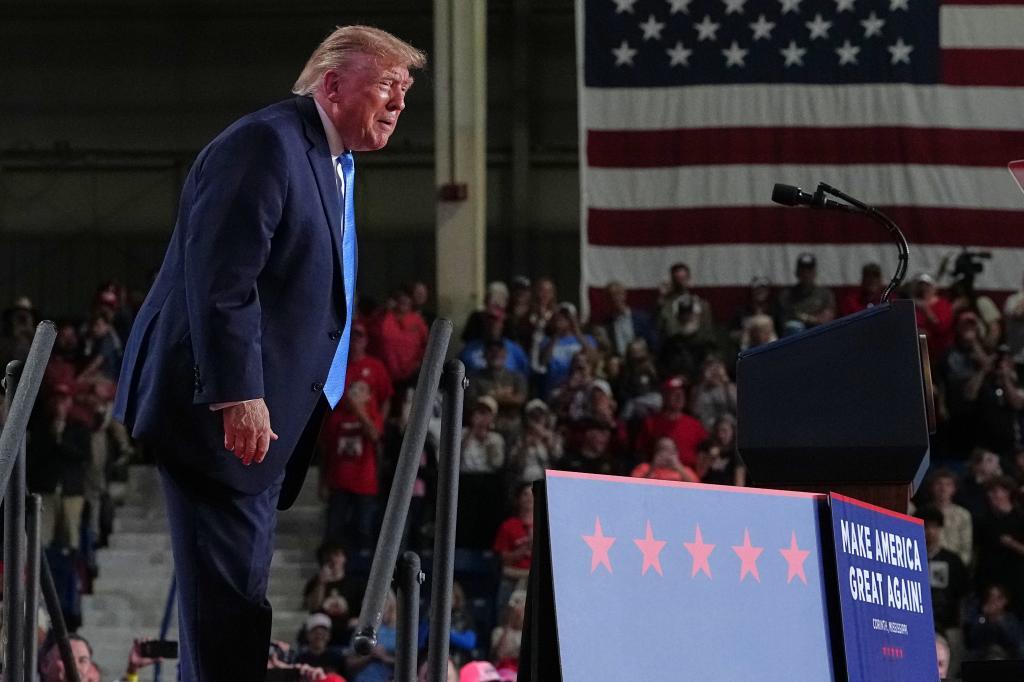
"I'm here because Cindy's doing great, but I just got to make sure. I can't take a chance," Trump told the crowd, his voice audibly hoarse, as he worked to boost Republican Sen. Cindy Hyde-Smith, who is facing a surprisingly stiff challenge from Democrat Scott Colom.
Colom was spotted at the rally site, too, creating the rare spectacle of Trump's staunchest supporters interacting directly with a figure the president would soon go on to denigrate as a "Marxist radical" and "fake" and "shameless phony who pretends to be a moderate" from the stage.
Mississippi, among the nation's most reliably Republican states, is not where the GOP envisioned needing a late-October stop from the president. But Colom is one of many Democratic underdogs who have managed to expand the House and Senate battleground maps because of widespread voter discontent over inflation, the Iran war and other aspects of Trump's second presidency.
He said he had planned to go to the rally site to listen to what was on Trump supporters' minds.
"They actually deserve a senator that will listen to them, that actually cares about what they think, actually cares about what they're going through," Colom said ahead of the president's arrival for the evening event.
Colom's spokesperson later posted a photo on X, saying he had "chatted with folks in line for the Trump rally because Scott is running to represent ALL Mississippians."
Trump's event kicks off a week of aggressive campaigning that will include more stops in states he won comfortably in 2024, including Texas, South Carolina and Iowa.
Top Democratic candidates and their surrogates were also greeting voters — more than 30 million of whom have already cast ballots — as they try to end Republicans' threadbare majority in the House, take over a Senate majority that was once thought secure for Republicans and end the GOP's national advantage in state capitals.
Former Vice President Kamala Harris, Democrats' 2024 presidential candidate, was campaigning in Wisconsin with Milwaukee County Executive David Crowley, who faces Rep. Tom Tiffany, a Trump ally, for governor. Crowley would be the state's first Black governor if elected to lead the battleground state.
"This is a tight race because the stakes are so high," Harris said at the event billed as a "Women for Crowley" rally.
Georgia Democratic Sen. Jon Ossoff and gubernatorial nominee Keisha Lance Bottoms were getting an assist from Kentucky Gov. Andy Beshear, chairman of the Democratic Governors Association and a likely 2028 presidential candidate, two days after Trump made his second October visit to the state.
Meanwhile, in Michigan, Democratic Senate candidate Abdul El-Sayed distanced himself from an ad created by a political action committee called Rebellion PAC that blames high grocery prices on U.S. support for Israel.
"This ad is not affiliated in any way with the Abdul for Senate campaign," a spokesperson for El-Sayed, Roxie Richner, said in a statement about the spot, which features a couple discussing U.S. support for Israel as they shop for groceries.
"Apparently it's costing us a lot of money to drop bombs on Gaza," the woman says.
The ad had been condemned by U.S. Rep. Haley Stevens, who narrowly lost to El-Sayed in the Democratic primary.
The way to win Michigan "is not by blaming the high costs of our goods on the only Jewish homeland in the world," Stevens wrote on X.
El-Sayed, who would be the country's first Muslim senator, has denounced antisemitism while fiercely criticizing Israel for its military operations in Gaza — a position that has been a frequent point of attack for both Republicans and supporters of Israel in his party.
Vice President JD Vance traveled to Kansas on behalf of Sen. Roger Marshall, who finds himself in a tight contest with Democratic nominee and pastor Adam Hamilton. Hundreds of people were gathered inside the warehouse of a steel-fabricating company in north Topeka in a state where Democrats haven't won a Senate race since 1932.
Marshall told the crowd that Trump is on the ballot, even if his name doesn't appear, because of how Democrats will thwart his agenda if they win control of Congress.
"Democrats are coming out like it's a presidential year," he said, calling for GOP enthusiasm to match Democrats' energy.
Jace Sullivan, a 50-year-old electrician from Topeka who describes himself as "85% Republican," said Trump supporters need to "circle the wagons" and get out to vote.
Wearing a red "JD Vance for President 2028" shirt, he said he thinks Trump is rightly working to keep Iran from getting nuclear weapons.
"Gas prices are high and it does suck, but it's a means to an end," Sullivan said.
Earlier, Vance was in Belgrade, Montana, to campaign with Republican Aaron Flint, who is facing Democrat Sam Forstag in the race for the state's 1st Congressional District, and Republican Senate candidate Kurt Alme.
Sen. Tim Scott, who serves as chairman of the National Republican Senatorial Committee, told The Associated Press that GOP candidates are "closing very strongly" in races across the country, including South Carolina, which Trump is set to visit for the second time in as many weeks to stump for GOP Sen. Darline Graham.
"One of the reasons why we will be in the majority is because he has invested the time and the energy on the campaign trail," Scott said on the sidelines of U.S. Rep. Russell Fry's 3rd Annual Freedom Fry event.
But it's Trump's visit to Mississippi that perhaps brings the midterm landscape into the sharpest relief with just a week of campaigning left.
To be sure, Hyde-Smith, who is vying for her second full term, remains the favorite in a state Trump won three times by an average of nearly 20 percentage points.
But Colom, a local prosecutor who would make history as Mississippi's first Black senator since post-Civil War Reconstruction, is looking to parlay inflation, Trump's lagging popularity and Hyde-Smith's mistakes into an upset.
Colom has outpaced Hyde-Smith in fundraising since he launched his campaign last year, and he caught national attention this month with an ad that played off Hyde-Smith dismissing beef prices — driven higher by Trump's tariffs and fuel spikes resulting from the Iran conflict. The ad features Hyde-Smith, a former state agriculture commissioner, saying that consumers "have so many other proteins to choose from," followed by several characters, and then Colom, saying Mississippi should " pick another senator instead. "
Senate Democrats' super PAC has been a late entry in the contest, with a $1.2 million investment. Mississippians have not chosen a new Democratic senator since 1947, and Democrats last won a Senate race there when that senator, the onetime segregationist John Stennis, won his last reelection in 1982.
In New York, meanwhile, one of the party's most vulnerable House members pulled from Trump's campaign playbook. Rep. Mike Lawler, who is in a tight race with Democrat Cait Conley in New York City's northern suburbs, manned a McDonald's drive-thru — mimicking something Trump did two years ago, even as Lawler has tried to emphasize his independence from the president.