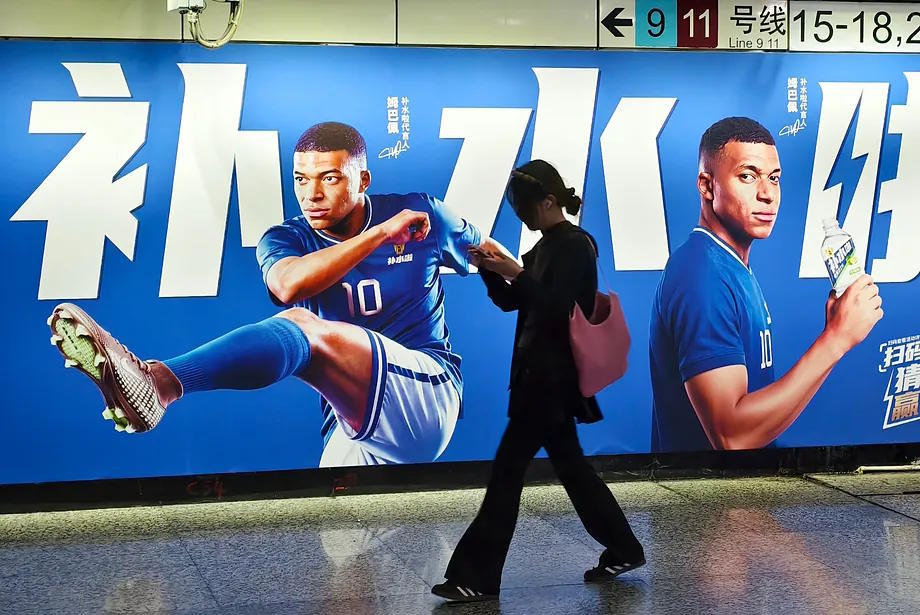
A joke about Mao Zedong continues to fuel a commercial, sporting, and diplomatic crisis between China and Spanish soccer. Not even a swift apology issued in three languages has been enough to calm the outrage in the Asian superpower.
Kylian Mbappé apologized on Tuesday in Chinese, French, and English. Javier Tebas, president of LaLiga, did the same on behalf of Spanish soccer and later met with China's ambassador to Spain, Yao Jing, in Madrid in an effort to contain a crisis that threatens major sports business interests.
But in Beijing, where the French forward's remark about Mao Zedong being a "dictator" has sparked a political and commercial firestorm, authorities appear unwilling to let the matter pass. State media continue attacking the Real Madrid star, and state broadcaster CCTV, which has suspended LaLiga broadcasts, has kept up the pressure: "We will listen to their words, but above all, we will watch their actions."
The warning came from China Media Group (CMG), the state-owned media conglomerate that oversees CCTV. After receiving Mbappé's apology, its executives called on LaLiga, Real Madrid, and the player himself to learn from the incident, "sincerely acknowledge their mistakes," and correct them. So far, they have not announced when Spanish league matches will return to the network's programming.
The reaction from China's leading state-run media outlets helps explain why the controversy is unlikely to disappear with a simple statement. On Wednesday, the People's Daily, the official newspaper of the Communist Party, published an editorial that turned the Mbappé affair into a warning for all foreign celebrities. "No brand wants to be associated with a liability," it declared.
The editorial argued that fame and athletic talent do not grant immunity when certain lines connected to history and national identity are crossed.
According to the newspaper, a celebrity's prestige can quickly become a burden for the brands that sponsor them. Multi-million-dollar endorsement deals, it argued, also depend on consumer trust and respect.
The editorial revived a phrase commonly used in Chinese nationalist rhetoric: chi Zhongguo fan, za Zhongguo guo, which can roughly be translated as "eating from China's bowl and then smashing its pot." It is used to criticize those who profit from China while expressing views considered offensive toward the country. According to the newspaper, companies that severed ties with Mbappé were not only defending their principles but acting according to sound business logic.
Even harsher was the Global Times, a nationalist newspaper with an English-language edition. Its editorial carried a blunt headline: "Mbappé has fallen, and he deserves it." The article argued that no international public figure who disrespects China should continue to profit from its market. It also called for stricter behavioral clauses in advertising contracts signed with foreign celebrities.
Another major state-run newspaper, the China Daily, sought to draw a broader lesson from the affair. It compared the French striker's speed on the field with the speed at which public outrage had spread. The paper argued that "global celebrities must understand the historical sensitivities of the countries where they do business," while also warning against turning such controversies into an ideological confrontation between China and the West.
The column also recalled another recent clash between Real Madrid and Chinese nationalism. In August, the club came under criticism after publishing a message expressing solidarity with victims of flooding and landslides in "Nepal and Tibet." Critics argued that the wording placed Nepal, an independent nation, and Tibet, which is under Chinese sovereignty, on the same footing. The post was subsequently deleted.
On Wednesday afternoon local time, Beijing appeared to leave the door open to reconciliation, although without committing to lifting any punitive measures against Mbappé.
"We attach importance to the apology offered by the individual concerned," Chinese Foreign Ministry spokesperson Guo Jiakun said when asked about the statement released by the French forward the previous day.
However, when reporters asked whether the apology would be enough to end the boycott and commercial sanctions, Guo simply repeated his earlier remarks, offering neither guarantees nor a timetable.
The relatively measured tone adopted by Chinese diplomats contrasted sharply with comments made that same day by a CMG spokesperson, who rejected reports that Real Madrid had argued Mbappé never intended to offend anyone and was merely exercising his right to express personal opinions.
"As long as Real Madrid does not provide a satisfactory apology, there is nothing to discuss," the spokesperson warned.
The response became even more forceful when directed at the Spanish club: "Any words or actions that hurt the feelings of the Chinese people will inevitably face collective rejection from all sectors of Chinese society."
The statement concluded with a warning that made clear Mbappé's apology alone would not end the crisis: "Real Madrid would be well advised to abandon any illusions to the contrary."
Doubts Over Mbappé's Commercial Future
The economic consequences of the controversy have also become a major focus of Chinese media coverage.
Zhu Meng, a Beijing-based sports commentator quoted by the Global Times, acknowledged that Mbappé reacted relatively quickly by issuing an apology but questioned whether that would be enough to regain the trust of former sponsors. According to the analyst, rebuilding a damaged reputation in the Chinese market could take a long time, even if the player continues performing at an elite level.
On social media, where the controversy climbed to several top positions on Weibo's trending lists, many users rejected the apology outright.
Yet the incident has also highlighted a paradox of China's censorship system: many internet users learned about the boycott without ever seeing the original video or fully understanding what Mbappé had actually said about Mao. Sports platform Dongqiudi even announced that it would not translate the remarks because it considered them offensive.
As the controversy continued to escalate in Beijing, Javier Tebas made a determined effort to ease tensions from Madrid. The LaLiga president met with China's ambassador to Spain on Tuesday afternoon in search of solutions that might resolve the dispute.
A photograph of the meeting accompanied a statement in which the Spanish soccer executive highlighted years of cooperation with Chinese sports institutions, companies, and media operators.
"China is and will remain a strategic partner for LaLiga," Tebas said, concerned that the actions of one individual could jeopardize agreements built up over many years.
Among the partnerships he highlighted were LaLiga's strategic alliance with the Chinese Professional Football League, which runs through 2029, as well as agreements with state-owned media conglomerate CMG.
Unlike the French player and LaLiga, Real Madrid had not yet issued its own public apology, according to the information available at the time. The Chinese Football Association continues to demand a formal statement from the club.
The controversy began after Chinese social media users circulated a clip from Mbappé's appearance on The Bridge. When asked about his favorite meme, the French striker laughed while recalling an image that superimposed his face onto the body of Mao Zedong, founder of the People's Republic of China, whom he referred to as a "Chinese dictator."
He said he used to share the image with friends while playing video games. The joke was tied to memes exaggerating his supposed influence in the locker room, but in China it was interpreted as an insult to one of the most revered figures in the country's official historical narrative.
The reaction was swift. Three major Chinese companies, beverage manufacturer Dongpeng, dairy giant Mengniu, and cheese producer Milkground, announced they were terminating their commercial relationships with the player. Sports platforms removed videos, news articles, and promotional content related to him.
Social media platform Xiaohongshu restricted his account, which had amassed more than one million followers, while the Chinese Football Association demanded formal apologies from both the player and Real Madrid. China's Foreign Ministry also stepped in, stating that remarks that "hurt the feelings of the Chinese people" would inevitably be rejected by Chinese society.