Two years ago, Farah Khan was furious, very furious. A lifelong Democratic voter and activist, she was one of the founders and most active voices of Dump Harris, a movement against the vice president and party candidate who aimed to defeat Donald Trump for her stance on Israel and Gaza. "I want them to pay, I want to punish the accomplices of genocide," she told EL MUNDO two years ago in a café in Dearborn, the quintessential Arab town in the United States. Two years later, Farah is still furious, but her anger has transformed and does not prevent her from voting, campaigning, and urging others to vote for Abdul El-Sayed, the Democratic Senate candidate who most drives Donald Trump and Republicans crazy.
"I don't give my loyalty blindly to any party. I am loyal to Abdul as long as his values, policies, and statements align with ours. As long as he cares about the people, we will be with him. If he turns his back on them, goodbye. You know, it's not about religion. I would have supported anyone with those values. But if he wins, and 'inshallah' he will, he will be the first American senator who is Muslim, and that is a lot here. He was a doctor and could have been making millions, but he wants to change the system. We need this kind of people, and there are only a handful of them who would sacrifice themselves, who would do whatever it takes to do the right thing, and those are the people we need. Seeing Abdul El-Sayed, seeing Zohran Mamdani in New York gives hope to our younger generation. I now talk to them and tell them they can forget about being doctors, about being engineers. Be politicians!, I tell them," she explains as we accompany her in canvassing, the process in which volunteers go door to door in neighborhoods to ask for votes or encourage people to register.
Farah's sentiment is the majority in the area and in the Arab community. "Until the genocide in Gaza, Arab Americans dealt with subtle hostility due to the reach and power of the Israeli lobby (AIPAC). Their choice was always between the lesser of two evils. But the Biden Administration convinced them that both parties were two sides of the same coin. Traditionally Democratic voters stopped feeling loyalty to the party due to the magnitude of Israeli cruelty. A total of 110,000 Arab Americans and their supporters voted without commitment, which ensured the defeat of the Democratic Party. Now, we will see what happens," explains Hani J. Bawardi, a history professor and expert on the Arab community in the United States, from his office at the University of Michigan.
Abdul El-Sayed, a doctor, public health expert, and now politician, is the great hope and excitement of tens of thousands of neighbors. There was a generation that began to dream when the United States elected a president named Barack Hussein Obama. And now there is a new generation, younger and more skeptical, that seems to find a new reference.
Born in 1984 here in Michigan, El-Sayed is the son of Egyptian immigrants and represents the progressive wing of the Democrats, but not the socialist movement. Educated at Columbia and Oxford, he advocates for universal public healthcare, fighting economic inequalities, and political funding reform. He has led the Detroit Department of Public Health and the Wayne County Department. In 2018, he ran for the Democratic gubernatorial primary but lost. However, in August of this year, he unexpectedly won the internal process to compete for a seat in the U.S. Senate. And that's when the storm broke.
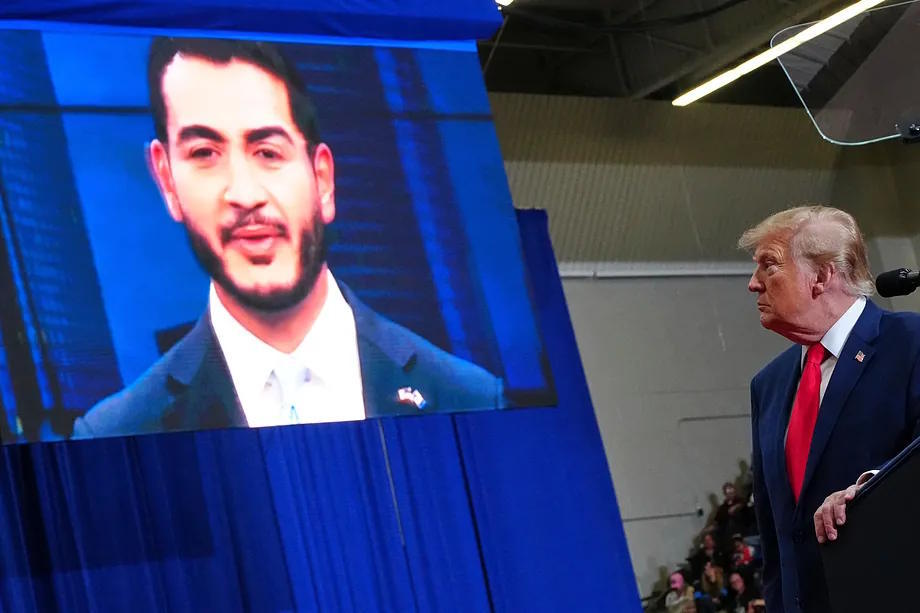
"His real name is Abduladadalalalala. He is Abdulbabababababa Mohamed al Sayed. So his middle name is Mohamed. Therefore, he was right. He is a jihadist," Trump says at rally after rally. "If you're not sure of someone's name from the Middle East, just say Mohamed, you have a 65% chance of being right. Hello, Mohamed. I've been doing it this way for years and so far I've never been wrong. To me, El-Sayed is Mohamed. I'm the president, I can call him whatever the hell I want (...) he's a lunatic friend of terrorists." "He's a jihadist and shouldn't be able to be in the Senate," Trump insisted this past Sunday at a rally in Michigan.
"I believe Abdul El-Sayed is from the Muslim Brotherhood. If he were to win, Chuck Schumer could place him on the Senate Intelligence Committee. He would have access to the highest level of classified materials. There would be an unacceptably high risk that the lives of American military men and women would be endangered because there are every reason to believe that El-Sayed would share that classified information with terrorists," boldly asserts Senator Ted Cruz, another heavyweight Republican.
The Republican strategy is no secret. It consists of completely questioning the loyalty of the Democratic candidate, saying that he does not recognize Israel and wants to annihilate it, that he is anti-Semitic, a friend of terrorists, and hates the United States. It is the same thing that Trump systematically says about Ilhan Omar, the Muslim congresswoman from Minnesota. Even the argument that his name is fake is the favorite attack of the last week for both. These days, Islamophobia is completely rampant. And it works among a significant portion of the electorate.
The campaign should be focused on issues like prices, housing access, and the future of the once-powerful automotive industry in a state historically linked to car manufacturing and especially exposed to Chinese competition and trade fluctuations with Canada. Trump is, in fact, considering announcing last-minute tariff cuts with the northern neighbor before the vote to try to give some relief to his most pressured congressmen and senators. The average from Real Clear Politics gives El-Sayed a 1.9-point advantage, according to polls conducted between September 28 and October 22. Perhaps enough, as it increases among registered voters, but lower than the previous 2.6-point advantage the Democrat had in polls conducted between September 27 and October 14.
El-Sayed advocates for an industrial policy that combines public investment, "selective trade protection," and the development of affordable electric vehicles, while the favorite, Republican Mike Rogers, advocates for halting the entry of Chinese manufacturers, keeping taxes low, and supporting tariffs, except those applied to Canada. El-Sayed wants to focus on healthcare coverage, regulate big tech, and promote a campaign finance proposal that he will submit to a referendum, while Rogers and conservative media insist repeatedly on cultural war issues, turning the contest into something about transgender athletes, the Second Amendment, gender affirmation, and loyalty to the flag and the Constitution.
"He is someone genuine, natural, who understands the needs of the community", points out Osama Siblani, founder and face of The Arab American News, the community's go-to newspaper since 1984. Two years ago, he distanced himself from Harris, but now he supports El-Sayed. His voice carries significant weight in the community. Anyone who wants to be heard goes through the newspaper for an interview or a forum. His schedule is chaotic; talking to him these weeks is a constant challenge. But he is delighted, nothing like the last presidential elections.
In the latest issue of the newspaper, a Muslim who served in the Navy writes an article addressing an uncomfortable situation that every Arab or Muslim in the United States faces at some point. El-Sayed went viral for his response to Tommy, a young white Christian who confronted him during an event and asked if he condemned the Muslim Brotherhood. El-Sayed turned the argument around, pointing out that the question implied, in fact, the assumption that he had dual loyalties and not towards the United States and its Constitution. He reminded him that this was certainly not the case and that the same false debate arose over 60 years ago when John F. Kennedy, a Catholic, was asked by Republicans to explain whether he would be loyal to the Pope. Like JFK, El-Sayed responded that he did not want to be a Catholic or Muslim senator, but just a senator. It later emerged that Tommy was the son of a Republican lobbyist. However, the Arab American News columnist, weary, called for more and advised the Senate hopeful to be even more forceful, or else he would spend the rest of his life justifying himself. "Having a birth certificate is not enough to be American," his rival Mike Rogers shot back on Sunday at the rally with Trump.
Abdul has become a national figure; he is on television all the time, does not shy away from debates, and thus his contest is undoubtedly one of the most followed. Congresswoman Alexandria Ocasio-Cortez and Senator Bernie Sanders, representatives of the far-left wing of the Democrats, have each donated a million dollars from their own funds to help him win the seat. Volunteers from all over the country are now coming to work for free on his campaign.
It's Saturday afternoon, it's a sunny day, and members of the Working Families Party from Massachusetts gather with locals at several tables in Shiban Coffee, one of the most well-known and lively cafes in the area. The place, decorated with pumpkins everywhere, seems more prepared for Halloween than for elections and politics. Among them is Saif, a cycling enthusiast who just traveled great distances through Andalusia on his vacation. He lives in Maryland but has come with his wife, taking advantage of their daughter studying in the area, to help distribute flyers, knock on doors, or whatever is needed.
There is no doubt that El-Sayed has charisma. He speaks well in public, sounds natural, approachable. Much less affected than his party colleagues at joint rallies. He is quick, witty, although he often seems angry, no matter how ironic or sarcastic he wants to be. His team knows that being a star, doing well on television (even Fox) or social media is a necessary but not sufficient condition. In Michigan, for example, there is a particularly delicate factor. Part of the African American electorate remains resentful of the support that Arab American voters gave to Trump or the Green Party candidate in 2024 in protest against Biden and Harris's policy in Gaza. They believe that may have cost him the position and do not forgive. There are also historical grievances between both communities regarding access to services, discrimination, and economic inequality.
That's why the party is fully engaged. That's why Harris herself accompanied him recently at an event, and last Saturday he appeared with Obama at a school outside Detroit. The former president remains the big progressive star across the country. He fills rallies, connects with voters as if they were at mass. They follow him and would still follow him anywhere. In the gym of Cass Technical High School, with walls covered in robotics competition posters, 4,500 people crowd the court and auditorium to hear his speech and chant "Yes we can" or his "don't boo, vote". He is on fire, attacking Trump and his administration hard. He calls them incompetent, corrupt, and above all mocks their obsessions. And the audience responds enthusiastically while Trump gets irritated. Obama is not the only African American present. There is the leader of the state teachers' union and the candidate for Secretary of State. Any help is crucial when polls show only a two or three point difference.
"It is evident that the internal social democratic agenda merges with a change in attitude that moves away from traditional support for Israel. AIPAC has become a burden for candidates. This represents a radical shift in U.S. politics. The outcome of the upcoming elections will be decided by an internal cultural war in the United States. Gaza is at the center of this division," notes Professor Bawardi. And the cultural war goes far beyond Gaza and the Arab issue.
Fifteen minutes by car from the gym is Suhair Ghannam. She was born in Nazareth but has lived in Michigan for over 40 years. She is Palestinian and American and wears large watermelon earrings, a symbol of her homeland, and a blue shirt that says Christians for Abdul. She and her friends begin to disperse after their weekly meeting at Peace Park in Dearborn, where they met three years ago at protests against the genocide in Gaza. "It started for a cause, and unfortunately, there are no reasons to stop," she explains while putting dozens of the Democratic candidate's posters in the trunk of a car. "We don't like the defamation being used by people like Mike Rogers and Trump. We need to talk about politics, not religion. What do they intend?" she adds.
She, like many of her neighbors, distanced herself from the Democrats over Gaza, but now she has returned. "Oh, that was very painful. It was very, very painful. We were part of the uncommitted, and we know what happened afterward, and we have to live with it. But now many people from different backgrounds remember it differently and tell us that it was because of that that they are now engaged. Even African Americans," she assures. "My neighbor across the street is Rabbi Asher Lopatin, one of the founders of Democrats for Mike Rogers. The neighborhood is 65% Jewish, and they believe El-Sayed is an anti-Semite. It may be a coincidence, but this week the rabbi, one of his clearest critics, took down the sign he had put in his yard in favor of the Republican. I see it as a sign," Suhair concludes with a smile.