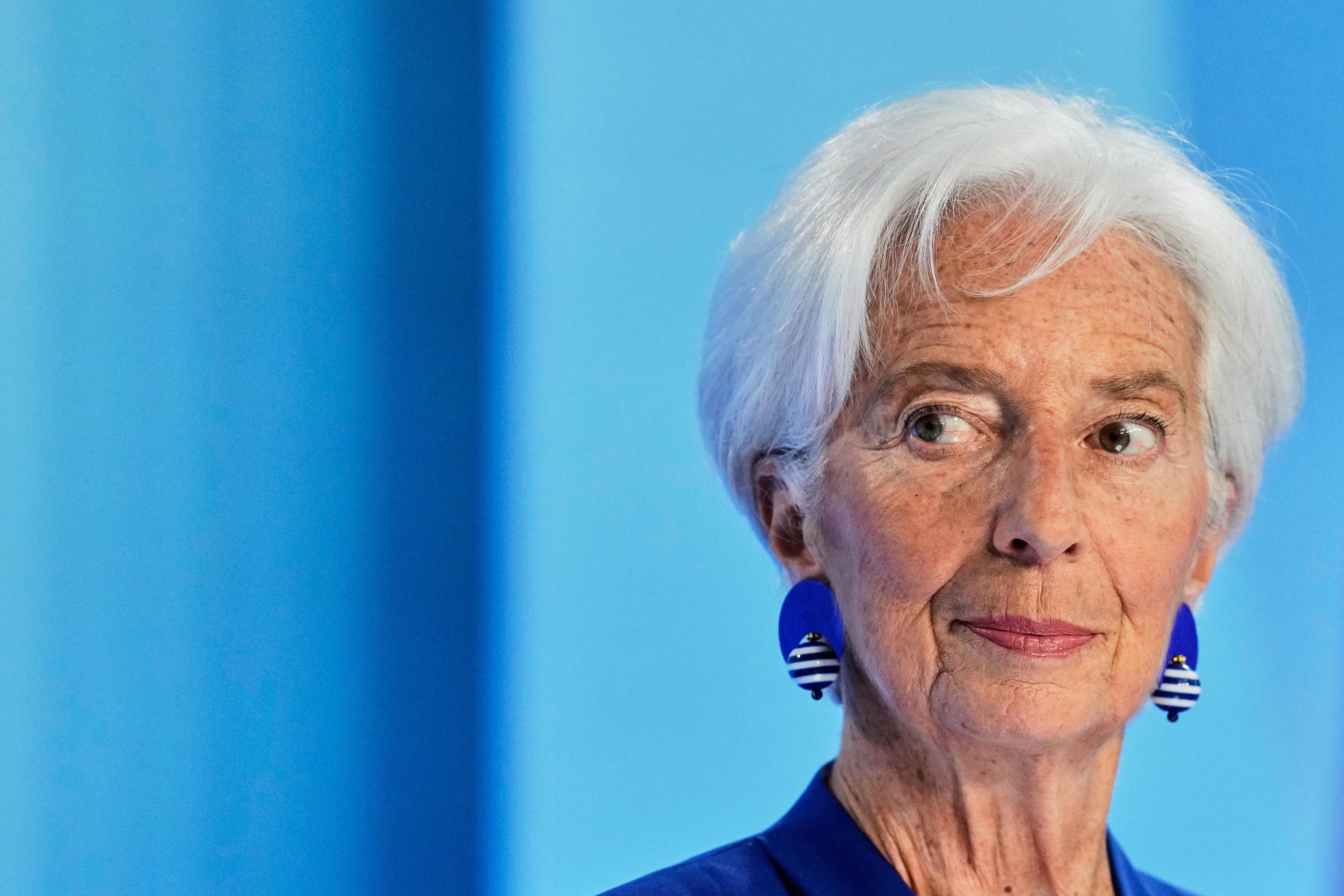
The President of the European Central Bank (ECB), Christine Lagarde, has just announced that she will step down early from the presidency of the institution on February 7, eight months before her official term was set to end on October 31, 2027, and communicated a year in advance.
In a brief statement published by the central bank, the president reportedly informed the members of the ECB Governing Council of her decision to take "a step back" from her position effective February 7, taking advantage of the meeting that has been held since Wednesday within the institution in Frankfurt to discuss monetary policy decisions, as happens regularly every month and a half. Subsequently, Lagarde released a video on social media X stating that she would "leave the institution feeling that she has done a good job and with an ECB prepared for the future."
The possibility of Lagarde stepping down early has been resonating in the market for months, despite being publicly denied by the institution and by the president herself, who acknowledged how inappropriate it would be to leave the central bank during a time of uncertainty like the current one, which has unexpectedly prolonged. The war in Iran, initiated by the U.S. administration on February 28, has had economic consequences and has even led the ECB to change its course, which aimed to keep interest rates stable in the eurozone once the first episode of inflation was deemed under control. Today, however, high energy prices and an inflation rate clearly above the 2% target have forced the central bank to raise official rates twice in a row to slow down the economy and contain price increases.
Just yesterday, the price of natural gas in Europe surpassed the historic threshold of 100 euros MGW/hour, while the price of Brent crude oil remains above 114 dollars. Additionally, the extremely delicate situation in France, the second-largest economy in the Eurozone, is pushing the Union toward its worst crisis since 2012. The market is closely monitoring the behavior of French debt, from which investors have been fleeing en masse for weeks, demanding increasingly higher returns for acquisition. The ten-year bond is trading around 4.9%, although it has exceeded 5% in recent days.
France has also played a significant role in the future of the ECB. For months, the market has been focused on the French electoral calendar to determine the rotation of some key positions at the European level, including the presidency of the ECB. The fear that the far-right and anti-European party, National Rally, led by Jordan Bardella under Marine Le Pen's guidance, could reach the presidency and have a say in the election of the next ECB president may have prompted the institution to reconsider changing its top figure months in advance. German Isabel Schnabel announced in September her early departure from the ECB (her term was set to end in December 2027) to join the International Monetary Fund (IMF) as Director of Monetary and Capital Markets in January. Additionally, the ECB's chief economist, Philip Lane, will also leave in May next year when his term ends, necessitating the search for a successor.
Awaiting President Lagarde's remarks, who will address the media this Thursday after the ECB Governing Council meeting on monetary policy, the reality is that the race to choose her successor is now open, although for months, amid increasing rumors, countries have been revealing their cards. In these predictions, Spaniard Pablo Hernández de Cos, former governor of the Bank of Spain from 2018 to 2024 and currently at the helm of the Bank for International Settlements (BIS) in Basel, is the clear favorite.
Furthermore, in the midst of the race toward the general elections on November 29, Hernández de Cos would have the backing of both the Popular Party (PP) and the Socialist Party (PSOE), which is crucial for his candidacy to another community institution, considering that it is the Ministry of Economy that proposes the candidate.
There is one more fact that plays in his favor: Spain has never held the presidency of the central bank. Since its establishment, there have been four presidents: the Dutch Wim Duisenberg until 2003; two Frenchmen starting with Jean-Claude Trichet until 2011, who faced the great international financial crisis and coined the term trichetazo (when he mistakenly decided to raise rates with the crisis already underway), and now Christine Lagarde, with an Italian, Mario Draghi, presiding in between, who led the ship during the eurozone debt crisis and uttered the most famous phrase of the institution: 'whatever it takes to save the euro' that saved the markets during a critical debt stress moment.
The former Minister of Economy during Mariano Rajoy's government, Luis de Guindos, has been the only Spaniard to hold a significant position in Frankfurt. He was vice president from June 2018 until May 31, when he was succeeded by Croatian Boris Vujcic.
Just six days ago, Bloomberg placed the Spanish candidate as the preferred choice among European economists, according to a prestigious survey conducted among key voices in the Eurozone. Twelve of the respondents ranked Hernández de Cos as the best positioned to succeed Christine Lagarde, followed by Dutch Klaas Knot, a recognized economist and current governor of his country's central bank, seen as the main rival of the Spaniard and considered by nine economists as the future president of the ECB.
The President of the European Council, Portuguese António Costa, has stated via social media that the process to choose a successor will begin today to ensure "a smooth transition to the next ECB leadership." Christine Lagarde's next stop could be the presidency of the World Economic Forum, which organizes the prestigious economic forum held in Davos. In fact, the WEF has been actively searching for a president since the early departure of Børge Brende last February, and since then it has been operating under the mandate of Alois Zwinggi, who serves as interim president and CEO until the succession is resolved.
Christine Lagarde will leave after seven years in office with a Europe very different from that of 2019 and not without having faced challenges. She navigated a pandemic in 2020, confronted Russia's invasion of Ukraine in February 2022, which revealed hidden inflation after months of post-pandemic lockdowns, leading to the highest inflation crisis in the eurozone this century. This prompted the central bank to undertake the largest and fastest interest rate hike in the short history of the Eurozone, reaching levels of 4.5%. It was on the path back to containing loan prices and inflation until the renewed impact of geopolitical tensions. Prices in the EU rose another 3.8% in October, according to preliminary data. Donald Trump's second presidency in the U.S. opened a new chapter in diplomatic and economic relations, following the tariff war of 2025 and the war in Iran earlier this year. Under scrutiny, Lagarde managed to champion a new era of rising rates among the world's major central banks, something unusual as it had been customary to follow the lead of the U.S. Federal Reserve.
But Christine Lagarde also leaves work to be done. Under her leadership, the European Union has pushed for significant reforms not only to create a more integrated capital market but, above all, a more independent one. The goal is to achieve systems that are independent of large U.S. corporations at a time when distrust has spread across all institutions. Her project to build the digital euro from scratch is another example of this. There is a lack of clarity on how it will be financed, what uses it will have, or who will fund its development. The first tests with digital euros will take place next summer in a pilot project conducted by employees of various central banks in Europe. Some claimed that the digital euro would be her great legacy... although she will ultimately leave before being able to see it in operation.