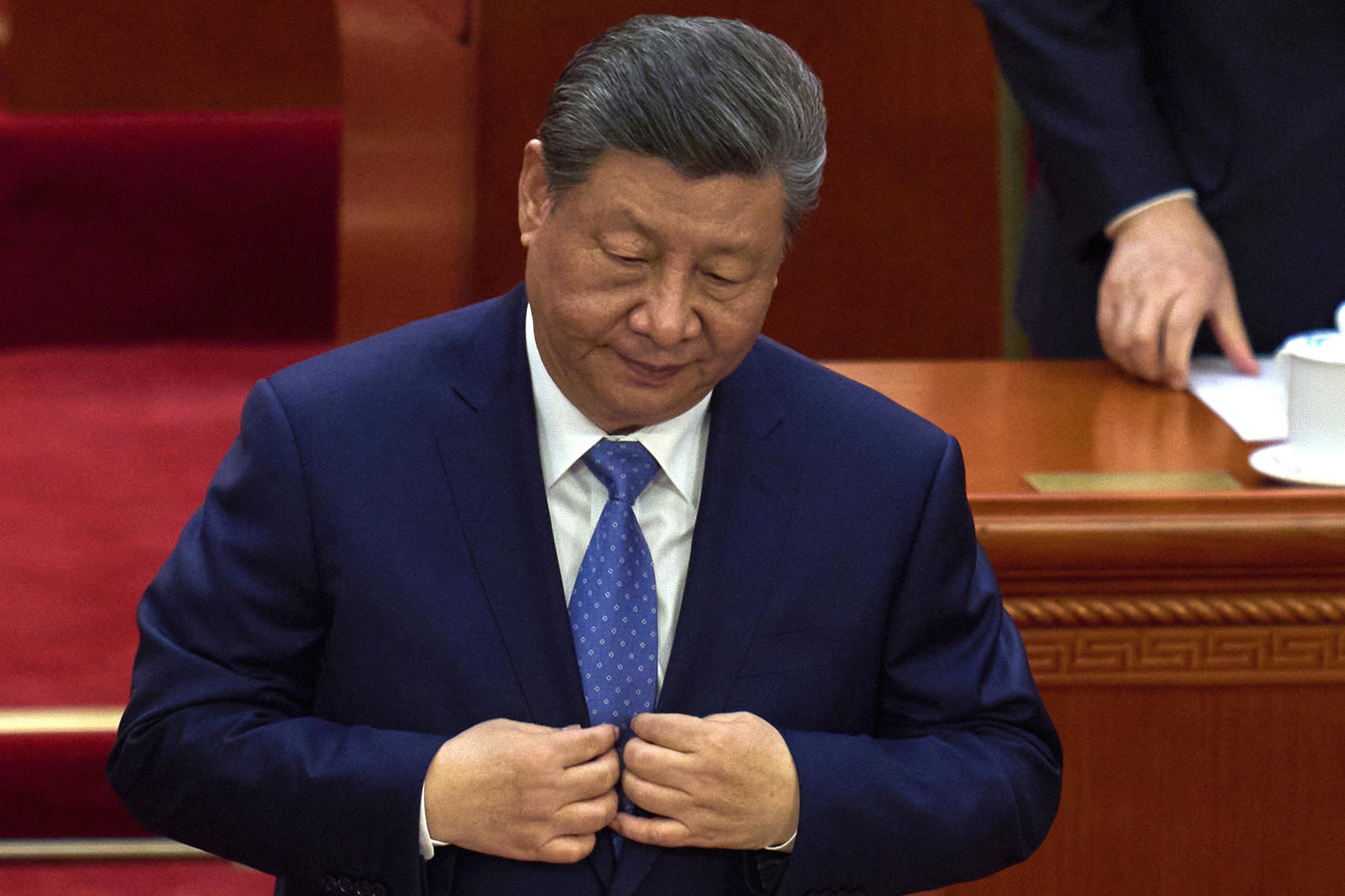
In the grand hall where the elite of the Chinese Communist Party (CCP) gathered, under the omnipresent red of the flags and with leaders seated in long rows of perfectly aligned tables, the absences counted as much as the presences.
Four years ago, when President Xi Jinping began his third term at the helm of the Asian giant, 376 primary and alternate officials were elected to the Central Committee, one of the most exclusive circles of power in China. This week, when its members reconvened in Beijing, many of those faces were missing. According to estimates from the Asia Society analysis center, only 291 occupy their former seats. Almost one in four leaders has been sidelined due to expulsions, investigations, dismissals, and mysterious disappearances from public life.
These are the "sick trees" Xi referred to. In a speech released this month by Qiushi, the regime's ideological magazine, the leader called for uprooting the rotten elements of the organization. "The fight against corruption is a crucial battle that we cannot afford to lose," he warned. Before planting a new generation of leaders, Xi wants to ensure he eliminates the branches he considers rotten.
The fifth plenary session of the 20th Central Committee, one of the most important political meetings of the year in China, was held behind closed doors and under heavy security. Attendees were isolated from the outside for four days to discuss the future of the party that governs over 1.4 billion people. The official agenda focused on deepening internal discipline, strengthening political oversight mechanisms, and closing institutional cracks that allow systemic corruption.
But behind this bureaucratic language lay a much more significant question: who will survive Xi's great purge and who will rise in the power reorganization planned for the fall of 2027.
The bloodletting has been particularly noticeable in the People's Liberation Army (PLA). Of the seven original members of the Central Military Commission, the body that directs the Armed Forces, only two remain, including Xi himself. Among the fallen are generals who had risen during his tenure and who, until recently, were part of his inner circle.
The closure of the plenary has resulted in a significant shift in the upper echelons of Chinese power. Beijing has promoted General Zhang Shengmin, 68, to the Politburo of the CCP, the most important power circle after its Standing Committee. Zhang is not just any military figure: he was for years the main responsible for the anti-corruption campaign within the PLA.
His rise restores military representation to the Politburo, where there had traditionally been two generals, after both fell from grace. The decision reinforces the political prominence of the man tasked with overseeing and purging the ranks of an army shaken by the largest internal scandals in recent years.
The plenary also served to formalize the extent of the purges shaking the foundations of Chinese power. The CCP ratified on Thursday the expulsion of 33 high-ranking civil and military officials, an extensive list of fallen leaders that includes Ma Xingrui, a former Politburo member and former Party secretary in Xinjiang, and the powerful General Zhang Youxia, who was vice chairman of the Central Military Commission and one of Xi's most trusted men within the Army.
Among the expelled are also General Liu Zhenli, former chief of the Joint Staff, and Liu Jianchao, a prominent diplomat who was once considered a future foreign minister.
Xi's Anti-Corruption Campaign
Xi has extended a mega anti-corruption campaign since coming to power in 2012. First, the so-called "tigers," high-ranking officials and leaders who seemed untouchable, were purged; then, thousands of "flies," lower-level administrative officials. The disciplinary machinery eventually reached ministers, provincial governors, heads of large state-owned enterprises, and military commanders.
The problem is that, so many years later, corruption continues to emerge within the very ranks that Xi has been continuously renewing. The president has denounced "officials who publicly comply with instructions while sabotaging them privately." And the fall of former protégés demonstrates that even personal proximity to the leader does not guarantee immunity.
In the fall of 2027, the next CCP Congress will elect a new Central Committee and reorganize the main governing bodies. Many of the president's current collaborators exceed the usual retirement ages. Among them are Cai Qi, one of his most trusted men; Wang Huning, the regime's chief ideological architect; and Wang Yi, the face of Chinese diplomacy.
Leaders born in the late 1960s and 1970s are waiting for their opportunity. The new generation must demonstrate administrative experience, technological knowledge, and, above all, political loyalty. The big question is not only which young leaders will rise but how much leeway they will have to develop their own agenda within a system increasingly revolving around a single figure.
The supreme leader does not seem willing to vacate his seat. Xi, 73, is heading toward a fourth term at the helm of the party. Although there is no official announcement regarding his continuation, there is no one, neither inside nor outside China, who in a normal situation (not due to health issues) would bet on a change at the top of the world's second-largest power.