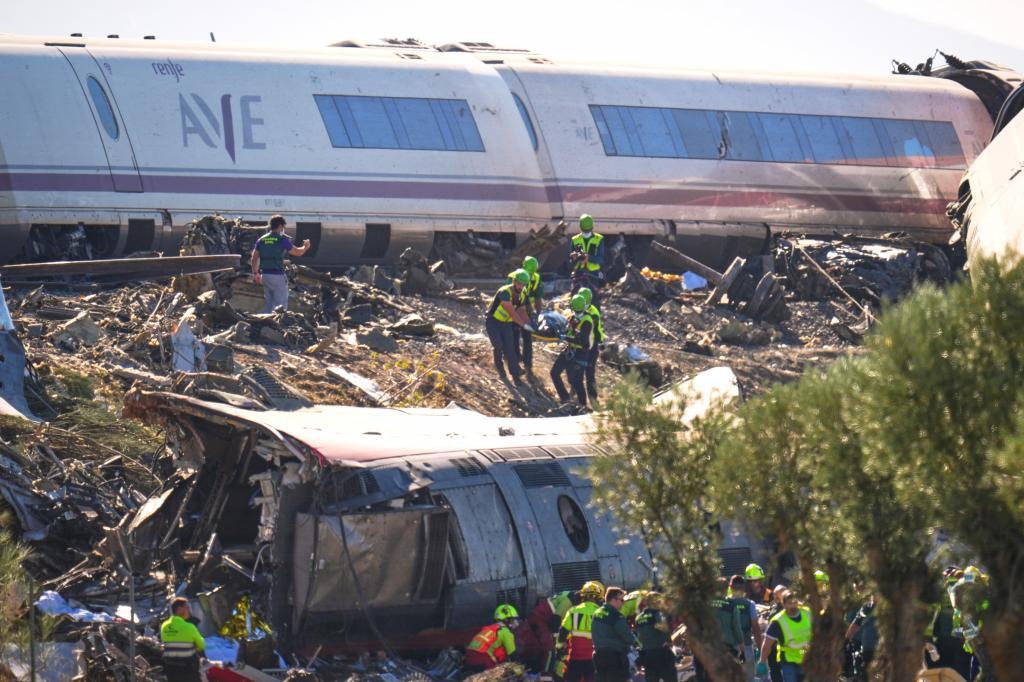
At least 68 people have died following the collision of two trains on the Madrid-Sevilla line on Wednesday morning, very close to the town of Urda in Toledo.
The spokesperson for the Government of Castilla-La Mancha, Esther Padilla, has reported that one of the involved trains, an Iryo, was carrying 147 people, including a baby, while the other train, an AVE, had 397 passengers.
When an incident with multiple victims occurs, such as this train accident, the protocol outlined in Royal Decree 32/2009 is activated, which regulates the actions of forensic medicine and scientific police, as noted by Fernando Serrulla, forensic doctor at the Institute of Legal Medicine of Galicia. This regulation establishes the procedure to be followed for the identification of bodies and the determination of the causes and circumstances of death.
According to the specialist, who has participated in the identification of bodies from several incidents with multiple victims, such as the 11M or the Alvia accident in Galicia, the protocol first establishes the creation of a Data Integration Center, aimed at expediting the identification tasks of the victims.
This body is formed by a Forensic Office and an Office of the State Security Forces and Corps and regional police. "Each of them will have a responsible person who will ensure that operational coordination and communication between institutions is carried out and maintained," the protocol states.
The center integrates 'ante mortem' information (personal description, medical data, tattoos, etc.) of potential victims with 'post mortem' information obtained during the body recovery or autopsy, aimed at facilitating the identification of the victims.
As Serrulla explains, the first step is generally to attempt identification through fingerprints, an immutable trait of each individual. The fingerprints must be compared with those in the police databases, a task that can be quick if the person carries some form of identification documentation.
"The initial identification tests are conducted by comparing fingerprint impressions on official documents," confirms Eduardo Osuna, professor of Legal and Forensic Medicine at the University of Murcia.
Initially, according to Serrulla, in this case, the vast majority of identifications should be able to be made through fingerprint comparison. "There is a list of passengers whose fingerprints can be quickly located in the database, which greatly speeds up the process."
In any case, in instances where identification cannot be made through fingerprints or other methods, such as dental studies, it is also possible to resort "to obtaining DNA profiles for the identification of the victims," adds Osuna, who emphasizes that "for DNA analysis to be successful, it is necessary to obtain samples from the relatives of the victim that the expert considers most suitable among those available. It is important to highlight, under the National Protocol for Forensic Medical and Scientific Police Action in incidents with multiple victims from 2009, the obligation to obtain a biological sample from the body for genetic profiling, should it be necessary," he states.
The identification is carried out by qualified personnel throughout a process involving forensic doctors, professionals from the National Institute of Toxicology and Forensic Sciences, and Scientific Police personnel, all of whom are experts in various identification techniques and processes, adds Osuna.
In this regard, four offices have been established in Madrid, Sevilla, Córdoba, and Toledo for the relatives of the victims of the train accident to undergo DNA sampling.
These offices are located in the Civil Guard Zones in Madrid (Calle Batalla del Salado, 32) and Andalucía (Avenida de la Borbolla nº 8, Sevilla) and the Commanderies of Córdoba (Entrance via Avenida de los Mozárabes) and Toledo (Avenida Barber Nº 42).
Genetic analyses usually take more time and resources than other procedures.
Ultimately, the existence of implants, pacemakers, or numbered medical prostheses can also assist in identification tasks.
Deaths resulting from disasters and incidents with multiple victims are considered violent deaths and are subject to judicial investigation, so an autopsy must be performed to clarify the cause of death in all cases.
Renfe has announced that it has activated the assistance plan for victims of railway accidents and their families (PAVAFF) and has made a support phone line available for relatives, 900 10 10 20.