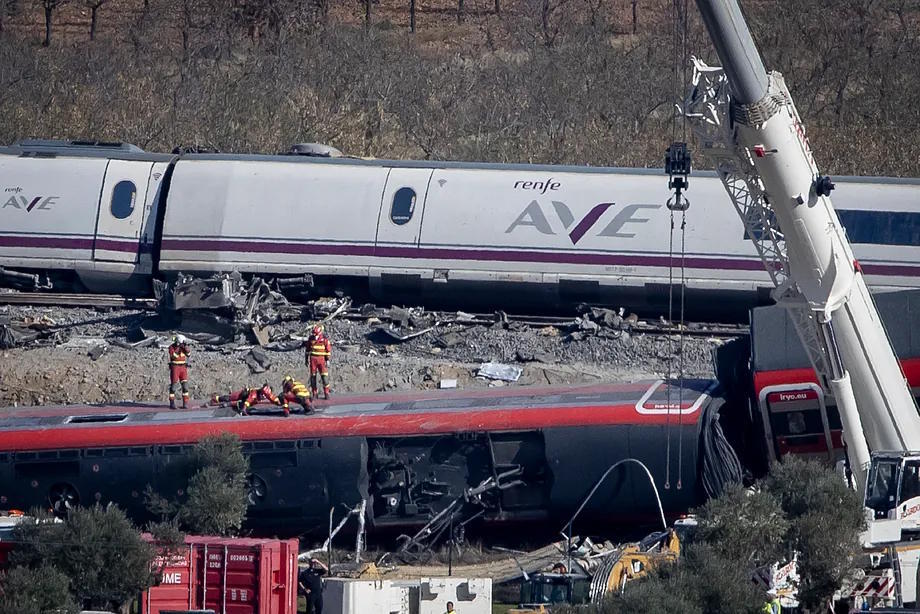
Between October 28, 2026, and October 1, 2025, Adif reported 10 incidents at points along the Urda section of the network. The latest, the accident caused by a collision between an AVE and an Iryo, has left 69 dead so far. Despite this, it is not considered a black spot, nor does it experience an especially high number of problems. In the past year, most incidents have been related to signalling in this section, where the safety system upgrade was supposed to be completed by early 2026.
Before the accident, one had to go back to July 7 to find another warning from Adif. It was published on its website, which does not keep a record of these messages, and on its X account, Infoadif, which provides service information on the state of the infrastructure and rail traffic across the network. On this platform, messages can still be consulted, and the one from July referred to delays "due to an incident in signalling between Urda and Malagón". The previous one, on June 24, was due to "a cable theft between Urda and Malagón" and also caused delays.
Most messages refer to incidents related to signalling, either due to cable theft — on June 11 and 12 — or for unspecified reasons, as on March 25 and October 13, 2025. Warnings were also issued for delays due to specific train problems — on April 8 and November 17, 2025 — and, on December 27 of last year, an incident involving the track switches in Malagón (Ciudad Real) forced single-track operation to Urda, causing delays.
The situation was similar when the timeframe is extended to last summer: there was another persistent incident affecting the signalling systems between Yeles and Urda that forced speed reductions and caused delays from July 31 to August 1. Two days earlier, on July 29, a nearby fire forced the suspension of traffic between Urda and Malagón, further south.
In any case, the 10 incidents in the past year do not represent an especially high figure for a section of a high-speed line. For comparison, in the same period, there were also 10 warnings in Hornachuelos — on the same line, 267 kilometers further south — although two of them corresponded to the same incident.
The Railway Accident Investigation Commission (CIAF) has not investigated accidents or incidents on the section in the last three years, during which it has intervened in other areas that could be considered black spots on the network. Madrid, especially the connection between Chamartín and Atocha stations, is indeed the subject of CIAF investigations. In Catalonia, particularly in Barcelona, there is also a certain concentration of investigations.
The corridor connecting the capital and Levante also suffers, paradoxically, from failures in the ERTMS signalling system, which should have been installed on the high-speed line where the accident occurred. It is worth noting that the LZB safety system, whose failure initially forced trains to stop, should already have been replaced by ERTMS, as the renewal was tendered in 2021 and the contract was formalized in October 2021, with a 52-month execution period that ended in January of this year.
In this regard, it is noteworthy that in recent years there has been a considerable increase in the number of high-speed passengers, both in long-distance and medium-distance travel. From one million passengers in the first quarter of 2016 in long-distance services, according to CNMC data, the figure rose to 2.25 million in the second quarter of 2026, the latest available data. However, this figure has not yet recovered from the drop experienced in the first quarter of the year, after the Adamuz accident, when it fell to 1.7 million from a peak of 2.5 million in the second quarter of 2025.
In medium-distance services, there were 1.94 million passengers in the second quarter of the year, almost double the figure recorded in 2016. The Cercanías network and conventional medium-distance services maintain figures similar to those of a decade ago, while conventional long-distance services have declined. In the last two cases, the decline is attributable to the growth of high-speed travel.
Meanwhile, the number of significant accidents reported in the annual report of the State Agency for Railway Safety has shown an almost linear evolution: it has fluctuated between 45 in 2016 and 57 in 2024, with a peak of 77 in 2023, although with fewer victims, 35, than in 2022, when there were 42.
It should be noted that all these reports correspond to years prior to a 2026 that has been particularly difficult for high-speed travel to southern Spain. Between the Adamuz accident — in Córdoba, although one train had departed from Málaga and the other was heading to Huelva — and the Toledo accident, on the line connecting Madrid and Seville, the two crashes have resulted in more than 100 fatalities.