When the polls close on November 3 in Alaska, there is little doubt that the focus of the night will be Dan Sullivan. The problem, however, will be determining which one.
The campaign in the cold northern state has been marked by the cost of living and the impact of fuel prices in a state where many communities rely on transportation not just by road, but by air and sea. The Iran war has inevitably focused the debate not only on the price of oil and diesel but also on security (Putin and Trump met there in 2025) and the priorities of the Trump Administration. Candidates have also spent a lot of time discussing federal aid, healthcare, and fishing. But the main issue, which has turned Alaska into a daily topic for national media and an obsession for Donald Trump, involves an unusual fact: the Republican candidate and an independent Senate candidate share the same name, Dan Sullivan. And not by coincidence.
In recent weeks, Trump has intensified his attacks against the second candidate (Dan J. Sullivan), whom he has labeled as "fake" and the result of a Democratic maneuver to confuse voters and siphon support from the senator (Dan S. Sullivan) of his party. Both the Democratic candidate and the second Sullivan have always denied any collusion.
On October 23, the furious president confirmed that he had ordered the Department of Justice to sue Alaska to try to prevent the certification of results if the Republican senator lost, claiming that the name coincidence aimed to confuse voters. The initiative is extraordinary in every sense because it seeks to intervene in the validation of an election before even knowing the result. Knowing that the Alaska Supreme Court had already allowed the second Sullivan to appear on the ballot.
The scenario, however, has completely changed after a deep investigation by The New York Times showed that several members of the campaign of Democrat Mary Peltola, rival of the Sullivans for the Senate, had participated in conversations to recruit a namesake candidate with the evident goal of confusing voters at the ballot. Taking advantage of an electoral system that combines open primaries and ranked-choice voting (something that will be voted on this year precisely in a referendum).
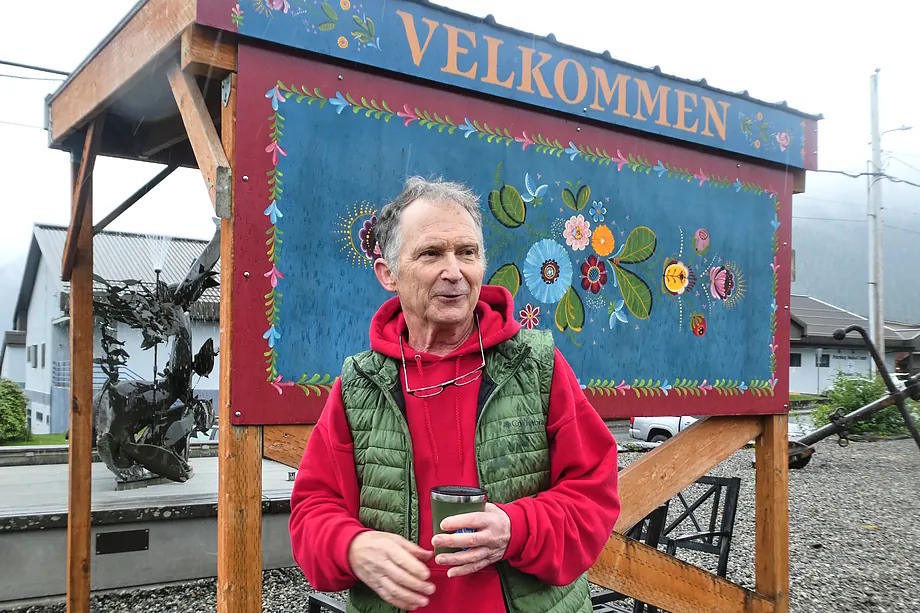
The New York newspaper reported, with the testimonies of 12 people, text messages, and extensive documentation, that in the summer of 2025, members of Peltola's team had begun to identify people throughout the state named Dan Sullivan until they found a retired teacher from a small coastal town, which cannot even be reached by land, willing to enter politics, mainly due to his hatred for Donald Trump.
According to the newspaper, the initiative called "ballot composition project," a very clear name, aimed to recruit other candidates who could split the conservative vote. It highlights the role of a political operator, Mr. Kurtz, who traveled throughout Alaska using false names and partial explanations to contact potential candidates to encourage them to jump in.
The messages examined by the newspaper also show exchanges between members of Peltola's campaign and officials from the Democratic Senatorial Campaign Committee as part of a much broader strategy, where they even discussed the idea of creating a right-wing party from scratch to compete against the Republicans. The testimony of Elisa Ríos, former campaign director for Peltola, is likely the most damaging, as she claims that while the candidate did not participate directly in the maneuvers, she was fully aware. And she, who was fired, has provided the most evidence of the operation.
After learning of the information, Trump has demanded that Peltola and the second Sullivan be removed from the ballot and that they be prosecuted. "It has just been determined that the Democratic idiots of Alaska, despite their sworn statements to the contrary, included a man named Dan Sullivan on the ballot to confuse the public regarding the highly regarded Senator Dan Sullivan. This is election fraud at the highest level, and the Democratic candidate involved in the plan, Mary Peltola, must be removed from the ballot and prosecuted, just like the FAKE Dan Sullivan. There is no other option! This behavior cannot be allowed to continue in our elections," he wrote on his social media.
Todd Blanche, U.S. Attorney General, agreed with his leader and insisted that the maneuver had clearly been illegal and should have consequences. But one thing is that there was dirty play and the operation was evidently aimed at confusing voters, and another is that it is illegal per se. Or that the election results could be annulled because of it.
Alaska, in fact, is known for all kinds of tricks. Both for its unique geographical distribution and because the electoral system allows for nonpartisan primaries, meaning that those who vote do not need to have a declared affiliation (in the U.S., when registering to vote, one specifies whether they are a Democrat, Republican, or Independent). Republicans, for example, did everything possible to keep in contention in a Democratic primary against Peltola a man who was serving time in a New York prison.
Last week, upon learning of Trump's preventive lawsuit, Republican Senator Lisa Murkowski reacted by saying that "the people of Alaska do not need help voting for their preferred candidates, and the state of Alaska has already handled this by clearly distinguishing the candidates on this year's ballot. The Department of Justice should never have filed this lawsuit." But this Wednesday, after the investigation by the Times was revealed, the conservative politician, who has recently supported the Democratic candidate aspiring to be governor in her state, said that "Alaskans deserve the honest truth from Mary and her campaign: what has been revealed is a pattern of lies and cover-ups and a culture of deception that has no place in our elections or among our elected officials."
For Trump and the Republicans, the importance of Alaska lies in the fight for control of the Senate. There are 35 of the 100 seats in the upper chamber at stake and under normal conditions, Alaska should be a safe seat for conservatives. But the low popularity of the president, and the setback that always occurs for the party in power during these midterm elections, are making contests that were once almost impregnable strongholds very competitive. From Texas to Kansas and from Louisiana to Missouri.