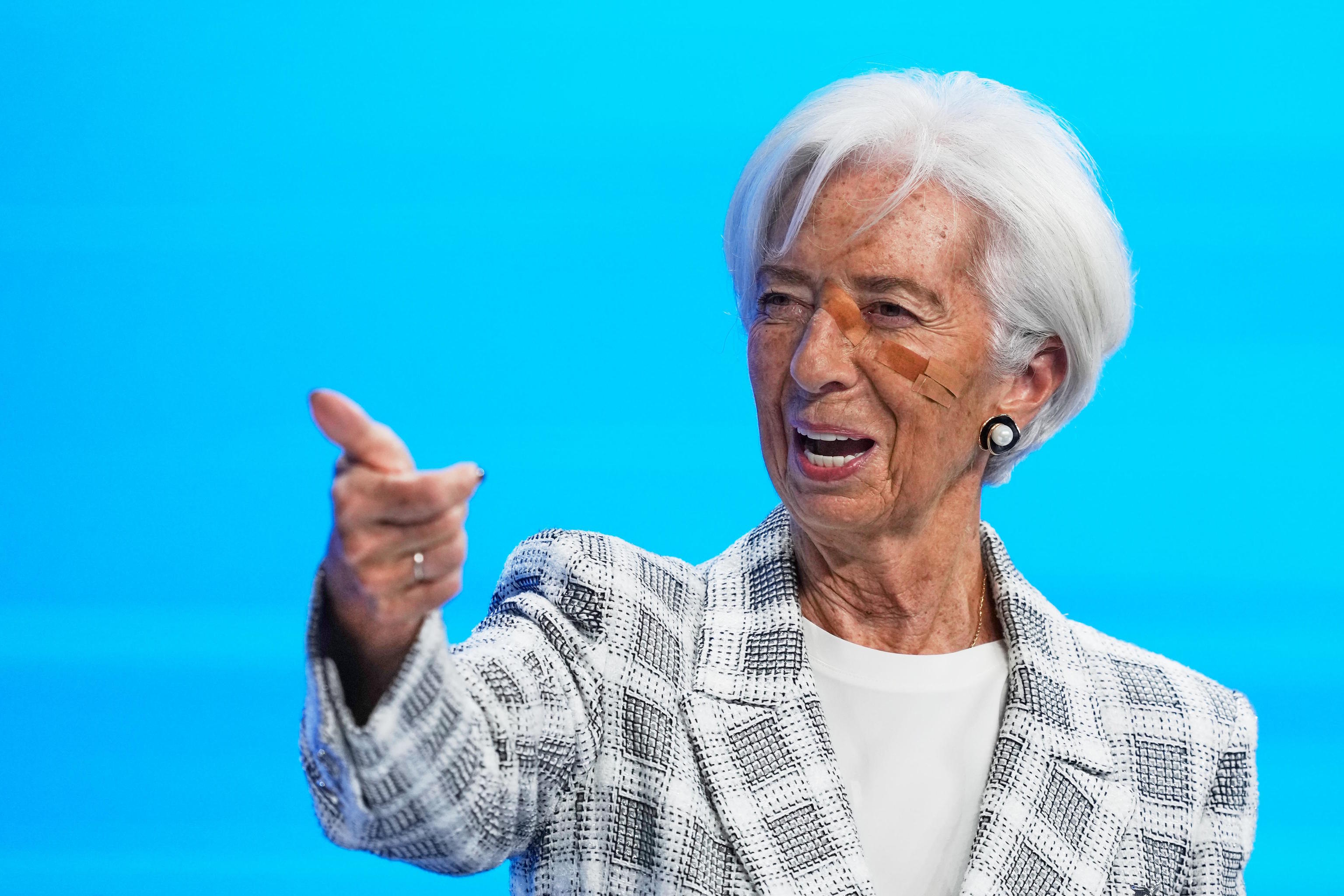
"There's never a good time to leave," Christine Lagarde managed to say after confirming the rumors that had been anticipating her departure from the presidency of the European Central Bank (ECB) for months. The current president - she will remain until February 7 - announces her departure a year before her term was set to expire, giving community authorities three months to decide how to allocate three key seats within the ECB: her own, the presidency; the one that will be vacated by chief economist Philip Lane in May; and another in the Executive Committee that belonged to German Isabel Schnabel until she announced her departure (also prematurely) in September to join the International Monetary Fund.
Lagarde is leaving under the pretext of feeling constrained and needing freedom to express herself, something inappropriate for a position that demands neutrality. According to reports, the president's current goal would be to engage in unpaid activities and to "be useful as a citizen of France, Europe, and the world." Sources close to the situation claim that Lagarde feels unable to remain detached from "the events taking place both in her own country and around the world." Other sources consulted by EL MUNDO do not rule out that Lagarde, who has held political positions in France, could actively campaign for center-right and pro-European candidates. France is undergoing a genuine social and political crisis, compounded by soaring debt (with a public deficit of 5.1%) and little room for budget cuts. The European spring poses a challenge for the European Union, considering general elections in France, with the threat of the far-right Marine Le Pen, and Italy is also contemplating calling for elections in April 2027.
With the clock ticking, the government has reportedly accelerated efforts to position Spaniard Pablo Hernández de Cos as Lagarde's future successor at the ECB. Last month, the president of the government, Pedro Sánchez, publicly endorsed the former governor of the Bank of Spain under Mariano Rajoy. He has been working on this behind the scenes for a year. In mid-October, it was Alberto Núñez Feijoó's turn, the leader of the Popular Party, to express his support for Hernández de Cos in Brussels. This is crucial at a time of political transition in our country, just ahead of the elections on November 29. Sources close to the candidacy acknowledge being "reasonably optimistic," although the potential change in Moncloa does not work in their favor. In any case, political instability is a shared recipe in Europe.
The news, communicated days ago to community authorities, has unlocked the race for succession at the ECB within a highly regulated process from Brussels. Minutes after the news was made official, the president of the European Council, Portuguese António Costa, kicked off the process, stating on social media that the aim was to ensure "a smooth transition to the next leadership of the ECB." At the same time, the Eurogroup committed to "act swiftly to prepare the recommendation of the EU Council to the European Council," which is responsible for appointing the six members of the ECB's Executive Committee, including the president and vice president, a position held by Spaniard Luis de Guindos until May 31, when he was succeeded by Croatian Boris Vujcic.
The urgency with which European authorities are addressing the transition at the ECB suggests that the decision on who will lead the central bank could be made within a month. With the calendar in mind, the Eurogroup will meet in Brussels on November 9, and attention is focused on the European Council meeting on November 26 and 27, by which time it should be clear who will be the candidate to succeed Schnabel, who will leave a month before Christine Lagarde. Another possible date being considered is the next Council meeting on December 17 and 18.
Spain has never held the presidency of the central bank. Since its establishment, there have been four presidents: the Dutch Wim Duisenberg until 2003; two Frenchmen starting with Jean-Claude Trichet until 2011, and now Christine Lagarde, with Italian Mario Draghi presiding in between. The rival on paper to beat for Hernández de Cos is also Dutch Klaas Knot, considered more hawkish and aligned with German views on greater fiscal discipline, which would theoretically raise concerns among governors of southern European countries.