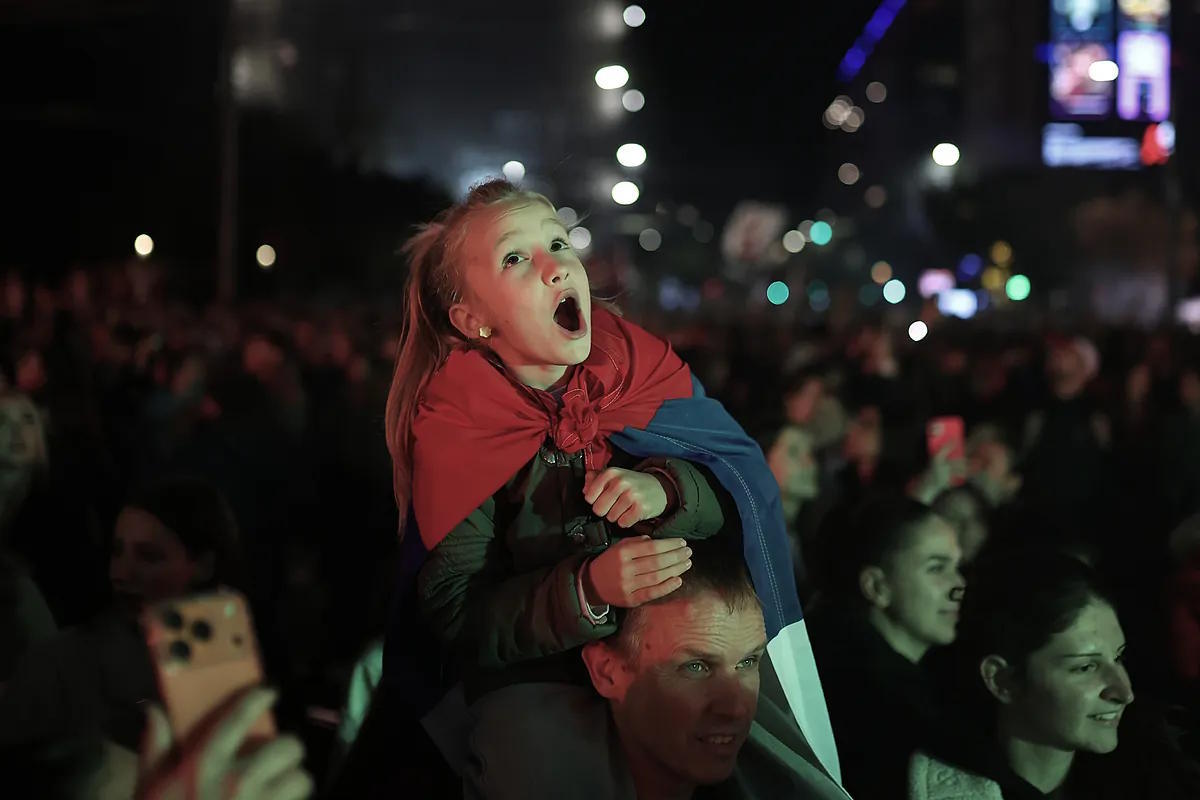
The political experiment in Serbia begins following the decisive electoral victory of the Student List last Sunday. The initial steps of this diverse civil movement are being scrutinized under a microscope that may offer few answers just yet. How to erase 14 years of a regime as personalistic as that of Aleksandar Vucic? How will they end corruption? What will they do about foreign policy? Who will be the new prime minister?
The cleanup has started literally, as legal deadlines loom and the Parliament is being formed to appoint the new prime minister (of the 250 seats, student representatives will occupy 141 and the SNS bloc 106; the remaining six will be for the Hungarian, Albanian, and Bosniak minorities). Dozens of young people erase the graffiti that adorns many walls of Belgrade after two years of protests. Phrases like "FCK BLK" (roughly "F*** Blockers"; Vucic referred to the protesters this way) or "Blockers-Ustachas" (a serious insult in the country as it refers to Croatian nationalists responsible for massacres against Serbs during World War II) will now only remain in photos as testimony.
The same goes for the remnants of Vucic's supporters' camp in the capital, set up next to the Parliament and the Presidential office in the early months of 2025, in response to students who barricaded themselves in the faculties. The tents remained until the moment the former president—who resigned in September to run for the legislative elections—acknowledged his defeat. There is no trace left. After the celebrations early Monday morning, the cleanup crew made up of citizens passed through.
On Thursday, at a press conference held in a central park, the student movement demanded the resignation of high-ranking officials from the police, intelligence agencies, and the judiciary, and urged officials to prevent outgoing officials from destroying documents or evidence of possible irregularities. "Changes start now," declared engineering student Filip Ubovic, one of their spokespeople: "Institutions belong to the citizens, and the law applies to everyone."
"Now comes the decisive test", Naim Leo Berisi, director of the Institute for European Affairs (IEA), tells this newspaper from Belgrade, emphasizing that "the victory must be translated into a genuine democratic transformation and reactivate the country's European integration." "We need to 'put our house in order': a swift return to the rule of law, full freedom and pluralism in the media, and a fight against corruption, along with reforming security services," highlights Ivan Vejvoda, founder of the think tank Europe's Futures Initiative (EFI) in Vienna.
The former foreign policy advisor to reformist Prime Minister Zoran Djindjic, assassinated in 2003, and his successor, Zoran Zivkovic, believes that regarding foreign policy, the movement's signals have been very clear in these early days: "The continuity of EU integration as a fundamental goal and close bilateral and regional relations with all neighbors. Demonstrating that Serbia will be a factor of stability and not a source of discord in relations," he emphasizes.
"We will do everything possible to rectify and achieve the best possible cooperation with all our neighbors," Ilija Srdanovic, the cardiologist and university professor in Novi Sad who led the winning candidacy and is a favorite for prime minister, explained yesterday in an interview with the Croatian newspaper Jutarnji list. Srdanovic stated that the new government will seek to address issues such as the search for the missing persons from the 1991-1995 war between Serbia and Croatia, the opening of archives, and clarifying war crimes, as reported by Efe. "There are mothers, sisters, and grandmothers crying on both sides. We want to help both sides reach the truth," he added regarding the significant issue between the two countries.
Srdanovic, who has no political experience, also explained that issues regarding the recognition of Kosovo, sanctions against Russia, or EU accession, on which there are differing opinions within the movement, are not currently priorities and that they have agreed to set them aside to focus on "building a society based on freedom, equality, and respect for rights and law, with free media and independent institutions."
"Serbia has voted for a new political system but has not yet voted for a new foreign policy. Its members united with the goal of ousting Vucic, but governing will require reconciling divergent priorities and agreeing on a broader political vision," Berisi highlights. "Putting our house in order," as Vejvoda mentions. "The first steps are cautious, and I would say they are still digesting the victory," says Mira Milosevich from the Real Instituto Elcano, noting that the first task is to choose the prime minister—the name most mentioned, besides Srdanovic, is Dejan Soskic, former governor of the Central Bank of Serbia—and organize presidential elections, which should take place before the end of the year following Vucic's resignation in September.
The next step, in her view, will be to transition from the horizontal decision-making organization used until now to the vertical power required for the day-to-day functioning of a government: "There the students will be the ones to oversee those they have chosen to represent them." But, Milosevich adds, "their priority now is to cleanse the institutions of Vucic's corruption and clientelism, and this will not be easy."
"Precisely because the list is so heterogeneous, the signals regarding foreign policy are being deliberately discreet," says Adnan Cerimagic from the think tank European Stability Initiative in Berlin. "On the most challenging issues—relations with Russia, Kosovo, and the implications for Bosnia—there is no clear stance. But neither is Brussels pressuring for one," he emphasizes. "The signals sent by the trio Von der Leyen-Costa-Kos (the Commissioner for Enlargement) consist of meeting the List wherever they say they want to advance."
"If the government successfully implements genuine democratic reforms, EU integration could accelerate significantly," Berisi states, adding that "the decisive test will be whether the students can transform their internal cohesion into a credible vision for Serbia's place in Europe." The political experiment still has much trial and error ahead.