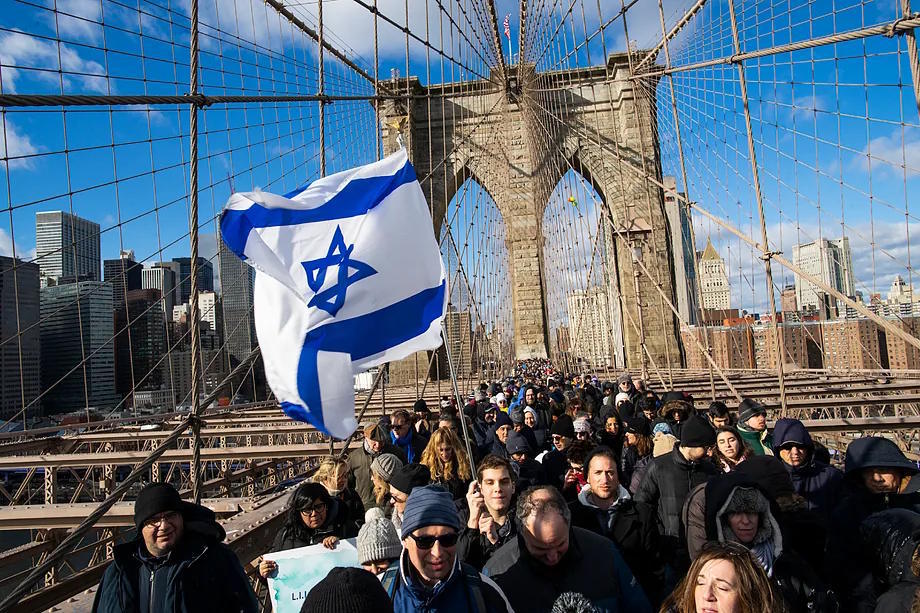
One of the theses put forth by Raul Hilberg in his monumental The Destruction of the European Jews is that the forced and passive cooperation of the Judenräte facilitated extermination. Hannah Arendt captured this idea in Eichmann in Jerusalem—barely acknowledging her debt to the political scientist—and turned the submission and organization of the Jewish councils into one of the most controversial chapters of an essay whose most well-known cliché is the "banality of evil." It is impossible to separate the Holocaust from the founding of the State of Israel in 1948, which for some complicates distinguishing criticisms of Israeli policies from antisemitism.
Nor can Israeli belligerence in defense and foreign policy be separated from the passivity that Hilberg spoke of. The alert for a possible attack is constant. It is evident in the security measures surrounding synagogues, in the protocols at universities with Jewish students, and in the monitoring of social media activity. According to the Anti-Defamation League, nearly 25,000 antisemitic incidents have occurred in the last three years in the United States. These incidents range from a swastika painted on a Jewish student's folder to insults and shootings. On May 21, 2025, a 30-year-old man killed two employees of the Israeli embassy at the entrance of the Jewish Museum in Washington. When arrested, he was wearing a red kufiya, shouted "Free Palestine," and claimed he did it for Gaza. In 2024 alone, American synagogues and Jewish institutions received 627 bomb threats.
In September 2025, The New York Times published a poll that, for the first time since it began asking in 1998, reflected that there were more Americans on the Palestinian side than on the Israeli side. According to the same poll, 40% believed that Israel intentionally kills civilians and 51% disapproved of the United States providing more economic and military aid to the Jewish state. The same trends have been confirmed in other polls throughout 2026. Among younger people, the balance tilts even more toward the Palestinians: only 23% sympathize more with Israelis, a historic low, according to a February Gallup poll.
Another survey from the Pew Research Center in March indicates that 60% of Americans have an unfavorable opinion of Israel, a rejection that rises to 80% among Democratic voters. This trend has been reflected in the victory of Muslim Abdul El-Sayed in the Democratic primary for the Senate in Michigan and in Zohran Mamdani's primary for Mayor of New York. Both label the reprisals of Netanyahu in Gaza following the October 7 attack as "genocide" and openly question the traditional pro-Israel policy.
Antisemitism is one of the main concerns of the Trump administration. In December 2019, during his first term, he incorporated the IHRA definition of antisemitism into government agencies, which states: "A certain perception of Jews that can be expressed as hatred of Jews. Physical and rhetorical manifestations of antisemitism are directed at Jewish or non-Jewish individuals and/or their property, community institutions, and places of worship." In his four years, Biden did not change the text. On January 29, 2025, just days after his second inauguration, Trump reinforced the definition to be used to combat antisemitism with all the legal tools at the state's disposal, allowing action in universities and considering antisemitism as grounds for immigration inadmissibility to reject foreign students.
Months later, Trump appointed Yehuda Kaploun as the special envoy of the State Department to monitor and combat antisemitism. On the eve of the anniversary of the October 7 massacre, in which about 1,200 Israelis died and which triggered the brutal offensive in Gaza, he summarized his work: "250,000 visas have been revoked, and we are currently working with many allies to incorporate the definition of antisemitism to combat hate crimes." Not all those visas were revoked for antisemitism. The problem with using the definition as a legal weapon is the difficult line that separates freedom of expression from crime and, above all, deciding whether criticisms of the State of Israel can be considered antisemitism.
In the Miami area resides the third-largest Jewish community in the United States, after those in New York and Los Angeles. On October 7, Maya Izoutcheev and Yarin Hadida, two young people who escaped from the attackers who burst into the Nova festival, met with Holocaust survivors Saul Blau and Allan Hall. It is moving to see them embrace at the end of the event. One of the survivors of the Shoah concluded the controversy: "Is Israel's attacks in Gaza genocide? What is genocide is what Hamas has done by building thousands of kilometers of tunnels and spending millions on terrorism instead of preserving the safety of its own people."
With these two words -antisemitism and genocide- the most controversial debate is waged, one that could decide the outcome of the midterm elections, in which Trump risks his majority in the House of Representatives and the Senate. A sector of MAGA, the movement that propelled him to victory, also questions support for Israel, an issue that until this year did not divide Republicans. This stance has resonated with media figures like Tucker Carlson, who in an interview with former British Minister Jacob Rees-Mogg suggested that Hitler had reasons to invade Poland in 1939 and that confronting Germany dismantled the United Kingdom. Earlier, in his podcast, amateur historian Darryl Cooper had labeled Churchill as the main villain of World War II. In April and May of this year, during the offensive against Iran, Carlson had already called Trump "a slave" to Israel and "a hostage" of the Israeli prime minister.
Synagogues have about 41,000 volunteers who receive specific training to prevent attacks. They are called bitajón. Prevention makes some sense considering Hilberg's claims about the forced cooperation of the Jewish councils during the Holocaust. In Miami alone, around one billion dollars a year is spent on preventing antisemitic acts.
Sheriff Rosie Cordero-Stutz has a rabbi named Rosenberg among her collaborators to detect such incidents before they occur. Again, the line between freedom of expression and crime blurs. The streets of Miami are equipped with thousands of security cameras, drones, and license plate readers that monitor to prevent any incidents. Florida International University also has a special security unit that ensures Jewish students do not suffer any discrimination. In reality, in Miami, perhaps due to these measures, there are few incidents that can be classified as antisemitic. This is where the Jewish community is most flourishing, and it is no coincidence that Ivanka Trump and her husband, Jared Kushner, have chosen this city to live. They have just been admitted to the exclusive Indian Creek club, which has an entry fee of around one million dollars. In 2020, they purchased a plot on the island from Julio Iglesias for about 30 million. Kushner has become Trump's main international emissary to get Arab countries to join the Abraham Accords and recognize the State of Israel.
Rabbi Rosenberg compares the current resurgence of antisemitism to the ice bucket challenge, that viral challenge where users poured a bucket of ice water over themselves. "It's a trend." And he is right. Just step away from the Jewish community in Miami and delve into the alt-right world to see that those who question mandatory vaccines (remember that the United States has recorded the worst measles figures in three decades in recent years) have no qualms about resorting to Holocaust denial arguments. They more or less suggest that Hitler went too far. And from there, they move on to the supposed submission of the United States to the interests of the State of Israel. Again, the question: is that antisemitism? For the head of the Holocaust memorial in Miami, the city is, after Israel, the best place in the world to be Jewish.