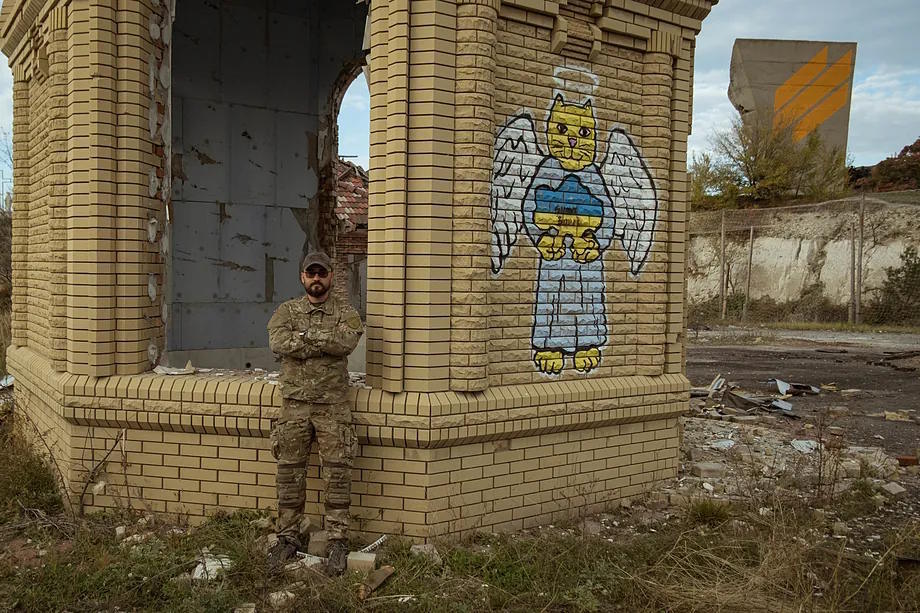
They say that when he operates his drone, he is a kind of exterminating angel with hundreds of enemy casualties in his record, but in person, Andrií is a shy and polite young man, with librarian-like hands, glasses like a watchmaker, and the face of a quantum physics student. "Don't take photos of me from the waist down; I'm not wearing the proper footwear," he says in his perfect English when he realizes he is wearing sneakers with his uniform. We are in the destroyed building of what used to be a school, in one of the cities liberated from the Russians, very close to the Donbas.
We have come to meet several protagonists of the so-called Operation Vivaldi, an offensive that has managed to liberate 277 square kilometers of territory occupied by the Z troops. For months, Kiev remained silent about the advances made by its troops in this hellish environment, with thousands of drones of various types monitoring every meter of the front and preventing any breakthrough: the most hostile context in history for an infantry soldier. Nevertheless, Ukraine, alongside its Third Army Corps, one of the best-prepared in Kiev and led by General Biletski, worked on a methodical advance system to minimize its own losses and push the enemy back to the Zherebets River.
This operation, which took place over months in radio silence, is significant in the current context of the war because it eliminated the Russian advance pincers that were supposed to take the city of Limán and surround the last major urban centers that Ukraine controls in the Donetsk region: Sloviansk and Kramatorsk. Additionally, this offensive has degraded the 144th Motorized Rifle Division of Russia to the point of rendering it useless for combat. The operation's figures include 250 captured Russian soldiers (many shown on video) and another 5,000 dead, although others speak of 5,000 total casualties, not just dead. Zelensky stated that Ukrainian losses were several times lower than those of the occupying army.
Valentin, infantry commander of Brigade 66 and one of the commanding officers, recounts that the use of weather was one of the keys: "We took advantage of cloudy days with low visibility, just when the enemy's spy drones were useless." However, on those days, drone pilots like Oleksí flew their devices close to the ground, scanning every line of trees where Russian soldiers could be hiding. "Before our infantry moved in, we would scout the terrain and look for hidden Russian positions. When we found them, we launched drones and ground robots at them." We continued asking Andrií:
—Were the Russian soldiers in this area well-trained and equipped?
—Yes, they were, but the problem is that we cut off their logistics for months. Some had nothing to eat, and we found them very weakened after staying in the same position for months, hiding without moving.
Ukraine massively used deception in its radio stations: the Russians believed that Ukraine would attack from another direction, which distracted them from the main objective, the village of Nove, on their northern flank. There was also information silence and electronic warfare: Kiev kept the operation secret, disrupted Russian reconnaissance drones and their electronic warfare, and attacked fuel supplies and depots in the rear. Additionally, they deployed airborne robots beyond enemy lines to create panic, sometimes with robotic assaults launched by heavy bombing drones over 10 kilometers into enemy territory. They also used BTR-60 armored vehicles in a kamikaze manner against Russian fortifications, essentially suicide robots with the shells of old Soviet armored vehicles.
Now we ask the commander of their infantry, who are the ones that must clear those wooded areas:
—When you reach their positions, do they prefer to surrender or fight to the end?
—Almost all fight to the end. Russian propaganda has told them for years that we kill them when they are already unarmed. In reality, it is never like that. We treat prisoners humanely.
When the line of trees was cleared, then the infantry would enter, but escorted by Ukrainian drones, tasked with taking down any Russian aircraft that appeared. This is where the role of the larger bombing drones came in, capable of dropping a 40-kilogram bomb on a shelter and turning it into a large crater. This was handled, among others, by Pavlo, a heavy drone pilot (or bomber) with a beard and sunglasses who never stops smiling. "This guy you see here has over 100 Russians killed in his record just in this operation," claims Commander Valentin.
Pavlo states that there were days when the drone was used for many things: "You could start the day by destroying an enemy position with a 40-kilogram bomb, then the drone would return, you would change the batteries and load it with food, water, and ammunition for your infantry. After that, that same drone could return with the weapon and belongings of an injured soldier who needed to be evacuated."
Both armies have almost given up on using armored vehicles, but in this case, Ukraine used them again. "In some missions, and with thorough preparation, advances with tanks must be done with drone escort to prevent enemy drones from acting," comments the commander. "Everything was very well planned, to the point that on the first day we only had one wounded during the liberation of the first town under Russian control. And it wasn't even serious." The name Vivaldi refers to The Four Seasons. General Biletski responded to this irony when asked about the final objective. Open sources suggest that the goal was to push the Russians beyond the banks of the Zherebets River, and that it was done in four seasons, meaning in four phases.
Is it possible to continue advancing in this situation? Can you keep advancing even in winter, when the leaves fall from the trees and the vegetation cover for hiding from drones ends? "Yes, we can continue liberating territory with this same idea. The key is to use the weather to our advantage, and winter conditions may offer us good moments to achieve objectives. Perhaps we will do it on this same front or perhaps we will change. We only obey orders and carefully plan each step," says Valentin. General Biletski assures that there will be more operations like this and that he will announce "good results very soon."