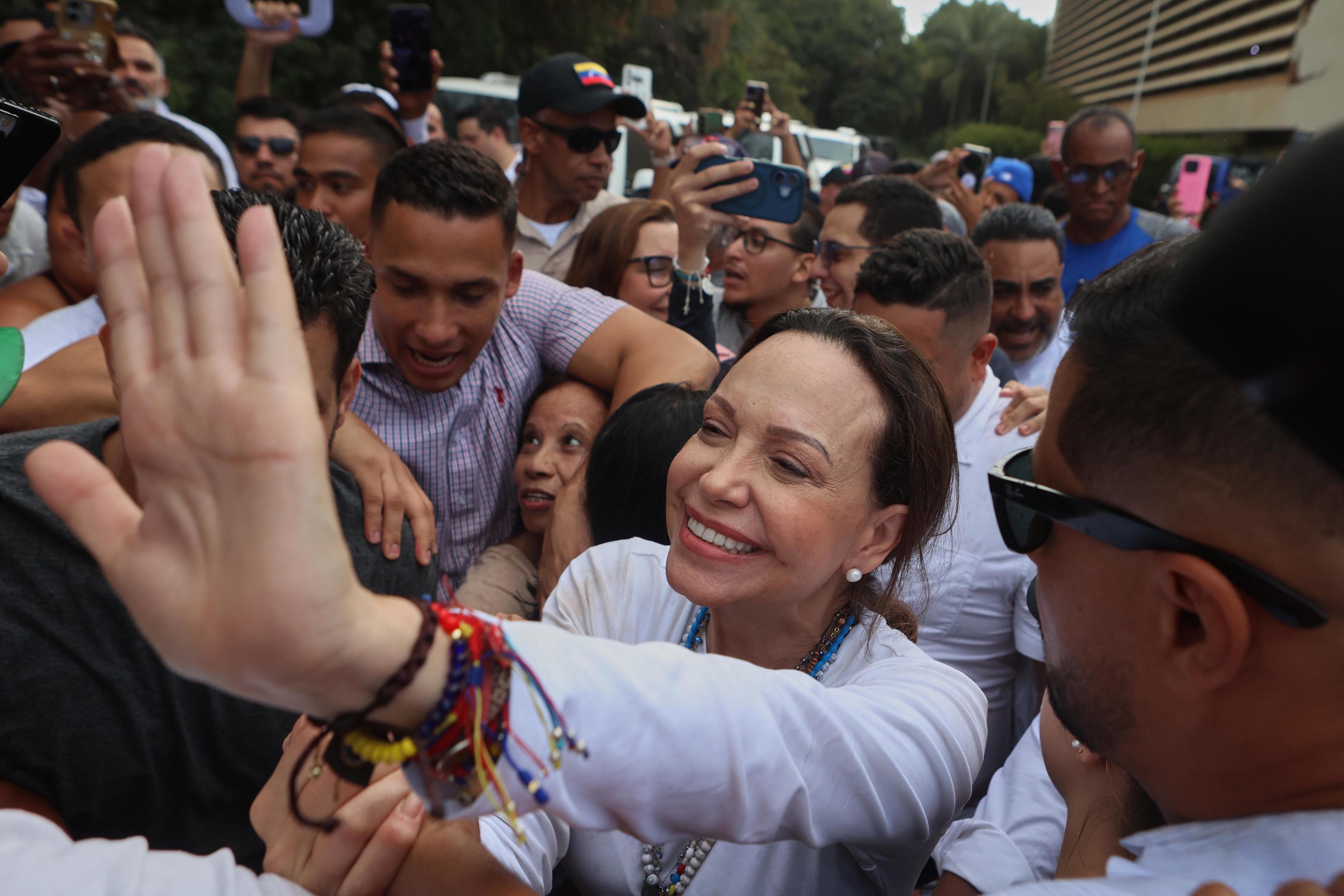
The day in Caracas presented a stark contrast between the appearances of both leaders, marking the pulse of the democratic transition in the South American country and rearranging the pieces on the international diplomatic board with the United States as a key player.
In her first public appearances before an audience of students at the Andrés Bello Catholic University, the Nobel Peace Prize winner defined herself as "the antithesis of Hugo Chávez, Nicolás Maduro, and Delcy Rodríguez", proclaiming that a "new era" has begun in the nation and that "the floodgates of freedom have opened." The opposition leader ruled out any direct approach or meeting with the interim president and emphasized that the absolute priority in this process of change must be "the total dismantling of the repressive system and the release of all our political prisoners."
Regarding the path to democratizing Venezuelan institutions, Machado supported the roadmap promoted by U.S. Secretary of State Marco Rubio, based on three stages —stabilization, recovery, and reconciliation or transition— noting that the timelines have become clearer and point towards "the holding of presidential elections in 2027." To ensure massive democratic participation, the opposition leader announced that the citizen network that worked on the 2024 campaign will promote the updating of the electoral census "so that all Venezuelans can vote."
Shortly before the opposition leader's speech, Delcy Rodríguez intervened via a recorded television message in which she assured that in the country "there will be elections", promising that the elections will be organized by "a renewed electoral authority and with the world as witness." Furthermore, the interim president asserted that "The election should not be a problem nor take us back to times of confrontation that no one wants," while announcing salary increases for the next year and reaffirming orders to security forces to avoid arrests without prior judicial mandates.
In parallel to her electoral announcements, Rodríguez restructured the government's diplomatic leadership, appointing internationalist Oliver Blanco as the new chancellor with the task of "continuing to consolidate international relations." Additionally, the president appointed Félix Plasencia to head the International Affairs of the presidency with the direct mandate to "establish himself in the United Kingdom until we recover the gold that belongs to Venezuelans," referring to the reserves of bullion held at the Bank of England.
Despite the institutional speeches, political tension remains present. During her university address, Machado recalled that "the repressive system that kidnapped thousands of citizens, tortured, and killed is still in power. Important steps have been taken, I wouldn't be here today, but those people are still there." Nevertheless, the opposition leader expressed her conviction that the initiated political process is irreversible, stating: "We are in transition, the times have become much clearer. That does not guarantee anything, but the path is clear. The new scenario has accelerated everything, everywhere, in NGOs, in unions, in the media. And, above all, within political parties. People are very clear about the path. What remains is to work."