Mathew has had to sharpen his sense of humor to survive. In front of the camera, he shows his hand with the surfer's gesture, with his thumb and pinky finger extended.
- Don't think I'm doing this for the photo. I can't move my fingers. [Laughter]
- Well, given the circumstances, I'm doing very well. I've lost sight in one eye and the other only sees bright spots, but damn, I'm alive and I celebrate that. [More laughter]
In a second in May of last year, Mathew, a Korean volunteer in the Ukrainian Armed Forces, had his life completely changed, although he still doesn't understand what happened to him, whether he stepped on a mine, was attacked by a drone, or had a projectile fall nearby. The fact is that when he woke up, he was missing a leg, half an arm, and had shrapnel all over his body and face.
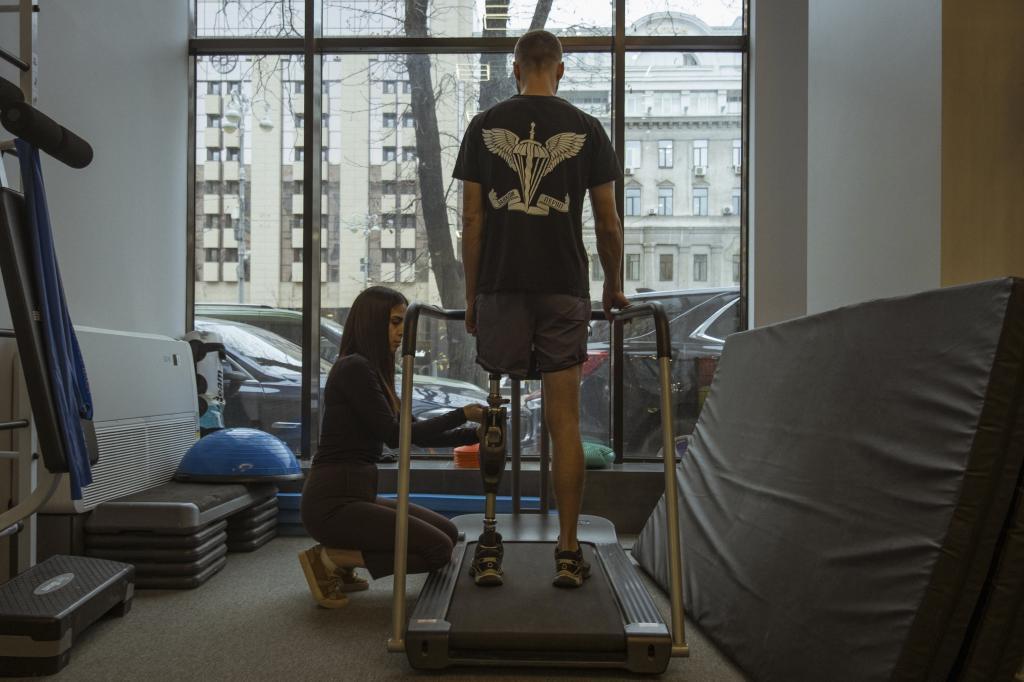
A year ago, Viktor (a huge guy, strong as an ox with a Viking beard) volunteered to rescue a comrade hit by a drone in the leg. They sped in a vehicle, and when they arrived, a booby trap was waiting for them. "It's funny because the guy we went to rescue saved his leg, but I lost mine," he recounts. Now he is trying out what they call a "bionic prosthesis" after using a mechanical one for months.
- What are you doing now, after being seriously injured?
- The same thing I was doing. Serving in my unit. I just signed a new contract.
- Do you want to go back to combat with one leg?
- Has the war ended? As long as this doesn't end, I have to keep contributing what I can.
An amputee soldier performs exercises to gain strength.ALBERTO ROJAS
We are in the rehabilitation room of the Protez foundation, a nonprofit American organization addressing one of the major problems in the country in this grim present: the mutilated. One only needs to walk through the streets of any Ukrainian city to realize that the massive use of tourniquets in the trenches has saved many lives, but the inability for quick evacuations has also led to many limbs needing to be amputated.
In this room, there is a certain active calm. A group of people attends to each patient (about 25 a day) while others work on new plaster molds for newcomers or adjustments to new prosthetics. Some of these can cost around 30,000 euros.
Behind the death toll caused by this invasion lies another less visible statistic: that of Ukrainians who have lost an arm or a leg. No one knows exactly how many there are. By 2023, estimates ranged from 20,000 to 50,000, and some organizations now speak of over 100,000 amputations since the start of the large-scale invasion.
Before 2022, the Ukrainian healthcare system treated only a few thousand a year. The only official data is on prosthetics: according to the Minister of Social Policy, Denys Uliutin, more than 44,000 people have received them at the state's expense since 2022, and the 2026 program has nearly 190 million dollars. The bottleneck is not just money, but the lack of specialized prosthetists and the industry's capacity to produce more.
The majority of amputees are young men, injured by explosions from drones, mines, or artillery. Many undergo several surgeries before they can wear a prosthesis, and then face months of rehabilitation. The unseen wound is psychological: phantom limb pain, anxiety, depression, post-traumatic stress. A study from Northwestern University with 156 Ukrainian amputees shows, however, that with early treatment combining pain and trauma, the average pain drops from 4.3 to 1.1 out of 10 in a year, anxiety is reduced to less than half, and quality of life improves significantly.
There are many examples of soldiers who, despite being totally mutilated in arms and legs, decided to continue serving, even if only from the rear. Ruslan Knysh, just 20 years old, lost all his limbs to a mine, but is training to become a drone pilot using a custom chin controller to operate unmanned ground vehicles. María Yurina, the head of the organization in Ukraine, states that they must "keep the prosthesis in working condition even if these soldiers decide to return to combat on the front," and notes that "an adult's prosthesis needs two or three annual check-ups, but a child's growing prosthesis requires seven or eight updates each year." "That increases our workload, but unfortunately, we need to expand the capacity of our centers. We are seeing more and more patients," concludes María.
The Protez Foundation is one of the organizations that has done the most for the mutilated in this war. It is based in Minnesota. It was created by Ukrainians from the diaspora and is led by its co-founder, Yura Aroshidze. It offers free prosthetics to soldiers, civilians, and children who have lost a limb. Initially, patients traveled in groups to the United States for their prosthetics to be made and fitted. Today, the foundation also has clinics in Ukraine: Transcarpathia and Kyiv, although a third is under construction on the outskirts of the capital. There, they handle follow-ups, repairs, and replacements. Their specialty is the most complex cases, high amputations of arms and legs.
"We are dealing with cases that have never been seen before, neither in Ukraine nor in the United States," explains Aroshidze. By 2025, Protez had fitted more than 2,000 prosthetics to just over a thousand patients, and its activity continues to grow, parallel to the number of amputees. Additionally, it combines the expertise of American specialists with the training of Ukrainian prosthetists and physiotherapists, which is what the country needs most. It is funded without public money, relying on private donations and support from organizations like Direct Relief or the European Bank for Reconstruction and Development. Nevertheless, its waiting list exceeds 1,800 people.
Sergií, injured a year ago by a drone, tries out his new prosthesis. Since he has already worn another and is accustomed to it, he has no trouble putting on the new carbon model, adapted to his anatomy, and standing up thanks to his strong arms. "This one is much better than the previous one. Gradually, the pain has disappeared."
- Did you have that pain sensation in the leg you no longer have?
- Yes, I had it all the time, but it only disappeared with psychological work. Once you realize that you lost that leg forever, it stops hurting.