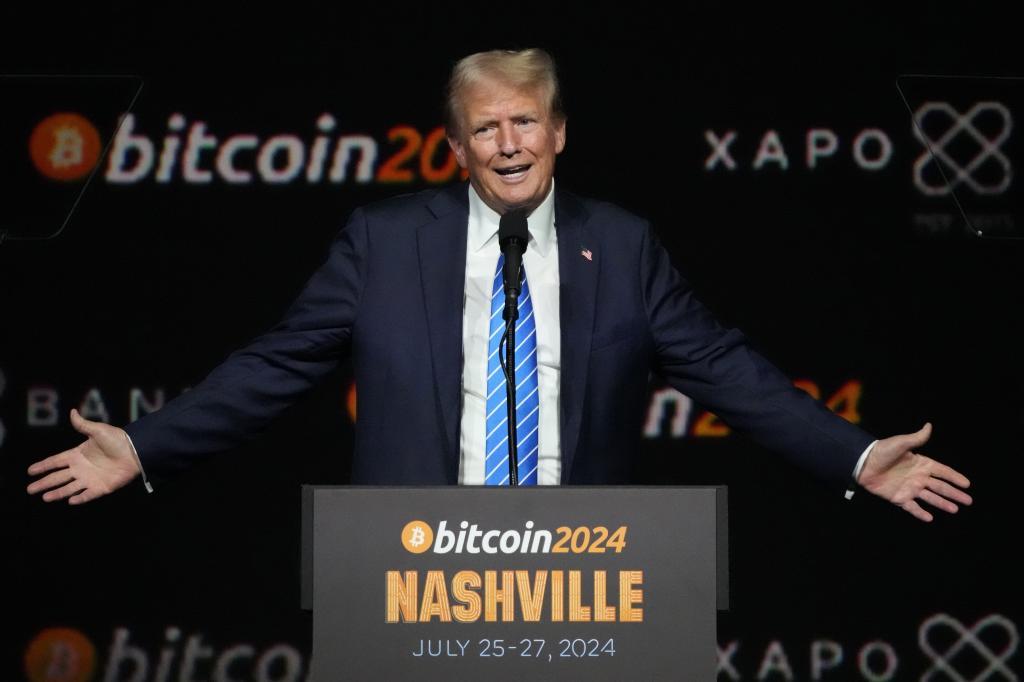
To understand the United States, one must understand the Donald Trump phenomenon. And as strange as it may seem, to truly comprehend the president, a New York millionaire residing in Florida with enormous popular support in three consecutive elections, one must travel to Davidson County, 15 kilometers from downtown Nashville, Tennessee. There lies The Hermitage, the 450-acre plantation that includes the mansion, the dedicated museum, and the slave cabins of Andrew Jackson, the seventh president of the country.
Often, references for Trump are sought in the late 19th century, that golden age for him when he claims that the U.S. was richer and more prosperous than ever before, when the nation was financed through tariffs on imports and without a permanent income tax. It was the era of William McKinley, one of the great defenders of protectionism and the war with Spain over Cuba. The 1920s and 30s are also discussed, with isolationist impulses and again in favor of tariffs. Even the anti-communist philosophical schools of the Cold War are mentioned. But the best mirror to study the MAGA leader and the almost blind support of millions is that of Jackson.
Trump's admiration for the former president is well known. Upon arriving at the White House in January 2017, he ordered his portrait to be placed in the Oval Office, near his desk. And when he visited The Hermitage shortly thereafter, he evoked him as "one of our great presidents", especially for how he had challenged the "arrogant elite" of Washington. The Republican claims aspects of the Jacksonian legacy that fit with his own rhetoric: the defense of workers, economic nationalism, and the image of a lone hero confronting established powers on behalf of ordinary people. The dark side is simply ignored.
Days before the elections, the museum sees many visitors. The exhibition does not make direct comparisons between the past and the present, but the number of similarities and references is not coincidental. John Mechan, Jackson's biographer, explains that "analyzing Jackson is confronting the best and worst of ourselves." Because Jackson embodies like few the fundamental contradictions of the United States: he was a defender of slavery, responsible for the expulsion of indigenous peoples, populist, and someone who challenged the authority of the courts. He is attributed, probably exaggeratedly, with having said something like: "John Marshall has made his decision; now let him enforce it if he can," a challenge to the Chief Justice over a ruling on the expulsion of indigenous peoples that the president did not want to respect.
At the same time, Jackson was a leader who (after defending the Union and respecting the outcome of the elections he lost) symbolizes the era when many states eliminated property requirements for voting and suffrage was extended to almost all adult white men. Jackson did not initiate that process, but his candidacy accelerated it. In 1824, about 27% of eligible white men voted; in 1828 it was 50%, and in 1840 the figure approached 80%.
The posters on the walls of The Hermitage speak of how throughout his career the Democratic president always blamed the establishment for conspiring, maneuvering, and engaging in shady dealings, including his defeat in the 1824 presidential election. Jackson railed against the forests just as Trump does against renewable energy facilities with genuine passion. "What good man would prefer a land covered with forests and populated by a few thousand savages to our growing Republic?" he said then. But there is more. Jackson had a shadow cabinet full of flatterers. And one of his first decisions was to fire 'officials', just like Trump with Elon Musk. He and his team saw their victory in 1828 as a message from the people to "clean Washington of corruption," believing that "a permanent group of government employees too often ended up corrupted." There is even a very personal detail: Donald Trump has restored a statue of Columbus to the White House, something he had in mind since visiting Jackson's mansion and discovering that there was a portrait of the discoverer in the entrance hall.
Laboratory of Conservative America
Tennessee, an overwhelmingly conservative state that votes Republican without fissures, functions as a microcosm of the contradictions of the United States, of the major political and legal debates, and of the issues that have marked society over the last century. The death penalty and the limits of state power. The right to bear arms and school shootings. The manipulation of electoral districts, problems with voting machines, and the role of the Supreme Court. The arrival of great fortunes to rapidly changing cities. Or the clash between the promise of technological growth and artificial intelligence and its costs to local communities.
Tennessee largely represents that conservative United States, which is wary of Washington, identity debates, and cultural changes. A territory that seems to have consolidated its political identity around the Republican Party, the church, and hard work. The highway billboards say 'God is real' and 'God exists', the cowboy look prevails, and a significant portion of its voters maintains an almost unbreakable loyalty to their candidates, even in the face of corruption allegations, political controversies, or the consequences of the war with Iran, issues that seem to carry limited weight.
"I find it really incredible," says Sam, a retiree who boasts that he lived next to Elvis Presley in Memphis as a child. "Everyone seems very concerned about gas prices and grocery lists and seems to ignore corruption. It's something I'll never understand," he laments, speaking about the midterms, the complacency of his peers, and very interested in the European perception of the quality of democracy in his country. And specifically, about the separation of powers.
In April of this year, the Supreme Court ruled in the case Louisiana v. Callais, shaking what remained of the historic Voting Rights Act of 1965, passed amid the Civil Rights struggle, which had allowed citizens and associations to challenge the design of electoral districts that clearly had racist effects, without the need for explicit intent in their configuration. The conservative justices, who hold a 6 to 3 majority, opened the door to changes, and Republican Senator Marsha Blackburn urged lawmakers to quickly redraw the boundaries of the only district with a majority African American population. Eight days later, District Nine, which previously had 60% Black population and 25% White population, changed to 32% Black and 58% White, shifting from urban to rural.
There, Justin Pearson, a young African American who seemingly has no chance in an area that voted for Trump in 2024 by more than 20 points, competes. But the district suffers the consequences of pipelines and the plans for massive data center expansions by Elon Musk. Pearson has managed to mobilize neighbors against light and noise pollution, a topic that generates extraordinary consensus among all voters and across the country, from Virginia to Oklahoma, from Texas to Oregon. "Unlike my opponent, backed by Trump, I am not a millionaire. I have not contributed a million dollars of my own money to my campaign. I do not have a multimillion-dollar mansion like a plantation. Nor do I have the support of corporations that make life difficult for the working class," he repeats over and over before small audiences. Barely 50, 100, 200 people at most in gyms, churches, and civic centers on the outskirts of Memphis.
Inequalities
We are a lower-middle-income state, with pockets of wealth in the major urban areas and large pockets of poverty in the countryside. If anything characterises it, it is inequality. The roads in the east, near Knoxville, are lined with caravans, abandoned cars, cheap housing and plenty of junk food. The outskirts of Nashville, by contrast, are full of enormous mansions. And the city centre, or Memphis itself, can rivale any of the wealthiest, most modern and thriving cities. Music, and country music in particular, has created many millionaires, but in recent years so have figures from the world of finance. Sportspersons, 'nepo-babies' and conservative influencers have chosen the area, drawn by low taxes and the availability of vast tracts of cheap land.
The number of homes sold in the metropolitan area that were in the top 1 per cent nationwide by price — around $3 million or more in 2025 — has tripled since 2017, according to a Bloomberg analysis of data from Realtor.com. Tennessee is therefore among the states most at risk of losing farmland to residential development, according to the American Farmland Trust. It is estimated that one-tenth of its farms disappeared in the five years leading up to 2022, according to data from the US Department of Agriculture.
Until not so long ago, politicians wanted to become governors as a stepping stone to the Senate. Now, the trend is beginning to shift. Blackburn is a good example. Tennessee, heeding the President, is voting as if this were a referendum on him, as if his name were on the ballot paper. But in reality, it is the Senator who is everywhere. She won the election two years ago and, although she has four more years left in her term, she has chosen to stand for governor. Her public explanation is that she wants to demonstrate the kind of leadership that will keep her state on the right for this generation and the next. She also argues that, as Trump is devolving power back to the states, strong governors are needed to bring that 'revolution' home.
The concept of 'strong' is important here. Hours after the prisoner Christa Pike made headlines across the globe, she made her move. Pike, who has bipolar disorder and has been imprisoned for 30 years for killing a friend, was due to be executed after being sentenced to death. But when she was administered the lethal injections - two of them, in fact - something went wrong. Against all odds, she survived and, ironically, had to be hospitalised. It was an absolute disaster, utter chaos. Since then, she claims, she has not had a single day without excruciating pain. The governor cancelled the executions, and the person in charge of the execution resigned. But Blackburn reacted by saying that the solution to this was to stop the nonsense and bring back the electric chair once and for all to execute the condemned. Her popularity remained completely unscathed; quite the opposite, in fact.
Blackburn es también quien tendrá que escoger a un candidato para ocupar su puesto cuando ella deje voluntariamente el Senado si gana, y algunos medios han revelado que el secretario de Defensa, Pete Hegseth, está haciendo mucho lobby para agarrarse al puesto, consciente de que si los demócratas recuperan el Congreso hay muchas posibilidades de que busquen forzar su cese.
Blackburn es también la protagonista indirecta de otra denuncia. El pasado lunes, Stella Parton, hermana de la leyenda del country Dolly Parton, publicó en su cuenta de Facebook que tras votar en la biblioteca pública de Hermitage, precisamente, su papeleta "no dejaba de cambiar al candidato equivocado". Según su queja. tuvo que volver atrás tres veces para corregir su voto porque la máquina marcaba a la republicana en lugar de a la demócrata Jerri Green. "Hay que impedir que amañen" las elecciones, escribió. No fue la única que se quejó en las redes sociales de problemas similares con las pantallas si bien no hay ninguna queja. No hay indicios de que haya algo raro, pero el país está tan polarizado, tan tenso, que las conspiraciones suman adeptos cada día.