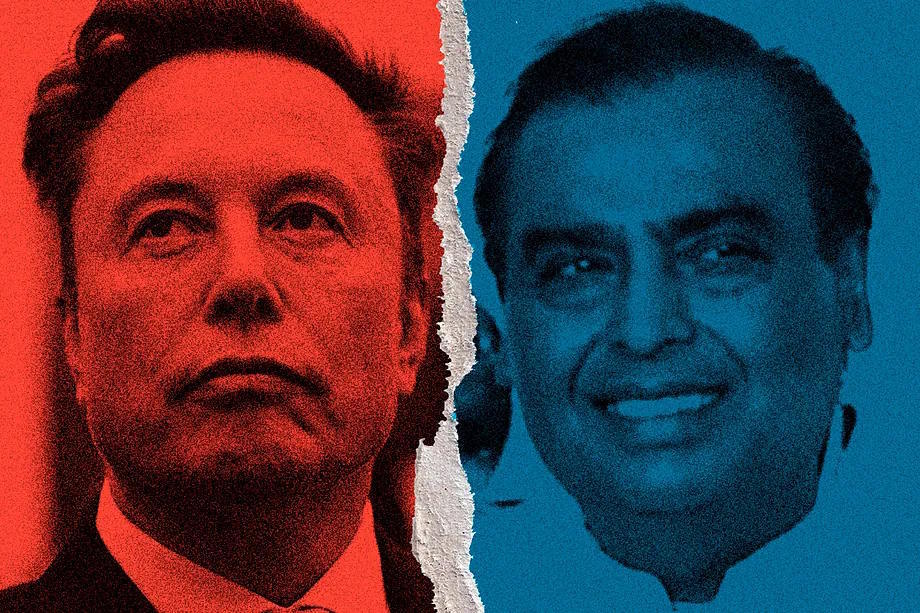
"Dear Prime Minister Ambani, please accept my humble apologies for not realizing that you are the true boss of India." The message, posted by Elon Musk on his social media platform X, was not directed at Indian Prime Minister Narendra Modi, but at Mukesh Ambani, Asia's richest man and patriarch of a business dynasty that controls everything from oil refineries to supermarkets, television networks, and the largest telecommunications operator in the country. The American tycoon's provocation has sparked a war between two billionaires accustomed to getting nearly everything they desire.
Behind this confrontation lies a billion-dollar battle for control of the digital communications of the most populous country on the planet. The fight is taking place in the skies, although the spoils are on solid ground: the enormous Indian telecommunications market. Musk accuses Ambani of using his influence over Modi's government to block the entry of Starlink, his satellite internet service, and to protect the dominance of Reliance Jio, the Indian businessman's operator with over 500 million customers.
Ambani, 69, needs no introduction in India. Nor a presidential residence. He has something more spectacular: Antilia, a private 27-story skyscraper built in one of the most expensive neighborhoods in Mumbai, featuring three helipads, a garage for 160 vehicles, swimming pools, and cinemas. A luxury fortress valued at around 1 billion dollars that has become a symbol of the enormous inequality in the South Asian giant.
He lives there with his wife, Nita Ambani, a former teacher and classical dancer. She is one of the most influential figures in Indian high society. The couple has three children, Akash, Isha, and Anant, who are involved in managing the conglomerate.
The family showcased their wealth in 2024 during the wedding of their youngest son, Anant, to Radhika Merchant, heir to another business dynasty. The celebrations lasted for months, featuring private performances by Rihanna and Justin Bieber, a luxury cruise through Europe, and a star-studded guest list: Bill Gates, Mark Zuckerberg, the Kardashians, Tony Blair, and Boris Johnson. In a country where millions survive on modest incomes, such ostentation drew significant criticism.
The head of the Indian clan inherited the foundations of the empire founded by his father, Dhirubhai Ambani, a trader who started with a small textile business. After his death in 2002, Mukesh and his brother Anil were embroiled in a family dispute that resulted in the division of the businesses. The former built a giant that today generates billions in oil, energy, distribution...
Opposite him stands Elon Musk, 55, born in South Africa and now the richest man on the planet thanks to Tesla, SpaceX, and his tech investments. While Ambani represents Indian dynastic capitalism, Musk embodies the entrepreneur who wants to transform entire industries, from automobiles to space exploration, and uses X as a platform to confront governments and competitors.
The first battle between the two erupted in 2024 when they disagreed over the allocation of frequencies necessary for satellite internet. Ambani argued for auctions; Musk preferred an administrative allocation. Modi's government ultimately backed the latter mechanism. The following year, there was a truce when Jio and SpaceX announced a deal to distribute Starlink equipment in the Indian group's stores. But in early October, Musk struck back.
He accused "certain Indian oligarchs" of blocking Starlink and labeled the situation a "crime against the people of India". The next day, he openly questioned whether Ambani was truly in charge of the country. Finally, he dubbed him "Prime Minister Ambani" and sarcastically asked him to allow his company to compete.
The feud comes at a particularly delicate time for the Ambani family. Jio has just completed the largest IPO in Indian history. Both contenders are well aware of the advantages of having access to the offices where major decisions are made. Musk accuses Ambani of using his immense fortune to influence political power, while he himself has funded electoral campaigns and cultivated privileged relationships with U.S. Republicans.