In a small souvenir shop attached to the Japanese Parliament, Sanae Takaichi (65 years old) has become a souvenir. Her caricature appears everywhere: on plastic binders, fans, stickers, colorful lighters, and boxes of sweets stacked on narrow shelves, under the cold white light of a place that seems halfway between a parliamentary kiosk and a fair shop.
There are buns with her face stamped on the dough, cookies with her smiling figure, and chocolate bars wrapped in pink boxes where the prime minister appears leaning over a podium, as if she were still delivering a speech even inside the packaging.
On one side, tourists browse; on the other, retirees gaze at the display as if looking at a collection of curiosities from Japanese politics. "She is a very active leader. I like her," one of them highlights while pointing to transparent folders decorated with a large red sphere reminiscent of the sun on the Japanese flag and a slogan written in capital letters: "Japan is Back". Below, Takaichi is depicted as a tiny leader, with one hand raised and a gesture of returning to the country something that, according to her narrative and that of her loyalists, it had lost.
The message is not just a catchy slogan. It summarizes an entire political promise: the return of a proud Japan, firmer, less self-conscious, determined to shake off decades of stagnation, diplomatic caution, and economic resignation. In those parliamentary stationery folders lies, in miniature, the slogan of a new conservative era.
The cult of the first woman to come to power in Japan unfolds here in a domestic version. Takaichi is also depicted dressed in regional attire in souvenirs from Nara, her hometown; she appears alongside deer, pagodas, and local landscapes; and shares space with personalized lighters and fans where she stands alongside other faces from national politics. All of this is part of takaichimania, a phenomenon that, for months, mixed party fervor, marketing, and popular curiosity.
The question, a year later, is whether that "Japan is Back" sold today in the form of folders, sweets, and trinkets is more than just a shiny slogan in the display window. Because outside the shop, beyond the caricature and the packaging, the examination of reality begins.
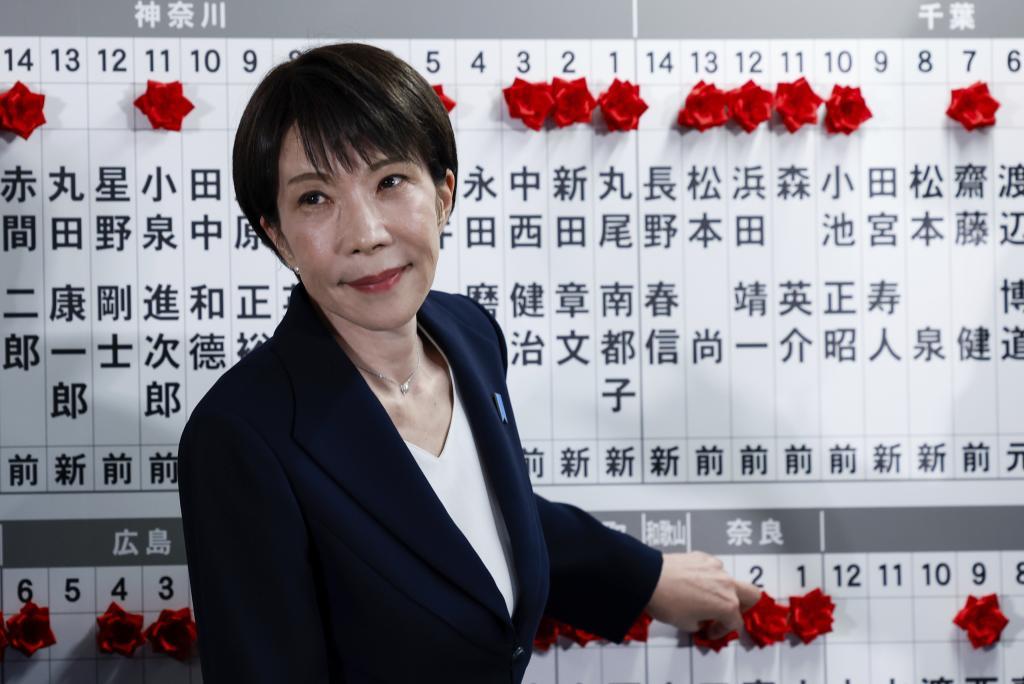
Takaichi came to power in October 2025. An admirer of Margaret Thatcher and a former drummer in a rock band, she inherited a Liberal Democratic Party (LDP) worn down by scandals and promised a "strong and prosperous" Japan. Her greatest electoral triumph came in February 2026, when the LDP secured 316 of the 465 seats in the House of Representatives.
Just walking through the avenues of the Nagatacho district, among ministries, glass offices, and dark-suited officials, reveals the contrast between enthusiasm and the grocery bill. Yudai, a self-employed man in his 40s, complains that everything is getting more expensive. Akaho, a hotel receptionist, criticizes that Takaichi, despite being Japan's first female leader, is less feminist than many men. "I like her a lot; she is working very hard. She is on the right track," responds Koba, a student from Okinawa. "She is a very active leader," replies his classmate Masahito.
Polls show a fervor that persists, although it is no longer unanimous. The Yomiuri Shimbun, the country's largest newspaper, reports a government approval rating of 57%. Among women, according to the Jiji agency, support has fallen from 65.9% to 42.9%. Professor Shin Ki-young, a gender studies specialist at Ochanomizu University, believes that the enthusiasm sparked by the arrival of the first woman in power has transformed into disillusionment.
"Many Japanese women, especially young ones, interpreted her appointment as an opportunity to break with decades of male dominance in politics. They expected her to promote policies for women, but there have been no notable advances," laments the academic.
Shin criticizes that Takaichi continues to reject the possibility of marriages retaining different surnames, an old feminist demand, and that she has opted to expand the use of maiden names without reforming the marriage system. She also recalls that the prime minister promised a government with female representation comparable to that of Nordic countries, but only appointed two female ministers.
Recently, Takaichi explained in Parliament that cooking, washing dishes, bathing, and putting on makeup take her "three or four hours" longer than her male predecessors. The statement sparked controversy over gender roles in a country where women still bear the brunt of domestic chores. Her praise for endless workdays and sleeping only a few hours also does not help break old labor molds.
Her diplomacy also has a unique style. In March, during her visit to Washington, Takaichi assured Donald Trump: "I firmly believe that only you, Donald, can achieve peace in the world." The flattery fueled criticism of Japan's subservience to the United States. Now, as Trump tightens his ties with Chinese President Xi Jinping, Japan fears being sidelined in the calculations of its main ally.
The wound with China remains open. Shortly after taking office, Takaichi suggested that an offensive against Taiwan could provoke a Japanese military response. That statement caused relations to plummet amid threats and trade pressures. The Japanese leader has not managed to restore dialogue with her powerful neighbor.
In Beijing, they frequently accuse Takaichi's government of fueling a dangerous militaristic shift that threatens to resurrect the ghosts of Japanese imperialism. They cite the increase in defense spending, the easing of arms export restrictions, and plans to reform the pacifist constitution as examples.
In Japan, not everyone applauds the rearmament project either. Last week, thousands of protesters gathered outside the Diet (the Parliament) to protest against the new defense policy. For her supporters, Takaichi is pulling Japan out of decades of indecision; for her detractors, she is weakening the post-war pacifist tradition.
Back in the prime minister's souvenir shop, irony is served in boxes of sweets. The caricature of the leader retains her smile intact. Outside, inflation, tensions with Beijing, and disputes within her own party are not wrapped as gifts.