Steve Witkoff, special envoy of the US president, Donald Trump, announced via social media that representatives from Russia and Ukraine will meet on the 10th and 11th in the emirate of Abu Dhabi for a new round of negotiations.
"The talks will focus on security agreements for the post-war period, de-escalation, humanitarian initiatives, and next steps toward peace," the representative stated in his message.
Witkoff's post added that negotiators from his country will also meet this week with officials from several European countries, the EU, and NATO "to address security guarantees for Ukraine, the post-war European security architecture, and economic opportunities aimed at supporting Ukraine's reconstruction."
The announcement from the US envoy confirms the reactivation of contacts between the two adversaries, the first since February, despite the war intensifying in recent days.
After weeks of intense diplomatic activity aimed at breaking the deadlock in the conflict, Witkoff met in Moscow last October with President Vladimir Putin to propose resuming trilateral dialogue, as explained by Ukrainian President Volodymyr Zelensky at that time.
In this regard, more than 3,000 soldiers from a dozen European countries will participate this month in maneuvers in Poland to rehearse their possible deployment in Ukraine if a ceasefire is signed.
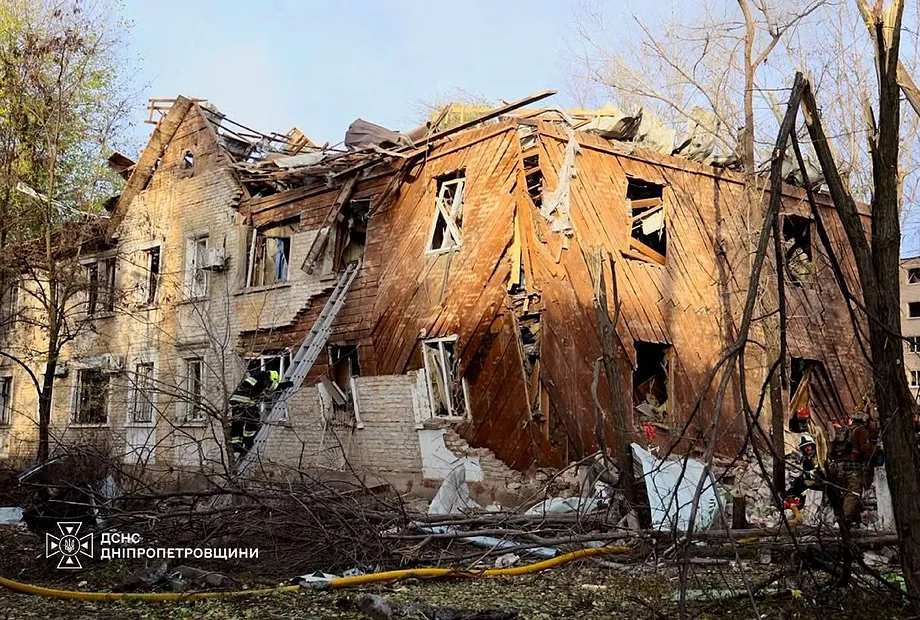
Witkoff's statement coincides with the crucial elections taking place today in the United States. At the same time, the renewed diplomatic effort faces the reality of a confrontation that has left dozens dead and injured in Ukrainian territory in recent hours, following repeated attacks by Russian aviation.
The deadliest assault occurred in a village in Zaporozhye, Komyshuvakha, where a barrage of feared cluster bombs, weighing hundreds of kilograms, crushed a humanitarian aid distribution center housing dozens of people.
The images that have circulated are devastating. The impact area is a succession of deep craters and piles of bricks, where rescue services—also targeted by the attacks—have been recovering mangled bodies for hours. The latest toll reported 29 dead, but warned that up to 48 are missing.
The incident in Zaporozhye occurred hours before a massive bombardment executed by Russia with missiles and drones against Ukrainian energy infrastructure in regions such as Dnipro, Odesa, and the west of the country. Another cluster bomb partially devastated a hospital in Kharkiv, leaving more than 60 injured, including patients and medical staff. Hundreds of thousands of people were left without electricity, heating, and hot water in all those areas.
Hours earlier, Zelensky had warned about this assault, stating it would take advantage of the international attention focused on the US elections.
"The assumption is that the world will be focused on the elections in the United States and that what happens here in Ukraine will take a back seat," he declared in his traditional Monday night address.
Russia continues to exploit Ukraine's shortage of interceptor missiles and the effectiveness of new jet drones, the Geran-4 and Geran-5.
According to Ukrainian statistics, their air defense was able to intercept 66% of jet drones in October, a rate indicating an increase in shootdowns compared to previous periods. Moscow's forces launched 6,473 such devices and older models during that month.
The think tank Institute for the Study of War indicated that Russia has also intensified the use of its new low-cost missiles, the Banderol and Dan-T.
The same Institute considered on Monday that Putin has opted to break Ukraine's resistance through this constant aerial bombardment, despite history recalling the failures of this strategy.
The advance of Russian forces is practically blocked on the ground, and for this reason, the Russian leader believes that this air offensive "can impose an increasing cost on Ukrainian society and create enough difficulties to weaken it and increase political pressure for concessions," the ISW wrote in its analysis.
"The Russians repeatedly demonstrate that they hate Ukraine. If they truly wanted de-escalation, after Oleshky—where a humanitarian truce allowed last week for the evacuation of hundreds of civilians trapped in this locality of Kherson—humanitarian measures could have continued. We proposed this. But Russia continues with the killings," Zelensky commented in a statement shared online.
The temporary ceasefire in Oleshky was the first of its kind accepted by both parties since the start of the full-scale invasion in 2022.