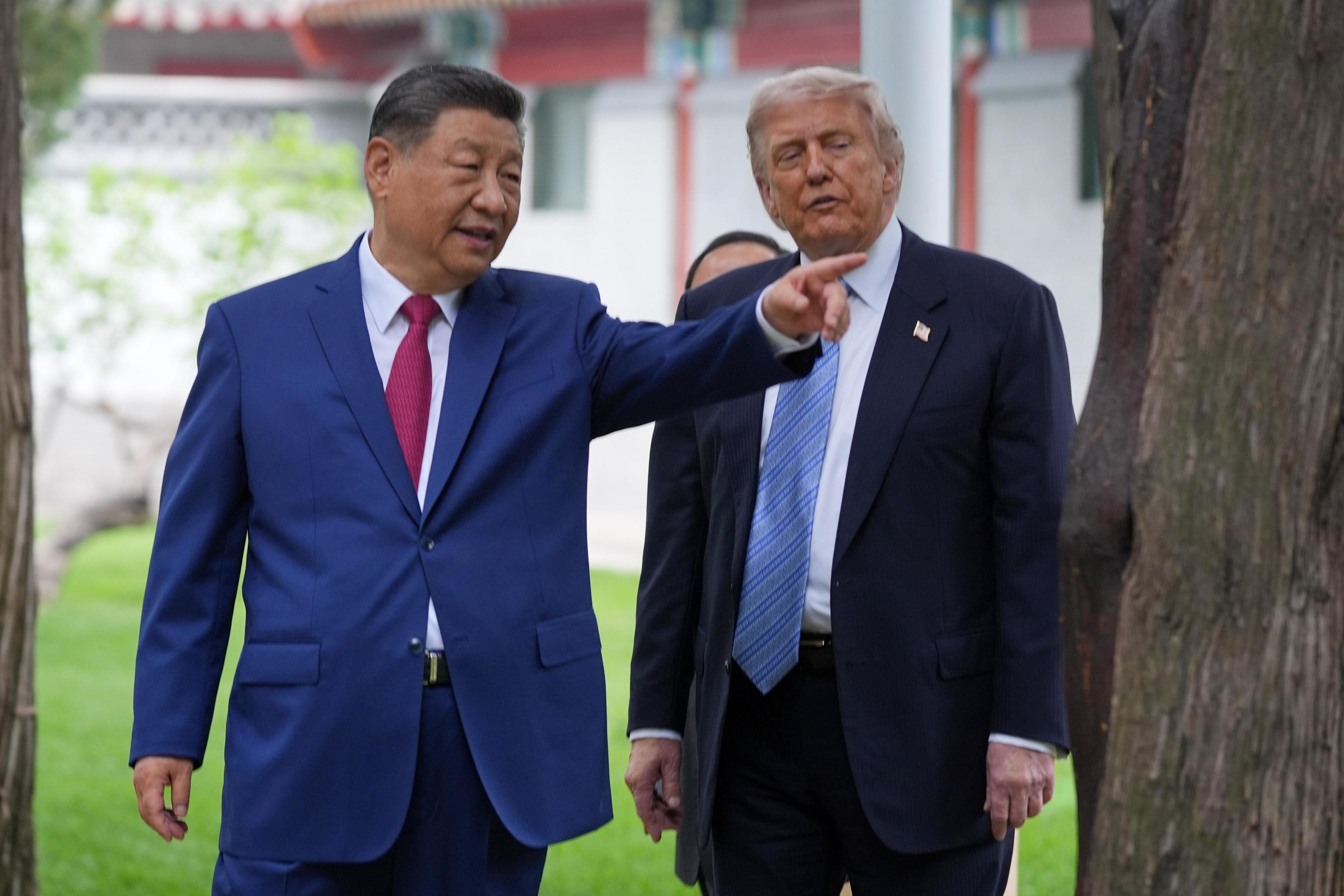
Vladimir Putin is eager for a photograph that would represent his greatest diplomatic victory since launching the invasion of Ukraine: sitting at the same table as Donald Trump and Xi Jinping to discuss the future of the world.
The setting would be Shenzhen, the tech city in southern China that will host the APEC summit (Asia-Pacific Economic Cooperation, an annual regional meeting) on November 18 and 19. But there is a problem: the host has not yet given the green light for this meeting to take place.
According to a report on Tuesday by the Financial Times, Washington and Moscow are pressuring Beijing to organize an unprecedented meeting between the leaders of China, Russia, and the United States. The Kremlin spokesperson, Dmitri Peskov, has stated in recent weeks that the three administrations are working on this possibility.
From Beijing, however, only contacts regarding a bilateral meeting between Xi and Putin, and another between Xi and Trump, are acknowledged, without committing to the trilateral format.
The Chinese resistance was highlighted on Monday by a revelation from German President Frank-Walter Steinmeier. During his official visit to the Chinese capital last week, he asked Xi about rumors of a possible summit with Putin and Trump regarding Ukraine. He later recounted that the Chinese president seemed surprised and assured him that there were no preparations for a three-way negotiation regarding the war. Xi, according to Steinmeier, argued that European countries should have representation in any meeting addressing the end of the war in Ukraine.
Last month, it was the Wall Street Journal that revealed that Putin had proposed to Trump the possibility of a trilateral summit during a call on October 9, with the aim of discussing the war in Ukraine without Volodymyr Zelensky or Kyiv's European allies. For the Kremlin, several analysts noted at the time, this meeting would be more than just a pathway to a ceasefire: it would be an opportunity to return to the club of powers that decide the fate of other nations.
Looking ahead to what will ultimately happen in Shenzhen, it is inevitable to draw historical comparisons with Yalta, the 1945 conference where Roosevelt, Churchill, and Stalin discussed the future of post-war Europe. Putin aspires to regain that logic of spheres of influence, although the parallel has its limits. Russia retains a massive nuclear arsenal and a permanent seat on the UN Security Council, but the invasion of Ukraine has made it much more economically dependent on China.
On Trump's side, he continues to move closer to Moscow: he has facilitated a deal on Russian diesel, halted new sanctions, and criticized Zelensky for attacking Russian oil facilities. According to some U.S. media in recent weeks, the Republican now wants to steer the possible meeting in Shenzhen towards nuclear control. This is something China resists because its arsenal is much smaller than that of the U.S. and Russia.
For Xi, presiding over a table with Trump and Putin would reinforce his image as a global arbiter, something that Chinese propaganda has been promoting for years. However, this summit would overshadow the entire economic agenda of APEC and would not help to redirect relations between the European Union and China, which have recently been strained by threats of a trade war.
And one must not forget the most sensitive issue for Xi: Taiwan. The image of three powers negotiating the fate of another country would rekindle fears that the future of the island could someday be discussed without its representatives.
Trump Also Wants a Face-to-Face with Kim
This month's frantic diplomacy has another protagonist: North Korean leader Kim Jong-un. Trump seeks to regain direct contact with the North Korean dictator and has explored a meeting during his Asian trip. They held three historic meetings in 2018 and 2019 in Singapore, Hanoi, and the border between the two Koreas, without achieving a lasting agreement on Pyongyang's nuclear arsenal.
The White House has explored contacts, but this time silence is coming from Pyongyang. Reuters reported last week that U.S. and South Korean officials increasingly consider a meeting this year unlikely: Kim has not responded to Washington's proposal.
With two weeks to go before the APEC summit in Shenzhen, neither of the two photographs Trump is pursuing is guaranteed. Putin dreams of discussing the future of Europe without Europeans. And Xi, the man who would have to open the door to the table of three, weighs whether it is worth doing so.