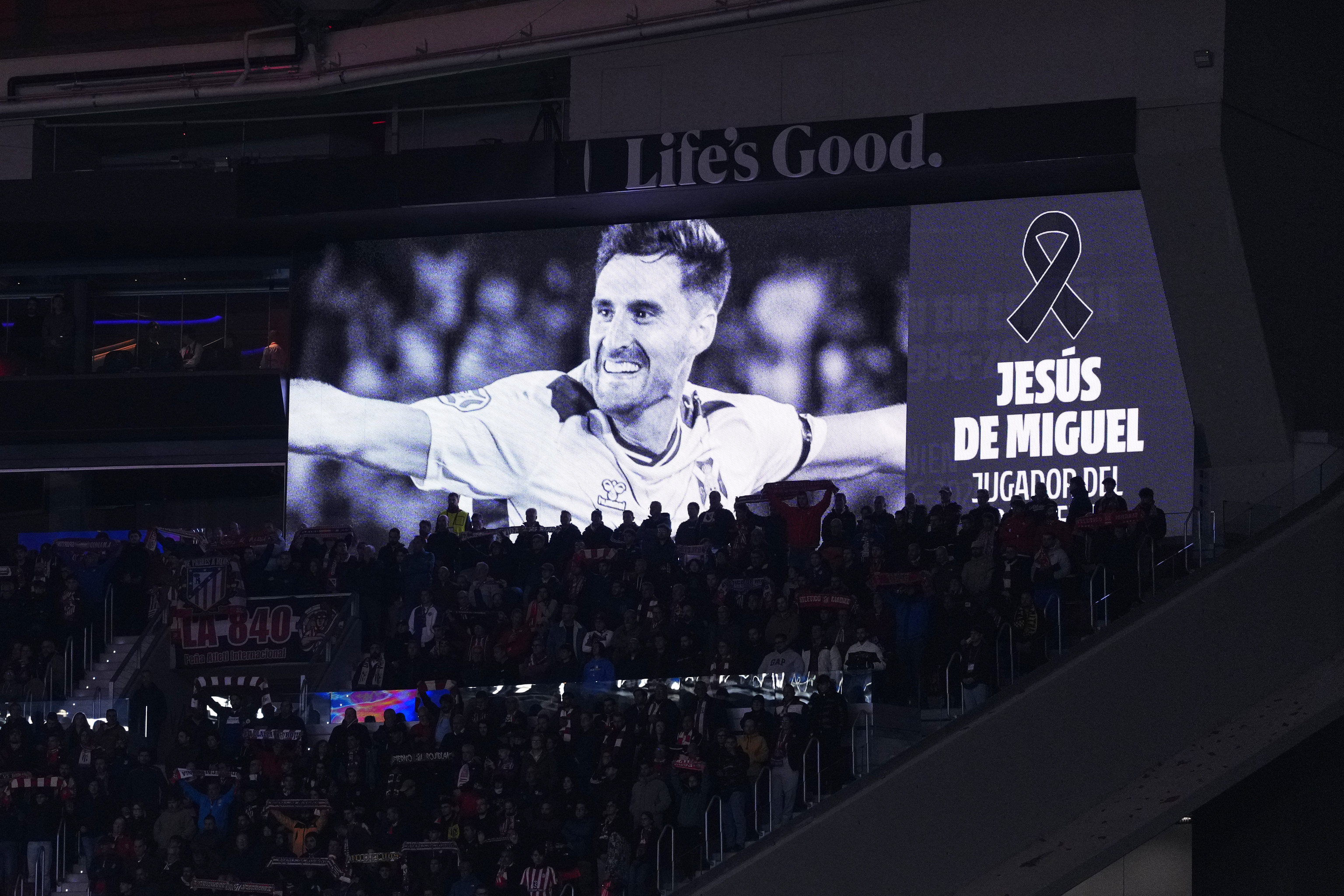
The CD Tenerife forward Jesús de Miguel passed away yesterday, Tuesday, in the ICU of the University Hospital of Nuestra Señora de la Candelaria, where he had been admitted after the chilling tackle made by Jesús Owono, goalkeeper of Andorra FC, in the midfield of the Heliodoro Rodríguez López on Monday afternoon. His death has shocked the football world and the island, which has rallied to support his family and teammates while attention now turns to the moments following the impact. The ambulance not entering the field, the rushed transfer on the stretcher, the resuscitation efforts by the medical staff...
De Miguel was taken on a Red Cross stretcher to an ambulance located on La Mutine street, next to the changing rooms, but which did not enter the stadium. He was transferred to La Candelaria Hospital, where he arrived stable but in serious condition. Early in the morning, his neurological state worsened, and at 8:00 AM, the fatal outcome was confirmed. National Police have opened an investigation that is already under judicial supervision, but the forward's death has raised questions that go beyond the sporting and criminal responsibility that may fall on the Andorra goalkeeper. The most obvious is: what decisions were made in the minutes following the terrible collision?
Jesús de Miguel was left unconscious on the field and suffered a cardiac arrest. Although details have not emerged, all indications suggest he suffered commotio cordis, a sudden death event caused by a blow to the heart. He regained his pulse thanks to the cardiopulmonary resuscitation (CPR) maneuvers performed by the medical teams already inside the ambulance.
The broadcast of the match did not focus at any moment on the location where De Miguel was being treated. It centered on the distraught faces of the players, who were crying and praying. In the stands, the 13,907 spectators were also aware from the very beginning of the seriousness of what had occurred. The delay in evacuating the player also raised alarms at the hospital that was awaiting his arrival. After being admitted to the ICU, the doctors analyzed the videos and images recorded by fans that were published throughout the night on social media. It was then that questions multiplied in the hallways of what is known as La Residencia: "Why wasn't an IV started, or a vacuum mattress used, or a scoop stretcher employed?"; "Why did he go into fibrillation and why wasn't the AED (automated external defibrillator) used?"; Was it treated as a trauma or as a cardiac arrest? Because a person in a state of total instability with vital compromise should never be moved," the doctors questioned.
The same happened in various parts of Spain. "I was struck that an ambulance did not enter the center of the field. We need to know what happened. Given it was a sternal and costal trauma, it could have even caused a cardiac rupture, which is difficult to manage. It's frustrating not to have measures in place at 100%," said a high-level health executive. "If it is confirmed that a guy was in VF (ventricular fibrillation) for 20 minutes in a stadium without assistance or defibrillation, we must get to the bottom of it. It is unacceptable for this to happen again," wrote Felipe Díez del Hoyo, interventional cardiologist at Hospital 12 Octubre Madrid.
Ambulance entry via San Sebastián
More doubts. The Heliodoro Rodríguez López stadium will celebrate its 100th anniversary in 2025. It has been owned by the Cabildo of Tenerife since 1972 and CD Tenerife has used it since then under a usage agreement. Its modernization has been under discussion for years. Its safety protocol establishes that players should be evacuated on a stretcher to the ambulance waiting on La Mutine street, under the Tribune stand, near the changing rooms. However, the ambulance can access the field through the San Sebastián stand, the only one that connects the street directly to the playing field. For example, the Three Wise Men access through there when they visit the stadium on January 5. The protocol states that the emergency vehicle can only access the field when the doctors declare "an absolute immobilization protocol for the patient," which did not occur.
Another aspect to uncover. The Red Cross has been present at CD Tenerife matches at Heliodoro for over 70 years. They are responsible for preventive and health tasks, both for players and spectators. After the incident, attention has turned to how players from Tenerife and Andorra had to help carry the stretcher to where the player lay and, subsequently, helped to remove him from the field, with Gomis, a Tenerife player, leading the transfer.
"There are many deficiencies that go beyond the physical condition of many of the Red Cross members. We knew that sooner or later a tragedy like this would happen. Many do not have the necessary qualifications or training," explains a former Red Cross technician who worked for them at Heliodoro for nearly two years. "In the first aid kits, you didn't even know what you had. Many times there was expired material or it was sealed, and you weren't allowed to open it, so you didn't know what was inside. I attended to a hypoglycemia: I asked a supposed medic for a glucometer, and he gave me a pulse oximeter. Some of us brought our own first aid kits," he recounts. He left due to experiences like those at the Ed Sheeran concert in June 2024 or the Spanish national team match in November of that same year. "On those days, many people from the Red Cross who did not have qualifications or were in the process of obtaining them signed up for preventive duties. They had no idea how to act. There were even people who were not in the Red Cross, like a beach lifeguard," this source denounces.
Doctor Guillermo Burillo, associate professor of Medicine at the University of La Laguna and scientific secretary of the Spanish Society of Emergency and Urgent Medicine (SEMES) in the Canary Islands, followed the match on television and admits the complexity of what occurred. "My first impression was that it was a cervical spinal injury until I later saw in the images that it was a blow to the chest, at the level of the sternum."
A national reference in the management of emergency patients, he states that what happened has been "unfortunate," as it is an unprecedented event in Spanish football but has been resolved in American football, where player Damar Hamlin of the Buffalo Bills survived in 2023 from commotio cordis after receiving CPR at Paul Brown Stadium. "The order in a trauma is ABC: airway, breathing, and circulation. But normally it is more of a trauma than a cardiac arrest. You don't go out with a defibrillator to attend to a player; you usually think more of a traumatic pathology. It is extremely rare for this to happen. It has to be a very strong blow. Unfortunately, the autopsy will determine what happened and only those who attended to him know the sequence," concludes Burillo.