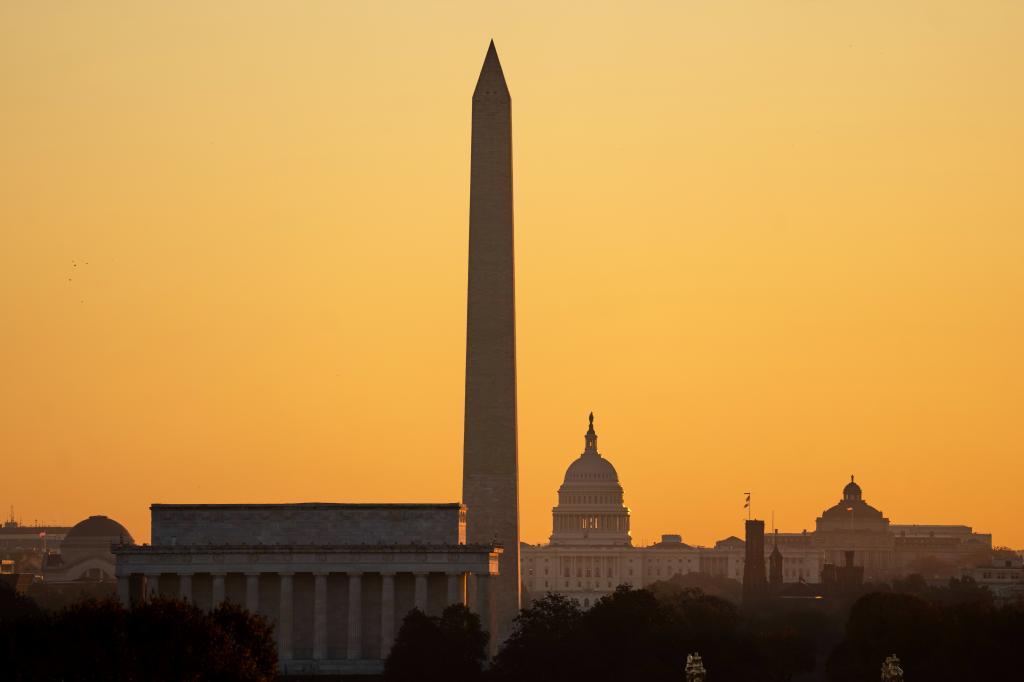
California Congressman Robert Garcia, until recently the number two of the House Oversight Committee, sent a brief statement to the press last night following the overwhelming Democratic victory in the midterm elections. After the win, Garcia will assume the chairmanship of the Oversight Committee, where he has committed to "combat the Trump crime family, corporate corruption, abuses by the Department of Homeland Security and ICE, and the cover-up of Epstein's files". His statement contained just two words: "Lawyer up". Start looking for lawyers.
The blue tsunami that has returned control of both chambers of Congress to the opposition to Donald Trump will have many consequences, some of them immediate. The outgoing legislature has shown the weakest, most exposed, and submissive side of the Legislative Power. The Republicans had a very slim majority, but the Democrats were completely lost after the 2024 presidential elections. Without leaders, suffering from a devastating identity crisis, lost in debates and internal criticisms, without direction or compass, consumed by identity issues and the clash between pragmatism and the woke soul. They were unable to confront the president on anything during his first year, and in the second, they struggled to get the machinery going.
But now, with a clearly weakened Trump, who has shown his most vulnerable side, questioned by voters and by his congressmen and senators, the story could be very different. Congress has enough power if it can activate itself, and in the past, it has been a formidable machine of checks and balances. The progressive obsession is to sweep away Trumpism and close the MAGA era by 2028, and that is why the first message from the new majority is that they will not only use this majority to counter tariffs, Trump's economic policies, and the Iran war, but also to go after the president and his team. Both civilly and criminally.
Starting in January 2027, when the new Congress takes office, the Democrats will have the ability to block legislative initiatives, halt or condition their appointments, and, above all, launch an intense offensive of oversight and investigation into his Administration. This includes impeachment trials and attempts at removal. The main headache for Trump and his inner circle will be the congressional investigations. The Democrats have already announced that they will use their new powers to examine possible cases of corruption, conflicts of interest, and abuse of power within the Administration, as well as the president's business dealings and those of his family and allies.
They will be able to subpoena agency heads, bring Administration officials to Capitol Hill for public hearings, and investigate the president and his allies. "We will have a Congress that recognizes we do not work for the president", warned last night the outgoing minority leader in the House of Representatives, Hakeem Jeffries, who is now poised to become the next Speaker of the House.
The available material is vast, and that is why the president, over the weekend, openly stated that he was considering granting preemptive pardons to his top collaborators, or to Elon Musk (not only the richest man in the world but also the one who led DOGE, the initiative to dismantle the state in the name of efficiency). Joe Biden paved the way by protecting his family and some of his administration's targets days before leaving office, and Trump has been clear since then about how he would proceed. It was, in fact, the implicit commitment for much of his team, which has acted blindly following his orders, to the limit or beyond without shame, feeling completely covered.
The juiciest aspect, given the precedents, is attempting to take down the president. Therefore, it cannot be ruled out that the Democrats will push for a new impeachment process against Trump. They did it twice during his first term. But one thing is to open it or for the lower chamber to support it, as happened then, and another to succeed in getting him out of the White House. To convict him and remove him from office requires two-thirds of the Senate, a majority that the Democrats do not have. They could reach 56 or 57 if they manage to win in Alaska or Mississippi, but even then, they would need about 10 Republicans to take that drastic step. There were a few willing, but it ended up costing them dearly.
In any case, Trump faces two years in which he will have to defend himself against an offensive of investigations, appearances, subpoenas, and possible revelations that could further weaken his presidency. Control of Congress is also in the United States a formidable tool for setting the media agenda, the topics discussed every day.
The first target, without a doubt, is his Secretary of Defense, Pete Hegseth. He is not only one of the most detested by the Democrats, and not just because of the Iran war. He is also the weakest link, who has the most enemies everywhere, probably the easiest to send a message. Perhaps without even waiting until January. Campaign rumors suggested he aspired to be appointed senator from Tennessee when Masha Blackburn, the current occupant of the position, leaves to become governor of the state. His head would be more than a symbolic victory.
The second is the FBI director, Kash Patel, accused of misconduct in office, using the organization's resources for private jet travel or protecting his girlfriend. He has been singled out for a recent trip to Moscow, for the unjustified dismissal of dozens of agents because in the past, while doing their jobs, they had investigated Trump or his allies. He is a figure with few friends and a clear target.
With the results that have emerged, the White House loses control of the legislative agenda. It is not that it has been precisely Trump's priority, who governs through executive orders, but they will find it almost impossible to pass laws and face enormous difficulties in appointing officials. The new Senate will be able to block presidential nominations, including judges and Supreme Court justices, if there are unexpected developments and any of the current ones decide to retire or pass away.
"Prepare for two years of total partisan warfare (...) I think Schumer and the Democrats will simply paralyze all judges, which means that if we have a vacancy on the Supreme Court, they will keep it open for two years (...) I also think we will see two years of relentless impeachments. I think the House will seek to impeach Donald Trump; they can do it several times. We will see subpoenas. We will see investigations. I think they will go after President Trump. I think they will go after his family and cabinet members (...) I assume that during the lame duck period we will see an impeachment of Pete Hegseth," declared influential Texas Senator Ted Cruz on television last night.
The presumed next speaker, House leader Hakeem Jeffries, has said that his priority will be to reverse Medicaid cuts, expand assistance under the ACA healthcare law, restore Congress's authority over tariffs, and stop the war with Iran. But among his ranks, there is a desire for Justice... and revenge. They want to settle scores after two years in which the Executive has acted with almost absolute freedom.
On election night, Trump posted a revealing image on his social media of a red war with the word VETO in capital letters. He had already said over the weekend that he would start vetoing everything if he lost Congress, but last night, in one of the many interviews he gave to analyze the results, he said with some sadness and resignation that he did not want to end his political days simply sitting and paralyzing the actions of his rivals.
The Oversight Committee, which Robert Garcia is expected to chair, wants to investigate the Trump family's wealth since their return to the White House, as they have made billions of dollars. Much of it in cryptocurrencies (while legislating on them), some in investments in companies that have received government contracts, and some through donations from foreign governments. Or directly through the use and abuse of insider information. The president has made a fortune in the stock market over these two years, with thousands of trades, some just before major political decisions that moved the market.
The Trump Family
There is already extensive prior research on the role of Donald Trump Jr. and Eric Trump—who run the family holding company—regarding their investments in crypto companies and venture capital funds that may have benefited from government contracts or decisions. There is also research on Jared Kushner, Trump's son-in-law, regarding his international business dealings and his relationships with foreign investors, particularly those from the Middle East, while he serves as one of the administration's two lead peace negotiators in that very region. Another example: Congress could investigate who authorized the visas for Flávio Bolsonaro—the Brazilian senator who fled his country after losing the election to Lula a few weeks ago and has taken refuge in Florida—and on what grounds. But there is much more on the list.
The Epstein case is one of the issues the Democrats want to turn into one of their major political battles. Garcia has announced his intention to hold public hearings to clarify how the Department of Justice handled the release of documents related to Jeffrey Epstein and why certain files or pages have not been made public. Among the key figures to be examined is Todd Blanche, who has served as attorney general since Trump fired his boss, Pam Bondi, regarding the handling of the case and the decisions made by the Department of Justice.
Garcia también quiere investigar las condiciones de encarcelamiento de Ghislaine Maxwell, la ex pareja, amiga, confidente y socia de Epstein y la única condenada hasta el momento. Cumple pena de prisión pero tras entrevistas privadas con Blanche fue cambiada a una cárcel más suave y se especula si a cambio de promesas de exculpar al presidente de cualquier comportamiento ilícito.
Los abusos del ICE y las actuaciones del Departamento de Seguridad Nacional son críticas para los demócratas y para millones de ciudadanos por todo el país. Dos de las imágenes más poderosas de la noche se vieron en Mineápolis y en Houston, donde cientos de votantes llevaron las pegatinas que en Estados Unidos dan en los colegios electorales para que los ciudadanos luzcan que han ejercido su derecho a los lugares donde fueron abatidos Alex Pretti, Renée Good o Lorenzo Salgado Araujo. García ha anunciado que investigará las actuaciones de los agentes de inmigración y las posibles vulneraciones de derechos civiles durante las operaciones de deportación de la Administración Trump. Ahí los principales responsables que podrían comparecer son Kristi Noem, ex secretaria del Departamento de Seguridad Nacional. Gregory Bovino, el cesado jefe de la patrulla fronteriza. O Tom Bohman, el zar fronterizo migratorio de Trump.
The future chair of the House Judiciary Committee, Democrat Jamie Raskin, also wants to investigate whether Trump used the Department of Justice and the FBI to target his political opponents. Among the names that have come up in this line of inquiry is James Comey, former FBI director, whose prosecution could be examined to determine whether it was politically motivated. Letitia James, New York's attorney general, is also the subject of legal proceedings initiated by the administration. John Brennan, former CIA director, is under scrutiny for investigations and actions directed against former intelligence officials. And advocates for the $1.8 billion fund launched by Trump to compensate people who claim to have been victims of the federal government's alleged political manipulation. That is, his allies, including those convicted of storming the Capitol in 2021. One of the FBI directors in Chicago filed a complaint this week regarding his dismissal, arguing that it occurred because he refused to prosecute Trump's enemies.
A particularly sensitive issue for the president is the new White House ballroom—his great obsession, which he talks about nonstop—and government contracts. The investigation could extend to contractors, donors, and businesspeople with ties to the president to determine whether promises were made in exchange for financial contributions.
The Armed Services Committee, which is expected to be chaired by Democrat Adam Smith, wants to investigate Trump's decision to go to war with Iran, the legal arguments used to justify it, and the lack of prior authorization from Congress. They are also seeking an in-depth analysis of U.S. military casualties, civilian casualties, damage to bases in the Middle East, and information provided by Israel. This includes attacks on vessels suspected of transporting drugs in the Caribbean and the Pacific, which have killed dozens of people without any scrutiny.