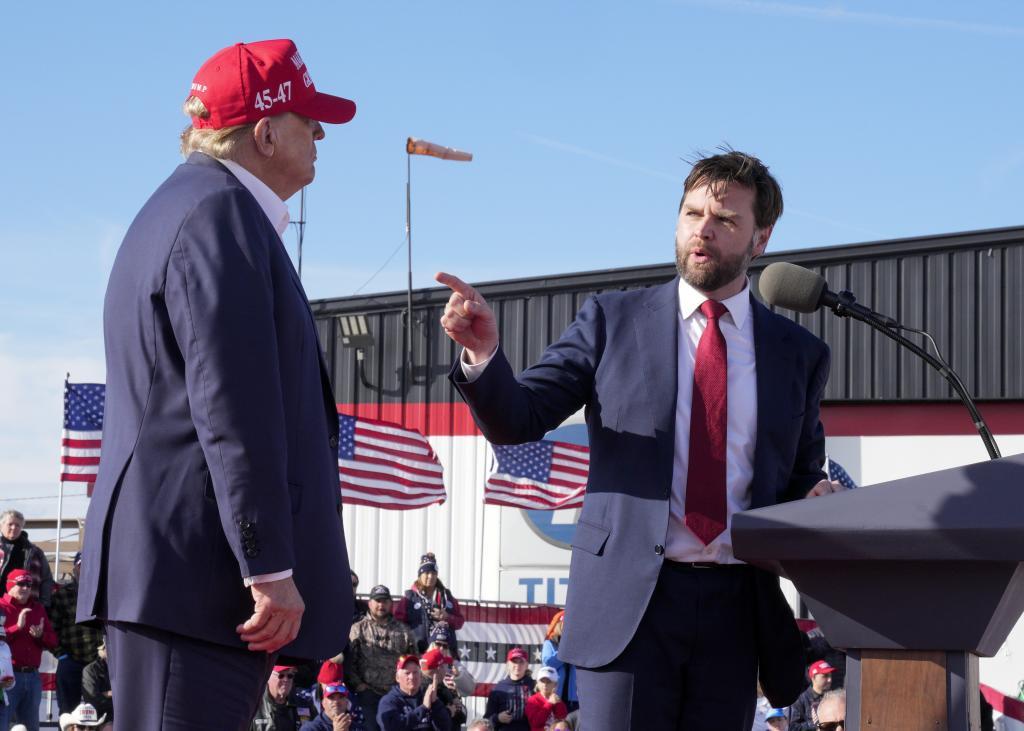
The electoral campaign for the 2028 presidential elections began Tuesday night, shortly after 10:00 PM Washington time. At that moment, with both chambers of Congress in Democratic hands, President Donald Trump began speaking with reporters, taking calls, and acknowledged that his party had suffered a crushing defeat. He did so by admitting that the Iran war bore some responsibility, more or less. That he would have to collaborate with the opposition. But he washed his hands of what happened: "I wasn't on the ballot," he defended himself after months of asserting just the opposite and turning the midterms into a referendum on his management and agenda.
The devastating defeat revealed the weakest and most vulnerable Trump to the country. The Trump Lame Duck, the Trump who will leave office in two years and who has fractured the MAGA movement. And it opened the door to start thinking about his replacement. Twelve hours later, the Vice President of the United States, JD Vance, was the first to step up, in a direct, aggressive, and above all very risky manner. Positioning himself without saying it and in an unprecedented way, because he did so by contradicting the president, challenging his narrative about the war, and shouting from the rooftops that the reason, the evident cause of the 'blue tsunami' last night is Iran. And therefore, the reason and ultimate responsible party is Donald Trump.
The clash is full of nuances, derivatives, and conflicting interests. Throughout Wednesday, Trump was repeatedly asked if he truly accepted that the defeat was Iran's fault, and therefore if he regretted it or would end hostilities once and for all. Trump, in his own way, admitted that the thesis of Iran's blame "is largely true," but quickly emphasized that "if I had to do it again, I would have to do it again. They can't have a nuclear weapon..." he said, referring to Tehran. In other statements, he clarified that the problem was not the intervention in the Middle East itself, and that people were with him on that, but the consequences. And that perhaps his administration had not explained it well.
His position is contrary to Vance's, although they may seem similar. But for the same reasons. Vance, who since February has been placing the narrative that he was almost the only one in the administration opposing bombing Iran, unlike, for example, Marco Rubio, has taken a bold move. He is aware that it is very difficult, impossible, to be president without the explicit support and endorsement of Donald Trump. But he also knows that he has lost initiative to Rubio, that he does not have the necessary popularity. The campaign has shown that. And that following Trump's agenda for another two years would end his aspirations. So he has made a bet.
He argues that the Iran war is the sole reason for the defeat. But it is not an exercise in intellectual honesty and pure self-criticism, but a campaign move. Vance claims that the war is to blame because he opposed it and advocates for stopping it now, not because it is the only explanation for the Democratic tsunami. Probably inflation is the most determining element in American discontent, as it was with Joe Biden. But there are many more reasons in the amendment to Trumpism; deportations, rampant corruption, abuses of power, the destruction of institutions. But Vance, like Trump, supports all of that. Therefore, to impose his narrative and gain advantages over potential rivals, he needs there to be only one very specific cause. The one that benefits him.
In a lengthy post on his X account, the vice president began attacking Republican strategists, who despite the clear numbers in the polls continued to sell the White House a sweetened narrative about the "composition," that is, whether the electorate felt close enough to 2024 for Republicans to win." Translated: they told the president that if the voter thought of him, victory was possible.
While Trump washed his hands last night, defending his policies, saying that it was all the fault of bad candidates, the media, or that citizens have become obsessed with inflation and prices (but insisting that they supported his foreign policy), Vance takes the bull by the horns and urges the conservative world not to deceive itself. "The main problem is that many people who voted for Trump/Vance in 2024 voted for Democrats in 2026. There will be much internal confrontation and discussions about what happened and why. One of the pollsters I really respect told me that our economic message was not sharp enough in the end. I'm sure that's true. But the real reason we lost is obvious to almost everyone," he adds in his message pointing to Iran.
The final part of his tweet is the most important: "The reason we lost is the war. The president himself said it last night. If you want to argue that it was worth it, that losing the Senate for the next 6 years was worth it, then do it. Argue that it was a valuable cost to pay. Agree or disagree, at least that's honest," he wrote, trying to present his analysis as a continuation of the president's, when in reality it is an absolute amendment to it. Trump spoke of Iran, yes, and said it was relevant... but reiterated that he does not regret it and said he would do it again. In fact, when specifically asked about Vance's thesis, he reiterated that it was worth it. "Yes, it was, we had no other option."
In his reflection, Vance also outlines, with the defeat fresh and no time to lose, a roadmap that he believes the party must follow to avoid crashing in 2028. A path aimed at the MAGA world, with basic ideas. Trump's ideas... before returning to power.
1) End the war
2) Focus on the cost of living/inflation
3) Put America first
4) Change our relationship with Israel
Vance presents this as the voters' responses to questions from "one of the smartest pollsters" he knows. But it is clearly his own agenda for his nomination. And he settles scores. "The four previous reasons are why many voted for Democrats. While many spent Monday attacking Rachel Campos Duffy for calling for a diplomatic resolution to the [Iran] conflict, it turns out her political advice was solid. (She is also a great person)," the vice president notes, referring to one of the Fox network hosts, who in recent hours has been harshly criticized for stating that a peace agreement with Iran could be good for the world, but that Israel was not making it easy and pointing to Netanyahu.
"To the people who are furious and want to say 'I told you so,' they are right, they told us," he says... speaking of himself, of course, as he was one of the few to mark certain distances and tell Trump that this could happen. He then jumped on the bandwagon, but without the enthusiasm of those who told Trump that victory was certain and easy, like Secretary of Defense Pete Hegseth.