At Tokyo station, travelers line up perfectly at the platform markings. In front, the sharp white nose of a Shinkansen glides by, resembling an airplane fuselage. In a few minutes, the bullet train will depart, brushing against 300 kilometers per hour. Punctuality is a national obsession. But there is a much less glamorous rule: when the system responsible for ensuring safety fails, the priority is no longer to arrive on time. The first thing is to stop.
After an AVE rear-ended a stopped Iryo train on the same track in Urda (Toledo), we look to Japan and China, the two giants of high-speed rail in the East, to ask what these countries do to prevent a technical failure or a poor human decision from leading to tragedy.
"In Japan, safety devices and action manuals are designed and implemented following the principles of fail-safe and redundancy, meaning through multiple layers of protection," explains Takahito Sasaki, a researcher at the Japan Transport and Tourism Research Institute (JTTRI), to EL MUNDO.
The specialist points out that the fail-safe philosophy assumes that any device can fail. "When a failure occurs, even if its cause has not been identified, the system must issue instructions that allow for maintaining safety. It should never give indications that, if followed, could create a dangerous situation," he clarifies. The goal is to prevent an isolated failure from triggering a chain of errors with catastrophic consequences.
This also applies to the human factor. "We start from the premise that people inevitably make mistakes. That's why mechanisms have been introduced that allow, even when someone mistakenly orders a train to move forward, the system to issue a stop command and halt the train," Sasaki asserts.
This technological protection is complemented by a culture of prevention among railway workers: "Employees are trained to make the decision to stop the train without hesitation in case of any doubt about the safety of operations." The key, the researcher insists, is that no emergency decision is left to improvisation.
"There are no significant differences in the basic safety philosophy between the Spanish LZB and the Japanese ATC system," emphasizes Yutaka Yoshida, a professor of Transport Safety and former researcher at the JR West Safety Research Institute, in conversations with this newspaper. Spain also has automatic mechanisms to control operations. The fundamental difference, the specialist highlights, lies in the management of anomalies and the conditions required to restore service.
In Japanese bullet trains, "if the ATC information cannot be received correctly, the emergency brake will be activated." Yoshida notes that in the event of a loss of information or a technical failure, the system must automatically adopt the safest position.
"It is preferable to suspend the resumption of service until the ATC system is properly restored, rather than forcing the resumption", asserts Yoshida, who emphasizes that operations cannot rely solely on the driver's ability to observe what is happening ahead.
Japanese statistics support decades of investment in prevention. Since the first Shinkansen connected Tokyo and Osaka in 1964, no passenger has died as a result of a collision or derailment on the high-speed network. Its safety relies not only on onboard technology but also on constant monitoring of infrastructure.
For decades, one of its symbols was the Doctor Yellow, a striking yellow train that traveled the lines inspecting tracks, overhead wires, and electrical equipment. On October 26, just two days before the Spanish tragedy, its successor, the Doctor S, began operating with passengers. Unlike its predecessor, it will be a commercial train equipped with sensors capable of examining infrastructure during regular trips.
In an archipelago constantly shaken by earthquakes, prevention is also measured in seconds. Earthquake alert systems can automatically interrupt the power supply and activate emergency braking upon detecting the first waves of a quake. The railway company JR East, responsible for a significant portion of high-speed trains, has refined its earthquake alert systems to reduce the average time needed to interrupt the power supply from 3.9 to 1.3 seconds after detecting the first waves of an earthquake.
China and the largest railway network in the world
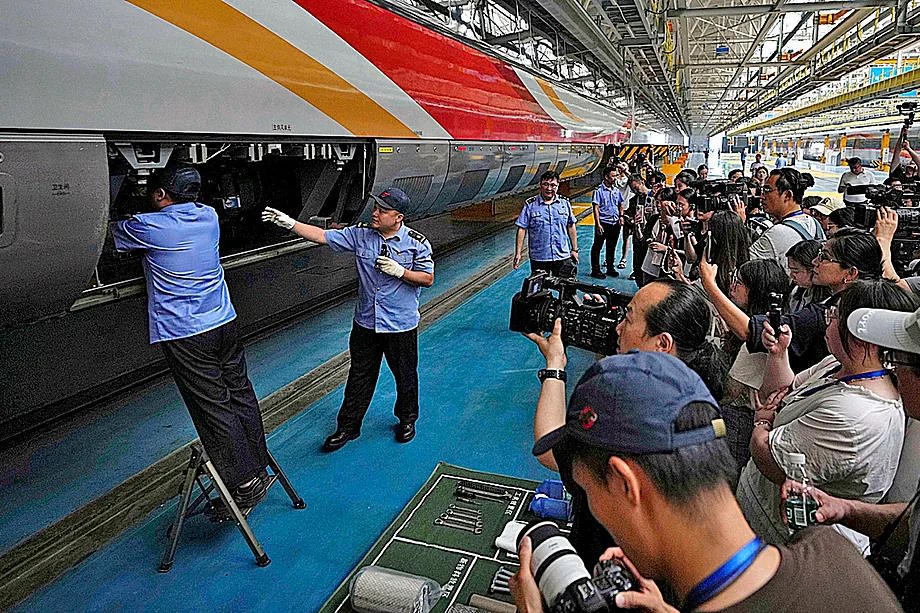
Neighboring China, which also boasts the modernity of its trains, faces another challenge: monitoring over 50,000 kilometers of high-speed rail, the largest railway network in the world, built in just two decades. Its engineers combine inspection trains, sensors, drones, and artificial intelligence.
"Safety is the lifeline of the system," says Liu Yan, deputy director of the Science and Technology Department of the National Railway Administration. "China has deployed 56,000 cameras at sensitive points along its railway corridors, especially at tunnel entrances and bridge accesses. AI algorithms can detect intruders and objects on the tracks.
AI is also used to anticipate extreme weather phenomena. Liu explains that in the railway corridors of the west, plagued by strong winds, the combined analysis of climate data helps decide when to reduce speed or suspend operations before conditions become dangerous.
But the Asian superpower has also learned through hard lessons. In July 2011, a signaling failure during a storm resulted in a collision between two high-speed trains near the city of Wenzhou. Forty people died. The official investigation uncovered design flaws and serious deficiencies in emergency management. More than 15 years later, researchers linked to the state giant CRSC have proposed a solution: to move part of the railway's brain to space.
A study released this year suggests using a low-orbit satellite network to transmit the position and speed of each train and manage their movement authorizations. The spatial data would be cross-referenced with ground sensors. The result would be a kind of digital nervous system less dependent on thousands of kilometers of cables and antennas installed alongside the tracks. The project, however, carries another risk: a cyberattack that could manipulate a train's location.
This week, from Beijing, the state agency Xinhua dedicated an extensive analysis to the cracks that the Urda tragedy has once again highlighted in Spanish high-speed rail. The publication addresses doubts about the maintenance and supervision of infrastructure, as well as the reliance on human decisions when automatic mechanisms fail. The agency also recalls the Adamuz accident, which occurred on the same Madrid-Sevilla line.
The debate comes less than a year after former Spanish Transport Minister Óscar Puente traveled to China to learn about some of the technological advancements of the Asian giant. The socialist visited testing laboratories and factories of trains capable of reaching 350 kilometers per hour. He also learned about Chinese innovations in signaling, safety, and railway maintenance, areas where both governments agreed to strengthen knowledge exchange. Cooperation that now takes on special relevance after the accident in Spain.
For Japanese professor Yoshida, the main lesson is not simply to install more sensors, multiply controls, or buy cutting-edge technology. It is about building barriers that continue to protect passengers even when a machine fails or someone makes a wrong decision.