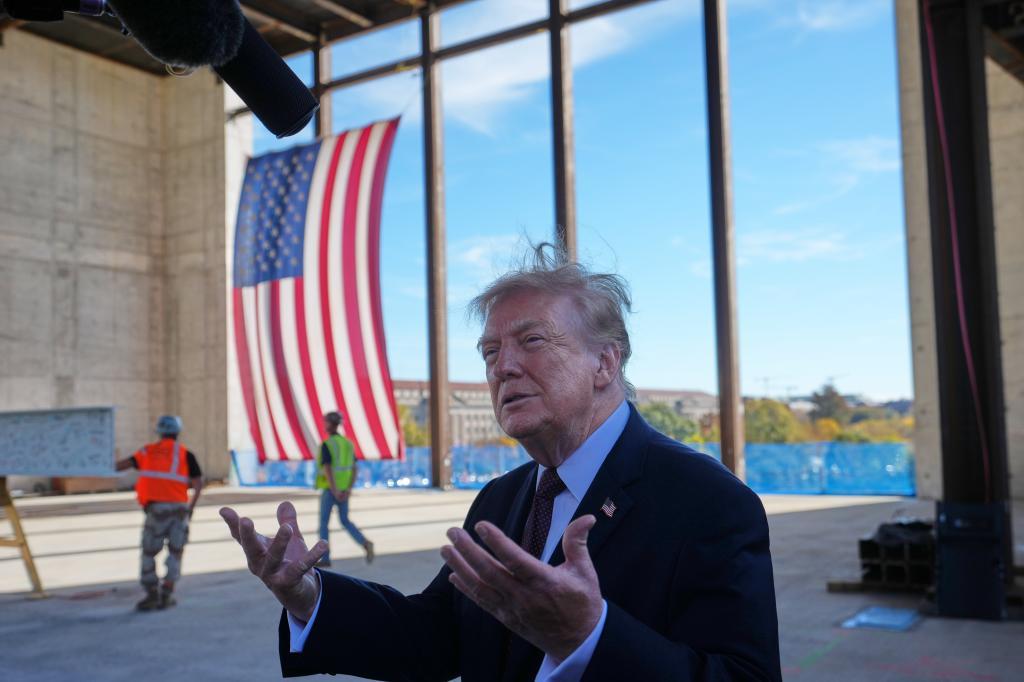
There are election nights that reward or punish leaders and parties, nights that change the distribution of power and cause tremors around the globe. And there are nights, few, that mark the beginning or end of an era. Tuesday's in the United States likely belongs to the latter category. For two years, Donald Trump has governed practically without obstacles, with the confidence of someone who knows no limits, almost blindly supported by a subservient party that has turned personal loyalty into a survival manual. Trump has governed without listening, punishing friends and foes alike, growing an opposition too weak to confront him. Trump seemed immortal, immune to everything, even the Capitol riot. A force of nature with a tight grip. Until now.
On a historic night, the Democratic Party achieved a resounding, overwhelming, total victory. A 'blue tsunami,' in American terminology, and a harsh punishment for the president and his ego. He turned the process into a plebiscite and lost. Although the exact results may take days, even weeks, to be known, progressives have unquestionably regained control of both chambers of Congress. They have gained key positions of governors, state legislatures, secretaries of state, judges. Two months ago, it was taken for granted that they would regain the House, though perhaps not by much, but it seemed impossible to achieve a flip in the Senate as well. Nothing could be further from the truth. The polls, especially those from the last week, perfectly captured the discontent and the spirit of the times. They predicted a victory, and it arrived, so clear that it has torn the seams of Trumpism.
Democrats will have, at a minimum, 54 of the 100 senators, but they even dream of two more, compared to just 44 Republicans so far. The same goes for the House of Representatives, The House, where they already have secured 237 seats, 20 more than necessary, but where they could add up to 30 more in the coming hours. Majorities more than sufficient to build a solid opposition, to oversee the Executive, to change the dynamics of the last two years. "Too big to rig," celebrated the result the likely new speaker, Hakeem Jeffries. A victory so large that neither the president nor his allies, who had been laying the groundwork and even started spreading false rumors on election day, can speak of fraud.
Americans who were able to vote for the first time were born with Obama in the White House and throughout their lives have had Trump perpetually in the news. The truly important aspect of the night goes beyond specific numbers, reflecting a massive weariness with a style of politics. A president can survive a defeat, especially if he emphasizes, as Trump did in the last 24 hours, that he "was not on the ballot" (after an entire campaign saying literally the opposite). But it is hard to maintain intact power when his own realize he is the problem. The big novelty of these midterms is that for the first time in over a decade, the question in Washington is no longer whether someone will dare to challenge the leader, but who will be the first and when, because they can no longer afford to wait.
The magnitude of the turnaround has exceeded the party's most optimistic expectations. To regain Congress, they needed victories in Republican strongholds. This is not just a figure of speech. Texas has not elected a Democratic senator since the late '80s. Kansas, since 1932, almost a century. South Carolina, similarly. There was also a 'flip,' a turn in local jargon, in North Carolina, Ohio, Maine, and rural Iowa. It even seems possible that Alaska and Mississippi could turn blue. All states that in 2024 gave Trump advantages of 10 or 15 points, or even more.
Democrats defended all key positions, such as Michigan or Georgia. They now control the government of nine of the 10 largest and most populous states in the country. They have massively regained the Latino vote and made inroads even among young people. They have placed the first Black governor in history, the first Hispanic governor in Texas, the first Native American in New Mexico, the first gay and the first Muslim in the Senate.
The result of the night opens de facto several avenues. On one hand, the 2028 presidential campaign, with candidates from both parties positioning themselves quickly. The first step was taken by Vice President JD Vance on Wednesday, pointing to the Iran war as the cause of the defeat and proposing a roadmap that involves distancing from Israel and foreign wars, and focusing on domestic issues, to avoid being overwhelmed in the next elections. On the other hand, important Democrats, senators, and governors, who have retained their positions and are already prepared on the exit platform.
The second is the institutional counterattack. Starting in January, Democrats will have the majorities, the institutional levers, and the political resources necessary not only to finally build a recognizable opposition but also to oversee the Executive, open investigations, block appointments, and turn the last two years of the presidential term into uncomfortable, very rough terrain. Many who previously remained silent out of fear now see an opportunity at last.
California Congressman Robert García, until recently the number two of the House Oversight Committee, sent a brief statement to the press on Tuesday following the overwhelming Democratic victory in the midterm elections. After the win, García will assume the chairmanship of the Committee, where he has committed to "combat the Trump crime family, corporate corruption, abuses by the Department of Homeland Security and ICE, and the cover-up of Epstein's files." His statement contained just two words: "Lawyer up." Start looking for lawyers.
Congress has enough power if it can activate itself and has been a formidable machine of checks and balances in the past. Progressives are obsessed with sweeping away Trumpism and the MAGA era in 2028, and that is why the first message from the new majority is that they will not only use this majority to counteract tariffs, Trump's economic policies, and the Iran war. But to go after the president and his team. Both civilly and criminally.
Starting in January 2027, they will have the ability to block legislative initiatives, halt or condition his appointments, and, above all, launch an intense oversight and investigation offensive against his Administration. Including impeachments, processes that could lead to removal. The main headache for Trump and his circle will be the parliamentary investigations to examine possible cases of corruption, conflicts of interest, and abuse of power, as well as the business dealings and activities of the president, his family, and his allies. They will be able to summon heads of government agencies, bring administration officials to Capitol Hill for public hearings. The first target, without a doubt, is his Secretary of Defense, Pete Hegseth. The second, the FBI director, Kash Patel. But the list is enormous, especially in the Department of Justice.
The third avenue is the most uncertain. On Wednesday, the president spoke of cooperating with his rivals, but he also posted on his social media an image of a red cap, the classic MAGA, with the word VETO. That will be what he has left if he cannot pass laws, make appointments, or secure funding for his ideas. If he is blocked. Aware and sunk, he lamented to one of the journalists he spoke with that he did not want to spend his last two years like this, simply "sitting and just blocking laws." Many, especially outside the U.S., fear that this internal impotence will unleash his darkest side abroad, from Ukraine to NATO. It is very possible. After 10 years on the offensive, it is time for him to go on the defensive. He is an 80-year-old man, with health issues, an increasingly incoherent discourse, running out of time. He is a lame duck, an enraged one, who refuses to accept setbacks and has more power than any of his predecessors. But a lame duck after all.