"Go downstairs, what are you doing here? Do you want an FPV [drone] to drop another bomb on you?". The video shows the last seconds before the tragedy. It reveals several civilians wandering in front of the entrance to the underground facility. The destruction caused by the initial bombs is also visible.
Then one of the agents is heard shouting: "Attention, attention, they have dropped [more] KAB bombs [powerful explosives weighing hundreds of kilos] towards Komyshuavakha! Quick, to the shelter! Hurry, everyone get in!".
Two men can still be seen hurriedly descending the stairs and reaching the old underground school. The last recording is of a young man smiling at the camera. At 0:59 a massive orange fireball fills the screen. Then nothing. All black.
The KAB-3000 M-54 were designed by the former Soviet Union to obliterate hidden underground facilities. And that's exactly what they did.
It was a direct hit. This Thursday, three days after the tragedy, dozens of rescue team members were still sifting through the rubble and earth of the massive cavity, almost as large as a swimming pool.
Trucks and excavators - several of them protected with cages to thwart drone activity - were collecting debris and clay, which they deposited on the sides. Several specialized dogs were sniffing through the ruins trying to detect more human remains.
The only thing left intact are two staircases leading to the lowest floor. A descent illuminated only by flashlights that ends in rooms blocked by cement debris, mixed with metal bars and a collapsed ceiling. The floor is carpeted with thousands of papers and some shoes.
The episode has been so bloody that the trucks of the NGO Proliska, which usually evacuate living people from threatened areas, are now transporting bodies, human remains wrapped in white plastic bags.
"Until Wednesday, we had taken 33", adds the head of that humanitarian organization, Yevhen Kaplin, who has traveled to Komyshuavakha.
But Oleg Buriak, one of the officials from the regional administration of Zaporiyia, is candid. Many bodies will never be recovered. They vaporized in the energy generated by the explosion.
"Those projectiles are designed to detonate at 50 meters. They penetrate the ground and then explode. They generate temperatures of thousands of degrees that burn everything. That's why everyone died. We are only finding pieces," he explains.
According to official records, the massacre in the Ukrainian village of Komyshuavakha, located just over 30 kilometers from the regional capital, Zaporiyia, has claimed 42 lives so far. Authorities say there are several dozen more missing.
The tragedy occurred last Monday when Russian aviation bombed the village with a barrage of KAB projectiles, as part of the offensive ongoing in this southeastern region of Ukraine.
The assault on the old school in Komyshuavakha, which was now serving as a humanitarian aid distribution center and provisional town hall, occurred in the morning in a double sequence.
The first devices devastated several nearby buildings, including one housing dozens of boxes of humanitarian aid marked with the initials of the International Organization for Migration or the NGO World Central Kitchen, and hundreds of bottles of drinking water. The shrapnel left several parked trucks nearby, including an ambulance, reduced to twisted scrap.
The KAB-3000 struck directly at the underground rooms where dozens of people had taken shelter. "We don't know how many people were inside. It could be more than 100. Keep in mind that many residents also used to sleep there thinking it was safer. Everyone who was below died. Only those on the first floor survived because the blast wave threw them outside," Buriak adds.
"This is one of the most serious mass murders Russia has committed in this war. We proposed to Russia to extend the ceasefire period that allowed the evacuation of people from Oleshky [a city in Kherson from which several hundred civilians left last week, isolated for months]. But the response has been this: more murders," commented Ukrainian President Volodymyr Zelensky.
The few neighbors still clinging to Komyshuavakha show up daily at the ruins of the school. Many come to ask about their loved ones.
Valentina, for example, still does not know the whereabouts of her son-in-law, Anatoli Martiroso, 45. He was one of the municipal workers repairing homes damaged by the conflict.
The center also served as a reference point for residents dealing with all kinds of paperwork. "We can't go to Zaporiyia, it's too dangerous", Valentina, 72, states.
The woman is shattered by grief. Her sobs interrupt her story at every moment. "I can't eat, I can't sleep, I have no strength!" she cries in a new outburst of sorrow.
"People gathered every Monday [like on the 2nd] to receive humanitarian aid and sort out their paperwork," she comments.
She was at home, not far away. She only remembers that when the KAB-3000 fell, she saw a "very bright light". Russian Telegram channels spread images of that exact moment. A gigantic mushroom of smoke and fire can be seen rising, accompanied by a kind of wave - the blast wave - sweeping through the village. A vision very similar to those offered by documentaries that recorded nuclear explosions.
"What have we done to [the Russians]?", she asks again through tears.
Valery Murmyl, 59, is another who has decided to brave the risk of approaching the scene of the incident to inquire about his wife Natalia, 58. They were together during the initial barrage.
"The Russians dropped five bombs near the school. Those didn't leave any injured or dead," he recalls.
After that scare, Valery decided to go to his mother's house. Not even twenty minutes had passed when the KAB-300 fell. Natalia stayed in the shelter. He never saw her again.
"When I returned running, everything was filled with smoke and dust. We were all civilians. There were no children anymore because they were evacuated earlier this year when the Russians started dropping KAB on the village," he says.
This information is corroborated by Oleg Buriak. Zaporiyia is perhaps the region that has built the most educational facilities of this type since the beginning of the full-scale invasion. There are 30, according to his records.
Some, like the one in Komyshuavakha, have been converted into shelters and humanitarian aid centers when the child population has been forced to flee these enclaves.
"Another school, in Balabyne [another village in the province], suffered some damage in September when the Russians dropped another KAB bomb on a nearby bus stop. We evacuated all the children the next day," Buriak clarifies.
The Russian offensive towards the village of Zaporiyia has stalled both to the west and south of that enclave. Moscow has responded by intensifying its bombings. The head of the Russian General Staff, General Valery Gerasimov, stated on October 16 that his troops are five kilometers from the regional capital, the city of Zaporiyia, a claim denied by all Ukrainian spokespersons.
The think tank Institute for the Study of War estimated around that time that Russian forces remain bogged down about 20 kilometers from the province's main metropolis, a fact this correspondent was able to confirm by traveling through several towns in the south and east of the population.
Rescue efforts in Komyshuavakha are being severely hampered precisely by the intensified harassment from the Moscow army.
In fact, members of the first aid teams are being protected by a whole cohort of soldiers equipped with rifles and shotguns, who fire intermittently at the small FPV drones that are a constant presence in the skies over the village.
The road connecting the area to Zaporiyia bears witness to countless vehicles that have been unable to complete the journey. Their charred remains lie scattered on the asphalt. It is too dangerous to send a tow truck to collect them.
The anti-drone net tunnel that theoretically protects it shows more than half a dozen FPVs trapped in the mesh.
"Look to the sides and the sky! They often sneak into the net tunnel in this area!" warns Serhiy Skibchyk, a member of the 65th Mechanized Brigade operating in Zaporiyia.
Walking through the deserted streets of Komyshuavakha is to traverse an almost ghostly space where pedestrians are as rare as vehicles. All have been driven away by the perpetual buzzing that forces visitors to seek refuge in empty houses, waiting for the flying devices to move away from the area.
Komyshuavakha is a village dominated by low houses. These typical brick constructions with traditional wooden roofs are characteristic of Ukraine's agricultural regions. Very few have not lost their roofs or walls. The dirt paths are also dotted with some burned vehicles.
The detonations of the KAB do not cease during the movement. At 9:30, a trio of booms follows. "More KAB!" shouts Serhiy. He immediately points to the sky. A huge column of smoke rises not far away.
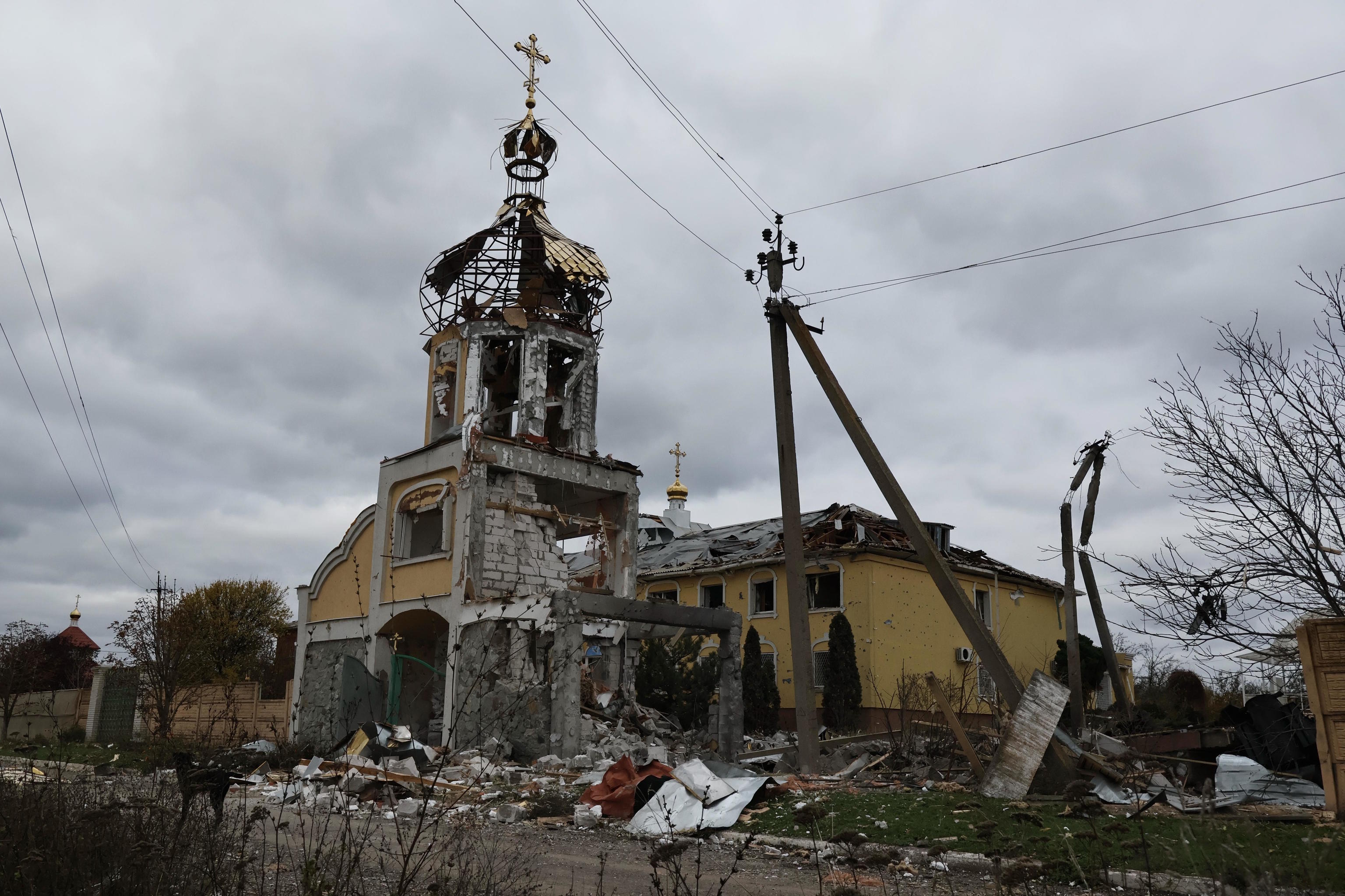
The devastating damage caused by these devices to the village has reached the convent of Santa Isabel. The large tower that presided over the complex suffered most of the damage from another KAB dropped by the Russians on the same day, the 2nd.
The shockwave ripped off doors, windows, and chunks of walls. Residents had to flee in a hurry. The dining room remains filled with plates of food they were enjoying: roasted sweet potatoes, cookies, and pieces of fruit.
The Russian action did not even consider the religious affiliation of the enclave, loyal to the Patriarchate of Moscow. It is the same church led by a staunch ally of Russian President Vladimir Putin, Patriarch Kirill.
The presence of the historic black-and-white photo of the former Russian Tsar Nicholas II, showing him with his wife and children, placed in one of the main rooms of the religious center, along with the dozens of books in Russian, confirms the affiliation of the nuns.
For Serhiy Skibchyk, the fact that Moscow's forces attack a religious building dependent on Moscow fits into the "logic" of Putin's regime. "There is nothing sacred to them. It's like asking a crocodile why it eats animals. It just does. They are Nazis, and that's why they destroy everything," he concludes.
Komyshuavakha has added its name to a grim ranking: that of the most brutal massacres of this war. In the future, it will be remembered alongside Bucha, the attack on the Mariupol theater, or the bombing of the Kramatorsk train station.
As the head of the Orthodox Church in Zaporiyia, to which the destroyed temple belongs, Archbishop Andriy Kovalenko, stated, we are living in "dark times." "It is hard to understand that sanctuaries and the peaceful lives of people united by a common faith and prayer are being destroyed," he added.