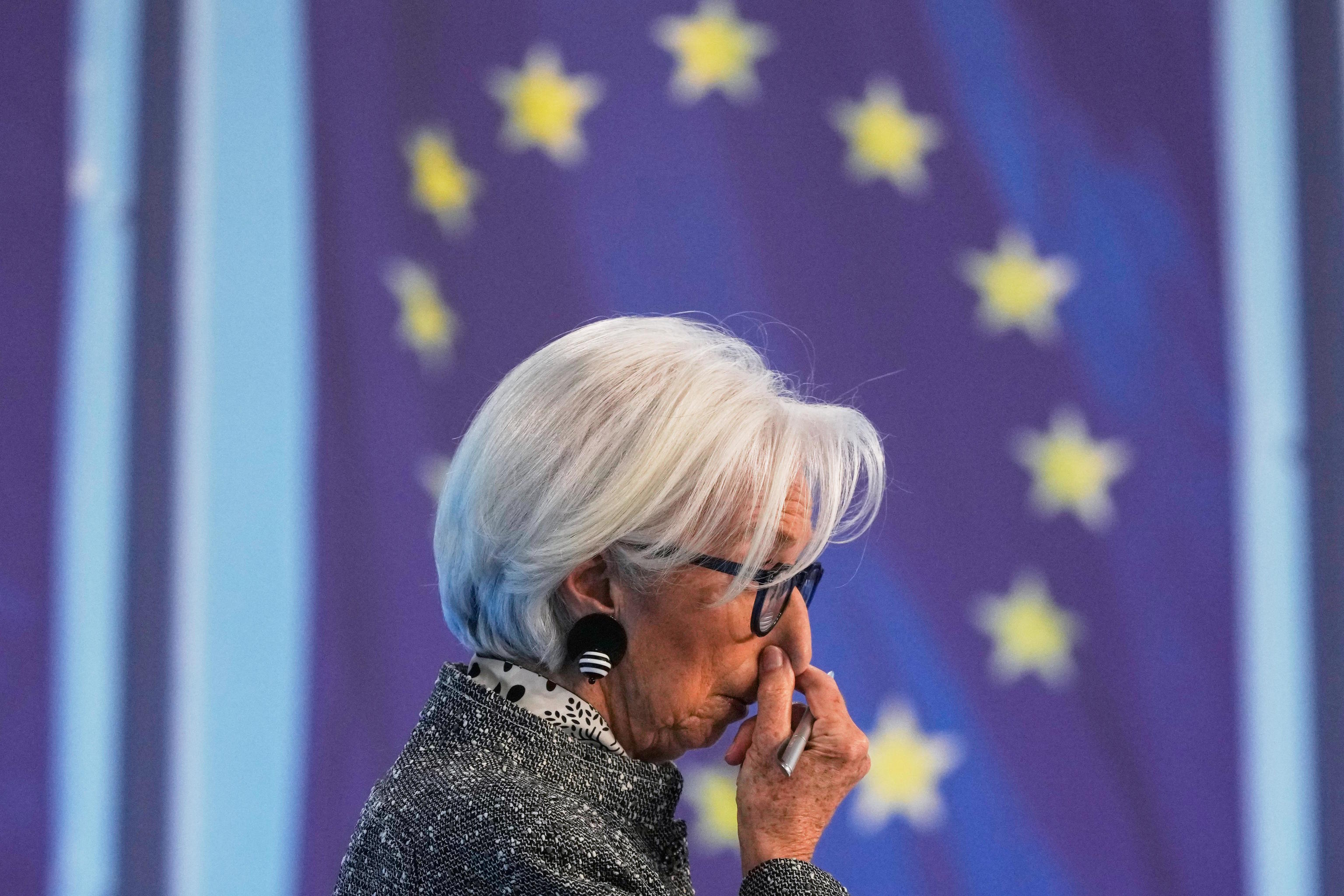
The Democratic victory in the midterm elections held in the U.S. last Tuesday clears the way for the last three months of Christine Lagarde's presidency at the European Central Bank (ECB). So far, the first impact has been the collapse of energy prices, mainly oil and gas, which would provide a respite for inflation; it repositions Europe on the global investment map if there is a slowdown, as expected, in investment in data centers and AI development, and, importantly, a better trade climate is anticipated between the EU and the U.S. after two years of unprecedented tension between the two global powers.
Lagarde will leave her position early (specifically, 8 months before) at the largest banking institution in the EU. She says she will do so to express herself "freely" in a context of strong geopolitical tensions, and some suggest she will play a significant role in the French electoral campaign next spring in favor of the French right. In making this decision, the need to renew the ECB's leadership before the elections in France or Italy, where anti-European forces could have a voice in the future mandate of the governors, weighed more heavily. Just months ago, Lagarde publicly denied her intention to "abandon ship" in the midst of a storm. Now, with the decision made, a less hostile climate in relations with the U.S. and a less autarkic presidency from Donald Trump favors a somewhat more comfortable end to her term.
The price of a barrel of oil has collapsed nearly 17% in less than fifteen days, and European natural gas another 14% just in the last week, although sales were mainly concentrated on the post-election day of Wednesday. Investors are pricing in a possible outcome of the war in the Middle East, which has constrained the global supply of refined products and put the European Union in a serious bind as winter approaches.
The high cost of fuels is a key issue for the ECB, after months in which energy inflation has accumulated double-digit increases: it was 14.3% in August, 18.9% in September, and closed October with a year-on-year increase close to 21%. "There are two key elements that we have seen" that have changed since the September meeting, Lagarde assured last week in Frankfurt, which influence the Governing Council to hint at a third interest rate hike in December. One of them "is energy prices" after a "significant" increase in the prices of oil, gasoline, diesel, gas, and all refined products. The other element that had changed was the rise in long-term financing costs resulting from tensions in the public debt market, led by France.
The latest quarterly forecasts from the ECB pointed to oil prices nearing $90 a barrel by December 31, dropping to $78 in 2027. Currently, in the futures market, oil is priced at $97 for January and $94 for February, above the central bank's estimates. However, the regulator was even more conservative in its estimates for gas, despite having significantly raised the expected price for year-end to €51 MGW/hour. Despite the recent drop, European natural gas is trading at nearly double, approaching €90, which means tripling the level it was at the day before the outbreak of the conflict in the East.
"We have moved from a world where inflation was persistently too low to one characterized by recurrent inflationary shocks; from a historically accommodative monetary policy stance to the fastest adjustment cycle in the ECB's history; and from a deeply integrated global economy to one increasingly shaped by fragmentation and geopolitical tensions," began Isabel Schnabel, a member of the ECB Governing Council, who will leave her position in December at the 'Money markets' conference held in Frankfurt.
Moreover, the Democratic victory anticipates a new cycle for companies linked to artificial intelligence. Analysts assume that investment in data centers will decrease and there will be more discussion about the speed of development of these companies. This, in principle, benefits Europe, where the weight of technology and AI in the market is negligible compared to the U.S. Within the MSCI Europe, the benchmark index for investing in the Old Continent, the largest company is ASML, valued at $612 billion, which supplies semiconductor manufacturers globally. Among financials, banks, insurers, and industrial companies, they account for nearly half of the market.
In contrast, if we break down the composition of its U.S. counterpart, just over 37% corresponds to technology, compared to 12% for financials or 10% for health sector firms. The most important company in the U.S. market (and the world) is Nvidia, with just over $5 trillion in market capitalization.
After an initial analysis, the more measured reading of the electoral result triggered massive selling in the Nasdaq 100 tech index, which fell by as much as 6% during the session. The capitulation was such that only Nvidia suffered losses of 8%, equivalent to about $376 billion, which added to losses of more than 10% for Tesla, and 7% for SpaceX—although at times they were higher, CoreWeave, a cloud infrastructure manufacturer for AI, dropped more than 12% amid concerns about its financing difficulties and doubts about whether such companies are being overvalued... and Anthropic is yet to hit the market. The company controlled by the Amodei family is counting down to its stock market debut, although market volatility could jeopardize it, especially its valuation. The company aims for a valuation between $1.5 and $2 trillion, which is 60% to 105% higher than what was expected before the summer, just as the market anticipates a rotation of assets towards more Europe and other sectors that had been left forgotten in a corner when everything revolved around AI.