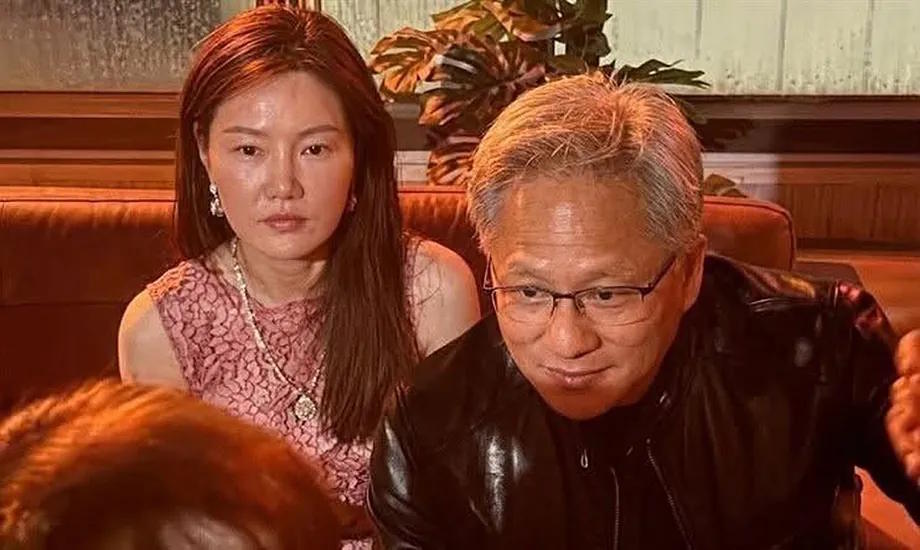
An orange light illuminates the interior of a bar in Taipei, where a group of tech executives has gathered for drinks after an industry fair. Among them stands Jensen Huang, president and CEO of Nvidia, with a glass of whiskey in hand and his signature black leather jacket. Beside him, in a photograph taken on a summer night in 2024, is Alice Huang, a Chinese businesswoman whose name at the time meant little outside tech circles. Two years later, that snapshot has become one of the images illustrating a espionage scandal at the heart of Silicon Valley.
Huang and Alice were having an affair. The 63-year-old businessman, of Taiwanese origin but a U.S. citizen, married and father of two, has admitted to being unfaithful to his wife. But this story goes far beyond an extramarital affair. A U.S. intelligence report claims that Alice had been recruited by the Ministry of State Security, China's main espionage agency, with the mission of obtaining information about Nvidia and attempting to influence the sale of its advanced artificial intelligence chips to the Asian giant.
The news has unleashed a storm in Washington. Because the protagonist is not just any businessman, but the man who leads the second most valuable publicly traded company in the world and the manufacturer of the most coveted chips, essential for the development of AI. And the woman sitting next to him in the Taipei photograph could be part of a calculated espionage operation by Beijing.
Alice, whose birth name is Huang Le, was an executive at Megaspeed, a Singapore firm investigated for allegedly facilitating U.S. processors subject to restrictions to China. A subsidiary purchased equipment with Nvidia chips for $4.8 billion. U.S. agencies suspect that Alice's mission was to gather information about those chips.
This entire plot, uncovered a couple of days ago by the New York Times and the Financial Times, is said to have circulated before the first summit between Donald Trump and Chinese President Xi Jinping held in May in Beijing. The U.S. president, informed of the suspicions, maintained his closeness to Huang, who accompanied him on his trip to the Chinese capital. Now, three congressional committees have summoned the businessman for closed-door explanations on November 18.
On Sunday, the scandal took a new turn. Huang broke his silence with a letter to Nvidia employees in which he acknowledged his infidelity and publicly apologized to his wife, Lori, and their two children. "I was unfaithful to my wife. My actions hurt her and our children. I have no excuse," confessed the billionaire.
He also apologized to the company's employees and shareholders. That same day, Nvidia announced the opening of an independent investigation to determine whether its top executive had been the target of a foreign intelligence operation. Huang stated that he would fully cooperate with the investigation.
Also on Sunday, Trump defended the tech magnate despite the espionage suspicions. "I think he is an honorable man and probably has an explanation. They should listen to it," he said on Sunday to reporters in Florida. The Republican urged that Huang not be publicly attacked and praised his contribution to the country's tech industry: "He has done a fantastic job for our nation."
The case has once again highlighted one of the oldest and most controversial tactics of Chinese espionage: the so-called honey traps. These involve using seduction, romantic relationships, or sexual encounters to approach individuals with access to sensitive information. For decades, Beijing's intelligence services have been accused of resorting to these strategies to infiltrate foreign political, diplomatic, military, and business circles. Behind some love stories, espionage operations have been uncovered that ended with ruined careers, leaked official secrets, and even prison sentences.
One of the biggest shocks occurred within the FBI. Katrina Leung, a Chinese-American businesswoman and agency informant under the codename Parlor Maid, maintained a relationship for 18 years with James J. Smith, the agent assigned to supervise her. She also had sexual encounters with another agent, William Cleveland. The FBI paid her over $1.7 million for information about China. But they discovered that the woman had also transmitted classified data to Beijing. The case erupted in 2003. Leung pleaded guilty to lying to the FBI and tax offenses, but not espionage.
U.S. politics also encountered Christine Fang. She arrived in California as a student and worked her way through campaigns and emerging politicians. Among her contacts was Eric Swalwell, a Democratic congressman and former presidential hopeful. In 2020, Axios revealed that U.S. services considered her a suspected Chinese agent and that she had had sexual or romantic relationships with at least two mayors. Last August, documents released by the White House reflected that Swalwell admitted to "occasional sex" with Fang.
In Arcadia, California, Mayor Eileen Wang became embroiled in a plot alongside her ex-fiancé and electoral advisor, Yaoning Sun. He informed Chinese officials and spread pro-Beijing propaganda. Last February, he was sentenced to four years in prison. In May, Wang pleaded guilty to acting illegally as an agent of the Chinese government.
In Taiwan, the scandal reached military secrets. General Lo Hsien-che allegedly fell into a trap set by a woman linked to Chinese intelligence who posed as a businesswoman. Other accounts mentioned blackmail related to his sex life. The Taiwanese provided sensitive military information to Beijing. He was sentenced to life in prison for espionage.
One of the most extravagant stories of Chinese espionage dates back to 1964. Bernard Boursicot, a young Frenchman working at his country's embassy in Beijing, fell in love with Shi Pei Pu, a Chinese opera singer who was a man but managed to convince him that he was actually a woman forced by his family to live publicly with a male identity. For years, they maintained a clandestine relationship. Taking advantage of that relationship, Chinese intelligence services managed to get Boursicot to hand over French diplomatic documents.
In 1986, both were sentenced to six years in prison for espionage. The Frenchman maintained that he never suspected his lover's true sexual identity and only discovered he was a man when the case reached the courts. This story later inspired the acclaimed film Mr. Butterfly, with Jeremy Irons playing the French diplomat.
Much more tragic was what happened in Shanghai. In May 2004, a Japanese consulate official in charge of encrypted communications committed suicide after suffering threats attributed by Tokyo to Chinese agents. According to Japanese media, he was blackmailed over an affair with a karaoke employee.
Other alleged sexual traps were surrounded by questions. In August 2008, during the Beijing Olympics, Ian Clement, then deputy mayor of London, met a Chinese woman at an official party. According to his later account, they drank a few drinks, and he invited her to his hotel room for sex. The next thing he remembered was waking up hours later, with the woman about to leave, his documents scattered, and his wallet open. Clement claimed he had been drugged and that the stranger had accessed confidential information from his BlackBerry.
Another scandal erupted in 2016 at the Dutch Embassy in Beijing. Its top official, Ron Keller, was suspended after news of his alleged secret relationship with a Chinese employee of the legation came to light. The concern of the Dutch authorities was that this relationship could make Keller a victim of blackmail and facilitate access for Chinese intelligence services to diplomatic information.
Last year, the U.S. prohibited its diplomats stationed in China from having romantic or intimate relationships with Chinese citizens. In the struggle between Washington and Beijing, a chip is worth billions. But a bedroom confession can cost even more.