It all started with a friendly gesture amplified to delirium. Earlier this year, billionaire Jensen Huang (63 years old) stopped for a few minutes at a modest fruit stand in Shanghai to buy some oranges. Just a few photographs and videos posted on social media were enough for the vendor to see how, within hours, his business became a pilgrimage site for numerous residents of China's economic capital.
Local television stations rushed to that market to capture how curious onlookers came to buy the same products that the "godfather of AI," as many refer to Huang in the Asian country, had taken. The entrepreneur is the founder and CEO of Nvidia, which dominates the market for advanced graphics processors, a strategic industry for Beijing in the midst of a technological race with the United States. But there, among the fruit stalls, the billionaire was treated like a down-to-earth celebrity, more interested in trying local products than discussing semiconductors.
The man who has been welcomed in China for years like a rock star now finds himself at the center of one of the biggest espionage scandals to shake Silicon Valley. Huang has acknowledged having had an extramarital affair with a Chinese businesswoman whom U.S. intelligence considers a spy for Beijing. The revelations have opened an investigation within the company. President Donald Trump himself stated on Monday that the FBI was also investigating the case. The Republican leader revealed that he had personally spoken with Huang to ask if he knew that his lover might be a Chinese spy. "He replied that he had no idea, and I really believe him," he explained.
The scandal now casts suspicion on the close ties Huang has cultivated with China, a country where the magnate enjoys extraordinary popularity and whose market he has been defending for years against restrictions imposed from Washington.
Back to social media in the Asian giant. This year, other images of Huang went viral, riding a bicycle in Shanghai, buying roasted chestnuts from a street vendor, and handing a seller a red envelope for the New Year with 600 yuan in cash - about 80 euros at the exchange rate - a gesture loaded with symbolism in local culture.
The spotlight followed the Taiwanese-American entrepreneur to Shenzhen, where he invited several companions to dinner at a popular hotpot chain restaurant. The restaurant also benefited from the involuntary publicity provided by its famous customer.
In May, Huang landed in China again. This time it was in Beijing, part of the procession of American magnates accompanying President Donald Trump during his state visit. And, as has become customary every time he steps foot in the country, the head of Nvidia quickly became viral material.
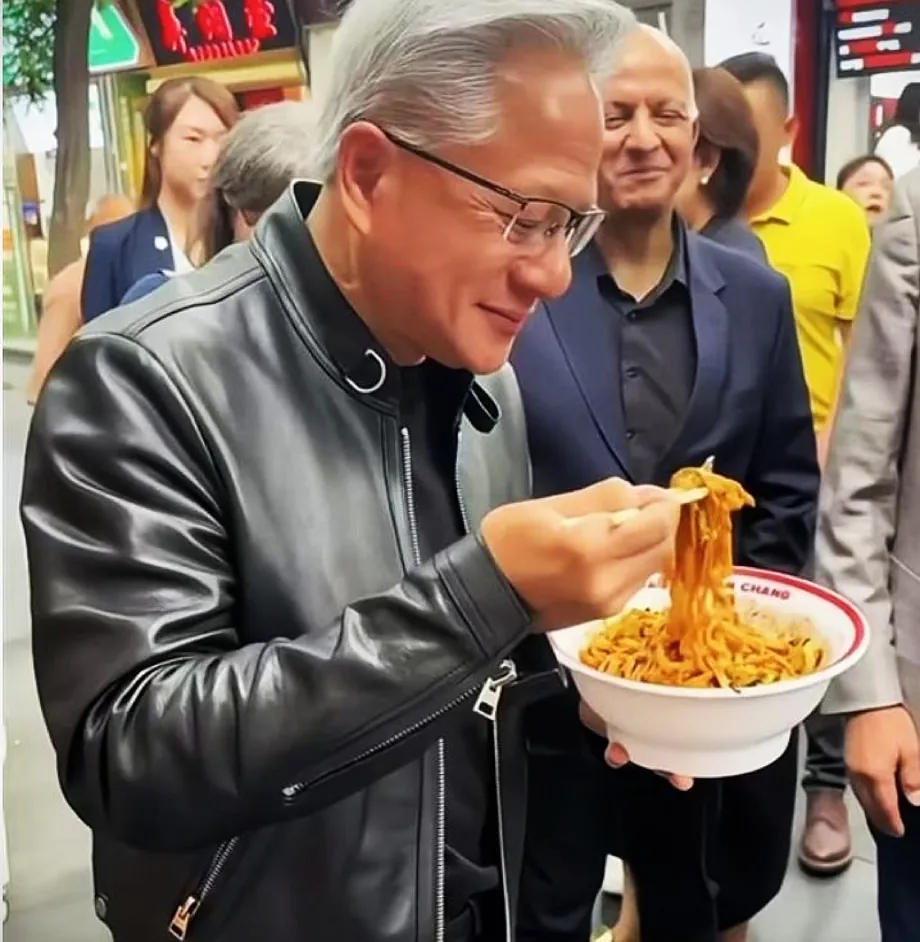
Social media was filled with videos of Huang eating standing up at the entrance of a restaurant on a shopping street, a bowl of zhajiangmian, the popular Beijing noodles drenched in a thick fermented soy sauce, vegetables, and meat. The restaurant, quick to react, did not miss the opportunity: shortly after Huang left, it was already promoting a special menu inspired by the entrepreneur, turned into the best advertising claim for the establishment.
The viral visits of the head of Nvidia summarize well a phenomenon that has persisted in China for decades: the almost reverential fascination that technological billionaires evoke. And Huang quickly learned the rules of the Chinese cultural game. During his trips to the country, he appears in public wearing traditional garments, walks the streets, participates in local celebrations, and makes an effort to speak a bit of Mandarin in front of the cameras.
But behind the oranges, noodles, and red envelopes lies much more than a calculated public relations strategy. Huang has cultivated a particular business romance with China for years that contrasts with the growing technological hostility between Beijing and Washington. While the last two U.S. administrations erected barriers to prevent the Asian giant from accessing the most advanced semiconductors, the founder of Nvidia became one of the main advocates for keeping the doors of the Chinese market open.
Huang's argument has been as follows: prohibiting China from buying U.S. processors will not prevent it from developing AI but will accelerate the emergence of national alternatives. The entrepreneur argues that trade restrictions are pushing Chinese tech giants to abandon Nvidia products and turn to local competitors like Huawei. Isolating China, he has stated on more than one occasion, means giving up a multibillion-dollar business and losing Washington's technological influence.
In April 2025, just days after the U.S. tightened controls on H20 processors, specifically designed to comply with U.S. limitations, Huang traveled to Beijing and met with Vice Premier He Lifeng. The entrepreneur insisted on his willingness to continue cooperating with companies in the country. His message was received with great satisfaction by Chinese authorities, who have long denounced U.S. attempts to hinder their technological development.
His proximity to Trump has allowed him to personally advocate for a relaxation of export controls. The U.S. government ultimately authorized the sale of H200 processors, Nvidia's most powerful, to Chinese customers in December of last year. According to a study by the U.S. consulting firm IDC, specializing in market analysis, Nvidia controlled 34% of the Chinese AI processor market for data centers during the first half of 2026, while its major local competitor, Huawei, had already reached 28%.
Now, the scandal involving the alleged spy Alice Huang adds a much more delicate dimension to that particular love and business relationship with China. The businesswoman, also known by her Chinese name Huang Le, was an executive at Megaspeed, a data center company based in Singapore that is being investigated by U.S. authorities for alleged smuggling of advanced chips to the Asian giant.
According to reports published by the Financial Times and The New York Times, U.S. intelligence suspects that Alice was recruited by China's Ministry of State Security, Beijing's main intelligence agency, to obtain information from the head of Nvidia. Huang has acknowledged the infidelity, but it has not been proven that he provided trade secrets or sensitive information to the businesswoman. Chinese government spokespeople rejected the espionage accusations on Monday.
The revelations are compromising because Alice's business is directly related to the technology that Huang has been trying to sell to China for years. According to the Financial Times this Tuesday, in early 2025, the businesswoman and her partner Kang Wei sought investors to finance a data center project in Southeast Asia valued at several hundred million dollars. During presentations, both boasted that they would have no trouble obtaining the coveted Nvidia GPUs and mentioned Alibaba as one of their clients. The Chinese company also maintained significant financial and commercial ties with Megaspeed.
Southeast Asia has become a possible route to circumvent U.S. restrictions on the sale of advanced chips to China. Megaspeed reportedly purchased Nvidia equipment worth billions of dollars to install data centers in countries like Malaysia. Washington is investigating whether some of those processors ended up illegally entering China, something the company denies.
The New York Times has also revealed that the Commerce Department's investigations into Megaspeed were interrupted after Nvidia's chief legal advisor contacted the investigators, claiming he had authorization from a senior official in the Trump Administration. The case ended up in the hands of the Justice Department. The episode has fueled suspicions about the influence of the tech giant in Washington.
Now, an extramarital affair with an alleged spy threatens to jeopardize Huang's business and reputation. In China, he remains the billionaire who buys oranges and eats noodles at street stalls. But in Washington, doubts are gro