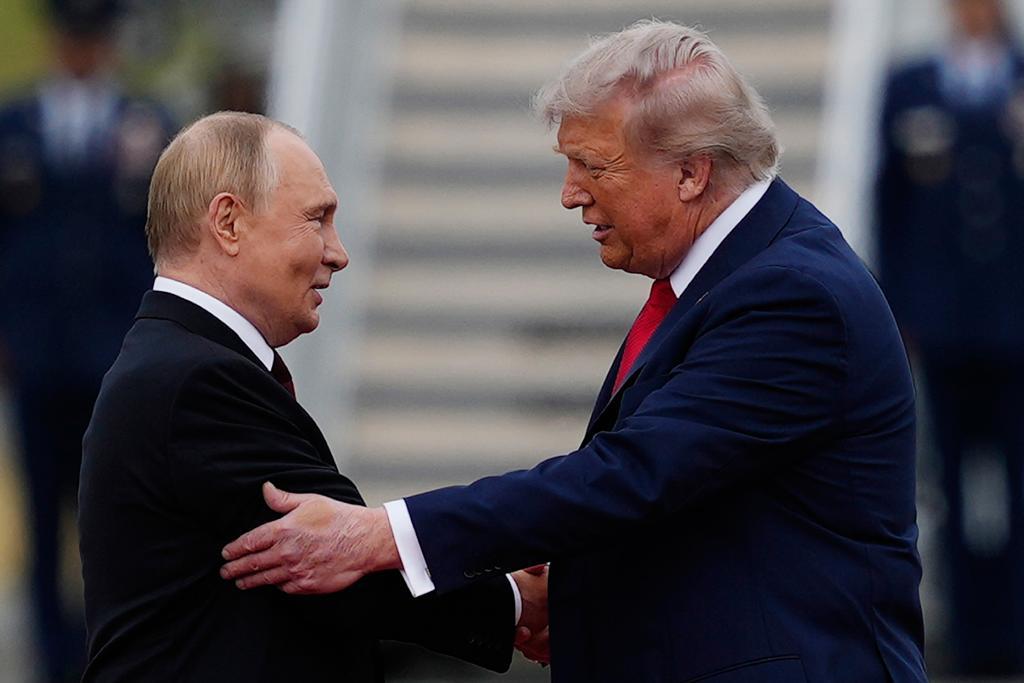
The President of the United States, Donald Trump, indicated again in recent hours that any agreement between Russia and Ukraine to end the war would require the latter to cede part of its territories.
Representatives from Kiev and Moscow are scheduled to meet tomorrow and the day after in Abu Dhabi, United Arab Emirates, to resume negotiations that were interrupted in February.
In an interview with a U.S. broadcaster, Trump expressed confidence in the outcome of the new diplomatic effort. "I think we will achieve it (a peace agreement), I believe it will happen, and in the end, they will have a Ukraine that looks slightly different," he stated, assuming that Kiev will have to cede part of its geography.
According to the Bloomberg agency, the Russian delegation will include more prominent figures than those who attended the last meetings, which may signal a new willingness from Moscow to engage in dialogue with Kiev.
The Russian team will be led by Vladimir Medinsky, an advisor to President Vladimir Putin, and will also include two deputy foreign ministers, the head of Military Intelligence, Mykhailo Hazuzin, and a senior military official, Yuri Zhigarlovsky.
Meanwhile, the Ukrainian representation will be headed by the chief of foreign intelligence, Rustem Umerov, and the head of the president's office, Kyrylo Budanov, according to local media reports.
Both countries have expressed their willingness to negotiate but with absolutely divergent objectives. For Moscow, it is a priority to discuss the territorial concessions it demands from its rival to stop hostilities, while Ukraine insists that security measures for its country must be established first to prevent Russia from resuming the war in the future if an agreement is reached.
Zelensky himself stated a few days ago that "the issue of territories is a red line that can only be addressed at the leaders' level."
"Our security guarantees cannot be dictated by the Russian side. The limitation of our army and Ukraine's neutrality are not up for debate. The Americans have long raised the issue of a land exchange; they call it a land swap," he added.
Most experts doubt the chances of success for this dialogue amid the ongoing military escalation between both nations, especially as Moscow seems determined to subdue its rival through a constant aerial offensive aimed at destroying its economy and energy infrastructure.
On the 22nd, the Ukrainian leader suggested that the conflict be frozen along the current front lines without implying that Kiev renounces sovereignty over the occupied territories. "No one will recognize the occupied Ukrainian territories as Russian," the local leader emphasized.
The British newspaper Financial Times reported last week that several European capitals have expressed concern over the possibility that Donald Trump might seek an agreement with Russia that jeopardizes the EU's own security.
Trump met last Thursday with a Kremlin envoy, Kirill Dmitriev, and said that the peace plan he is designing "will be a great agreement that will encompass more than just Ukraine; it may involve all of Europe."
This indication was reinforced by a post from his son-in-law, who wrote that Washington seeks to "develop practical agreements that address the security concerns of all parties," including "a lasting framework for long-term European security and stability."
Kushner has expressed his intention to reactivate the so-called NATO-Russia Council that was created in 2002 to maintain collaboration between the military alliance and Moscow. The institution was dismantled after Russia's invasion of Crimea in 2014.
Ukraine is wary of potential agreements with Moscow and Washington due to the historical experience marked by the famous Budapest Memorandum of 1994, in which it renounced its nuclear arsenal and signed the Treaty on the Non-Proliferation of such weapons in exchange - supposedly - for the promise that the signatories would prevent the use of "military force or economic coercion" against its state, something that proved to be mere paper promises.
Both the country's politicians and the majority of society consider that agreement to be one of the most strategic mistakes of their leadership and argue that if Ukraine had not rid itself of its atomic weapons, the current war would never have occurred.
The U.S. initiative began to take shape last September and gained new momentum after Washington made a concession to Moscow by lifting sanctions on diesel exports, a decision that generated enormous controversy in Ukraine and the EU.
The resumption of contacts - if it materializes - has not prevented Moscow from continuing its assault on Ukrainian infrastructure and economic interests.
This Monday, drones launched from Crimea struck a warehouse in the southern city of Odesa, leaving at least 3 dead.