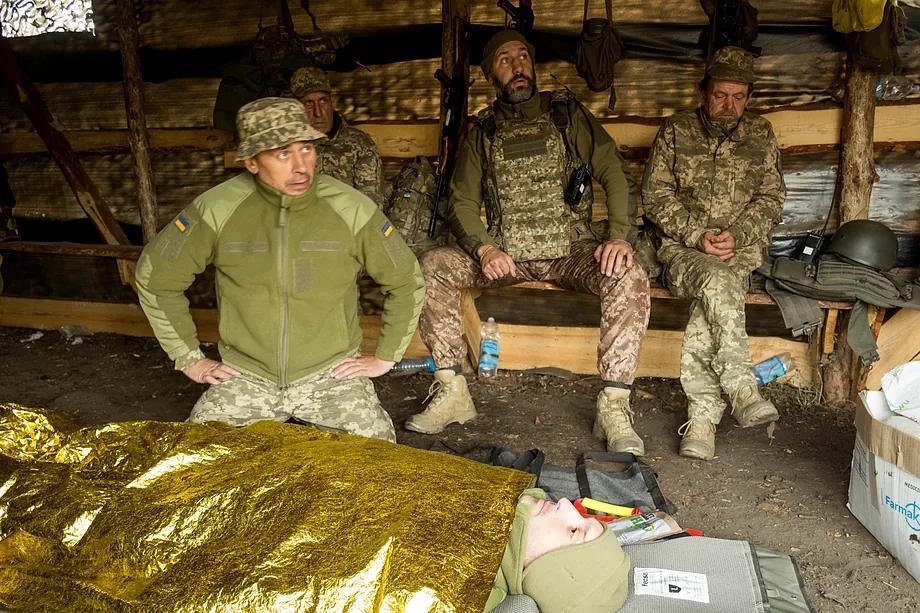
The sergeant major, covering his face with a balaclava, watches closely as the new recruits emerge from their underground shelter. "Look at them," he says, pointing to the sleepy group forming under the trees. "There are three types of recruits. The first are war dogs, hardened men with weapon experience, who learn quickly, adapt, and always respond under fire. Once they taste combat, they can never return to a normal life because they will be addicted to war for life. There are very few of these left; they are assigned to assault units and have significant military value. The second type is peaceful civilians who, due to circumstances, can become good soldiers, although they will struggle to survive. They are the majority of those in front of you."
—That one over there. He will never be a soldier, no matter how many uniforms he wears, how many weapons he wields, or how much training he receives. He will be the first to die because he will panic. If it were up to me, I would have transferred him to an office.
He refers to Vitali, who holds a weapon with his delicate pianist hands but looks anything but military. From helmet to boots, through the bulletproof vest, the gear fits this 28-year-old recruit like a Halloween costume. His movements in the last days of training, slow, mechanical, and clumsy, raise the suspicions of his peers, who watch him during the house assault exercise with half-smiles and disapproving gestures.
This is the last training they receive after weeks of intense instruction. Are they ready for combat? That would be saying too much. Some are, and others will never be.
The instructor has to insist on how Vitali should peek through the small windows, briefly and without exposing himself too much. But, to everyone's surprise, when he locates the enemy through the windows—several metal targets placed here and there—he doesn't miss. Each hit produces a metallic "clong." One bullet, one dead. The sergeant major comments, lowering his voice: "If he manages to survive everything else, at close distances he is relentless."
We are in a field of Brigade 100, within drone range of the front, and the soldiers look to the sky as soon as they sense a sound that is not the chirping of birds. They fear small FPV or fiber-optic drones that hunt people, but not the large Shahed drones, which seek bigger targets and pass over us without altering their flight. As a precaution, training is conducted in groups of only five or six soldiers.
Vitali looks nothing like some of his comrades, old enough to have served in the USSR and with an agricultural appearance, who quickly grasp the sergeant's orders and move as if recalling dance steps learned 30 years ago. "I'm here because it was my turn in the draft, and I didn't want to hide like others do," says Dmitro, 52, short but stocky, with dockworker hands, a face that has never known moisturizer, and a three-day beard that could catch fire.
That many Ukrainian recruits have gray hair is no coincidence but the result of a political decision and a demographic problem. Until April 2024, the law only allowed the mobilization of men starting at 27 years old. Zelenski then lowered the threshold to 25, after nearly a year of doubts, and has repeatedly refused—despite pressure from his allies—to forcibly recruit young people from 18. Those under 25 can only enlist as volunteers, through contracts with economic incentives. Behind this resistance is the fear of sacrificing a generation that is already scarce.
The country is grappling with the collapse of birth rates from the 1990s, following the fall of the USSR—a problem it shares with Russia—and, according to the State Statistics Service, in January 2022 there were about 1.6 million men aged 18 to 25, compared to 5.5 million aged 40 to 59. Kiev has preferred to fill its ranks with those it considers more expendable for the country's future. The result is an army whose average age exceeds 40 years—some analysts place it at 45—far above that of any other modern war. Many commanders openly criticize it: "When men aged 50 and 55 leave and 25-year-olds are not mobilized, it's not fair," General Dmitro Marchenko denounced.
Zelenski's decision has a significant reason. According to The Economist, about 27 or 28 million people live in the territory controlled by Kiev, down from 37 million before the large-scale invasion. Birth rates have fallen to between 0.8 and 0.9 children per woman, down from 1.2 before the war, and in the first half of 2026, deaths tripled the number of births. Today, only 43% of Ukrainian refugees in Europe plan to return, compared to 74% at the end of 2022.
In his visits to combat units over the past year, this reporter has encountered two realities. The assault brigades, the elite of the army, have the youngest personnel and the most experienced foreign volunteers, but they also suffer the highest casualties. In the infantry and territorial defense brigades, the profile tends much more toward maturity.
In a nearby field, we visit the 117th Territorial Defense Brigade. All its new recruits are over 45, and some are over fifty. How will they endure the harsh conditions of the front, where they can spend months in shelters almost without moving to avoid detection by drones? "They are very tough people. If they are here, it's because they have passed the prior training, although we would like to have younger and stronger people, of course," says Oleksandr, another instructor. We talk to Mijailo, one of them.
—Are you afraid to go fight?
—A lot. But on the other hand, I wish it would happen as soon as possible.
—Do you accept the draft willingly?
Mijailo shrugs. "It was my turn, and I admit I was busified."
The term "busification" has become one of the most feared in Ukraine. It describes a practice that the government has never acknowledged but that is repeated throughout the country: military recruitment officers detain men of military age on the street or after work, forcibly load them into a van, and take them to the enlistment office. Earlier this year, Zelenski ordered his then-Minister of Defense, Mijailo Fedorov, to put an end to it, but abuses persist. Frontline officers admit it: they do not need busified recruits, but motivated and trained men.
Russia has not declared a mobilization since the fall of 2022, but it suffers personnel problems and increasingly pays for volunteers to cover its enormous casualties. Although it has not published official death figures since September 2022, its own records have revealed it. Between October 29 and November 1, the Belarusian opposition group Cyber Partisans and the Ukrainian collective Silent Crow hacked Rosstat's systems, the state statistics agency. According to Bloomberg, which obtained the data, nearly 392,700 death certificates issued until August 2026 are directly linked to the war. Silent Crow raises the figure to 450,100 by including deaths not related to combat and without specified cause, which would make the war the fourth leading cause of death in Russia since 2022, according to The Moscow Times.
The data also shows who pays the price: an army that started out young is increasingly relying on older men - the same problem faced by Ukraine - and the poorest, most remote regions with greater ethnic diversity bear a disproportionate share of the dead. The figures far exceed the 285,881 soldiers identified by name by the independent outlet Mediazona and the BBC, and approach the BBC's own estimate, which places the actual dead between 518,000 and 633,000. British intelligence estimates the total Russian casualties, including dead and wounded, at around 1.5 million. Considering the delay in notifications, the figure would be around 600,000 dead since February 2022, a slaughter not seen since World War II.
Days later, we learned that one of the interviewed groups was attacked by a drone on their way to their positions. There were several dead and wounded. This is how this war is now: the most dangerous part is no longer fighting in the trenches, but trying to reach them.