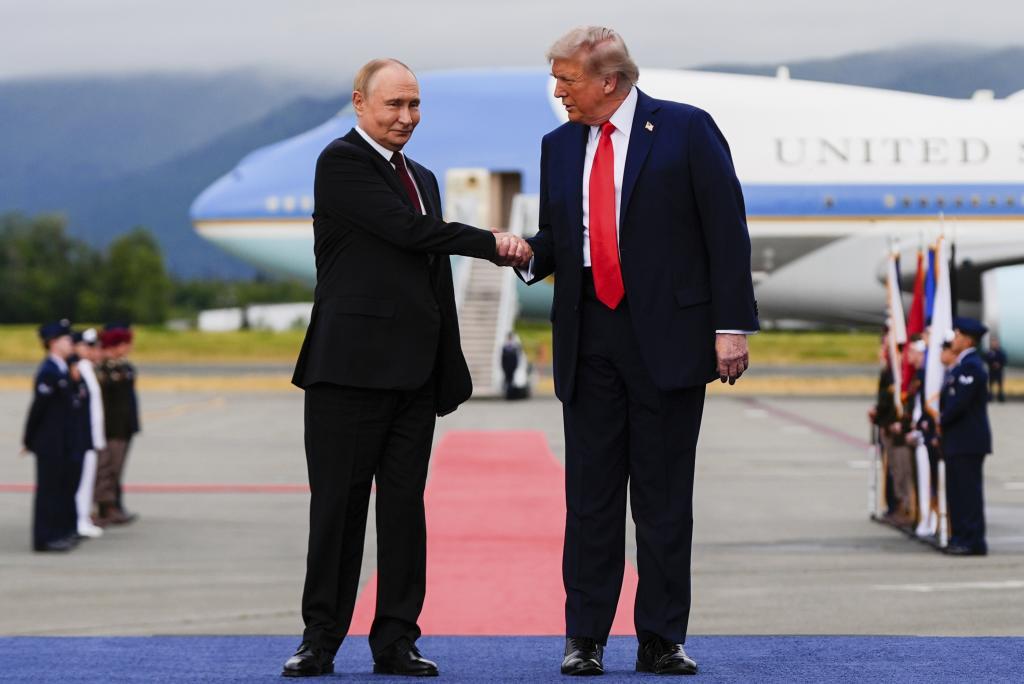
On Beijing's upcoming political calendar, one date stands out: November 18 and 19, when Shenzhen, the major tech metropolis in the south, will host the APEC leaders' summit (Asia-Pacific Economic Cooperation, an annual regional meeting). Trump's presence is expected, as is that of Russian President Vladimir Putin. The possibility of a historic photo of the three leaders has gained momentum in recent hours.
"I think one of the meetings will be with President Putin and President Xi, and that will be interesting," Trump stated on Sunday before returning to Washington from Florida. The American outlined some of the issues he wants to discuss: "We will talk about many things, including nuclear disarmament. We are trying to end the war in Iran." Moscow, for its part, has indicated it intends to use the meeting to discuss a negotiated exit from the war in Ukraine.
Trump's remarks came after Beijing confirmed last Wednesday, for the first time, that it is in talks to organize this unprecedented trilateral summit. The day before, Kremlin spokesman Dmitri Peskov had stated that preparations were underway.
According to a report from the Wall Street Journal, Beijing and Washington have significant disagreements regarding the format of the meeting. The Chinese government wants a carefully choreographed meeting, where the three leaders would be limited to reading pre-agreed statements.
The White House, on the other hand, is reportedly pushing for a more open meeting, with direct exchanges between the leaders. Reports suggest that Xi Jinping seeks to leverage the symbolic value of a historic photo alongside Trump and Putin, but without exposing himself to the risks of unpredictable negotiations.
The main obstacle to this meeting would be nuclear disarmament. Trump has reiterated that he wants to negotiate a new arms control framework following the expiration, last February, of the New START treaty between Washington and Moscow. However, China, whose nuclear arsenal is much smaller than those of the U.S. and Russia, refuses to negotiate under what it considers unequal conditions.
Reaction in China to the Republican Setback
Xi will welcome a weakened U.S. leader in Shenzhen following the Republican setback in the midterm elections, but who still retains significant powers for foreign policy negotiations. This will be the first major test of dialogue between the two superpowers following the Republican defeat.
Amid jokes and criticisms, on Weibo, China's version of X, thousands of internet users debated last week what consequences the electoral shift in the United States would have for the two largest powers on the planet. "Trump, total defeat", read the hashtag that circulated on the most popular social network in the giant Asian country.
The magnitude of the Republican setback fueled a mix of fascination and bewilderment. Some users in the giant Asian country mocked the loss of power of the U.S. president. Others wondered if a Democratic victory would really be good news for China after the good rapport that Trump and Xi have shown publicly during their two meetings this year.
An analysis that can now be made from the Asian country is that a Trump with less political strength may not necessarily be more comfortable for China. After a trade war that drove tariffs to triple-digit levels, Washington and Beijing achieved a truce. The meetings between the two presidents have significantly reduced tensions. Despite his many threats, Trump has shown a willingness to make personal deals with Xi. However, the new political landscape in his country may hinder his ability to fulfill those commitments.
Chinese state media closely followed all the news about the Democratic wave that regained the House of Representatives and the Senate, reaching conservative strongholds like Texas, Kansas, and South Carolina.
The state agency Xinhua dedicated an extensive analysis to "Trump's Dilemma After the Blue Wave," attributing the defeat to the discontent of voters angered by inflation, the trade war, and military intervention in Iran. The official outlet highlighted that voters punished the president more than they rewarded his opponents, and opened another section under a significant headline: "The Lame President".
The Chinese economic newspaper National Business Daily reported on the warnings from political scientist Sun Taiyi, who noted that Democrats could promote parliamentary investigations and even another impeachment process. From Nanjing University, Professor Zhu Feng, one of the most well-known Chinese analysts on international politics, summarized a prevailing thought among Chinese analysts: the rivalry with the U.S. will continue to exist, regardless of who controls Capitol Hill, and President Xi must prepare to negotiate with a president more constrained by the opposition.
However, official voices from Beijing have avoided making assessments in recent days. "The midterm elections are an internal matter for the United States," concluded Mao Ning, spokesperson for the Ministry of Foreign Affairs.
As a gesture of détente just days before Trump's visit to Shenzhen, Beijing announced on Monday a new two-month extension of the suspension of the additional 24% tariff on certain U.S. imports. The measure, which will take effect this Tuesday, still maintains a 10% levy on those products. The Chinese government presented the decision as a way to consolidate the trade agreements reached by Xi and Trump during their last meeting in Washington and to provide stability to bilateral economic relations.