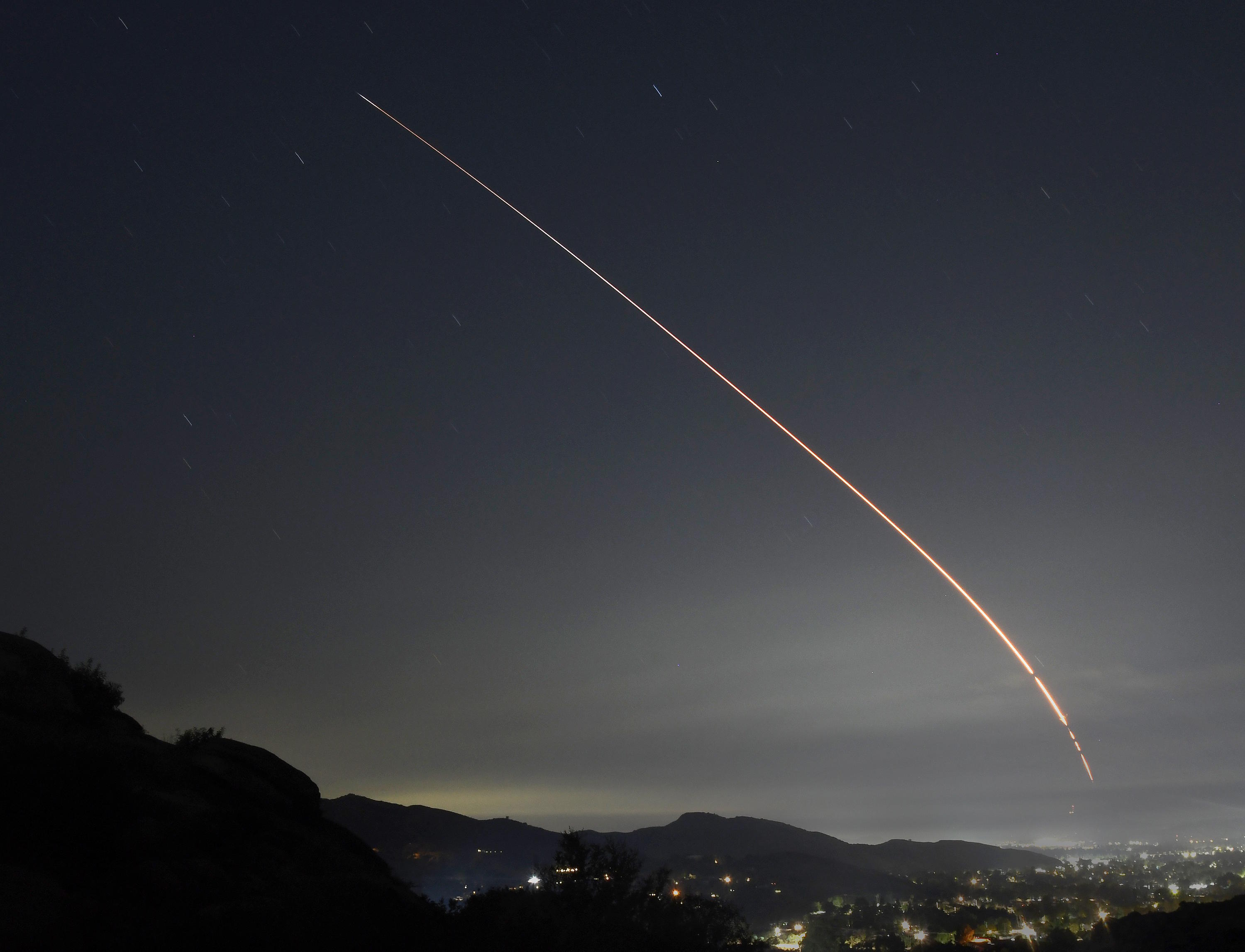
If one wants to know where one of the main struggles between the United States and Europe will be next year, just look to the sky and search for an element that is extraordinarily abundant, but for some purposes can be incredibly scarce, such as air and the electromagnetic spectrum.
The sky is organized globally by the International Telecommunication Union, a UN agency, into bands. Each of these bands has a defined size and is allocated for the same type of service or technology. This way, an orderly space is achieved where there are no interferences between 5G mobile telephony, 4G, reserved communications... and satellite services.
Specifically, the deadline for granting the band for mobile satellite services in the European Union expires in May 2027 and it will be put out to tender again. However, in this case, the European Commission has proposed to limit most of that piece of sky to European companies, a decision that has not been well received in Washington, which is still digesting the results of the midterm elections, nor in Starbase, SpaceX's headquarters in southern Texas.
"There will be devastating consequences," threatened the U.S. ambassador to the European Union, Andrew Puzder, regarding the implications if Brussels proceeds with its plan. However, there is a cautious optimism in the EU capital about the possibility of executing it and strengthening its sovereign capabilities.
"European countries are all quite concerned about their dependence on the United States. There is pressure and urgency to reduce it, and this is one way," explains Guntram Wolff, a senior researcher at the Bruegel think tank, in statements to Actualidad Económica.
The recent and unexplained outages of Starlink in Ukraine, which have impacted several ballistic missiles, and the growing tensions between the country's government and Elon Musk have only increased European reluctance to depend on SpaceX technology.
"What the European Commission seeks is to divide the spectrum into three blocks. Assign one block of 10 MHz to government services, a second block of 10 MHz to commercial services reserved for a European operator, and a third block to commercial services open to international bidding where global operators could enter," points out Luis Mayo, CEO of Hispasat, one of the companies expected to play a key role in this new arrangement through the Iris2 constellation.
In this way, Starlink would only be able to bid for 10 of the 30 megahertz available in the auction, a smaller fraction than it currently has for a 20-year period where it expects its business to grow exponentially, something intolerable for Musk.
The last time the band was awarded, it caused much less uproar. The process ended in 2009 and was won by two relatively unknown companies to the general public: Inmarsat (which would later become Viasat) and EchoStar, whose global frequencies have been purchased by Starlink.
This band is used to provide mobile services via satellite. Throughout the 20 years of the license, the allocated space has been underutilized, as its uses have primarily been for internet for airplanes and the Internet of Things (IoT), two minor elements.
However, in recent years, several factors have drastically changed the scene. The development of D2D (direct to device) technology eliminates the main barrier that many of these services had: the need for an adapted terminal. Now, a standard mobile phone can already have satellite connectivity. This possibility is joined by the explosion of new businesses associated with this connectivity, such as the digitalization of numerous areas without mobile coverage in rural or industrial environments or connectivity for cars and, especially, autonomous vehicles.
In its IPO prospectus, SpaceX estimated the market opportunity at $870 billion (€777 billion) in the mobile internet segment and another $740 billion (€662 billion) in direct to device connections. A lucrative market not just for Elon Musk.
However, Europe's focus is not so much on the business volume that these services can generate (for which a significant payment could be charged in the auction), but on European sovereignty itself and reducing dependence on the United States in a key area for communications, as seen recently in Ukraine.
Therefore, the first third of the proposal reserved for government communications has practically written the names of the services that will begin to be provided through Iris2, the constellation of 348 satellites created by Europe as a counterbalance for secure communications to Starlink.
Hispasat is one of the main contractors and leads the ground segment and the constellation in low Earth orbit, key in providing services through this band, and is also one of the main players in the SpaceRise consortium, which would be one of the potential bidders for the band.
A key element, as Mayo emphasizes, is the possibility that the European Union seeks ways to collaborate between government space and European commercial services to better utilize the assigned spectrum, which would lead to the need for some integration among the bidders or for them to share identity.
On the other hand, Deutsche Telekom, Telefónica, Orange, and Vodafone have signed an agreement to present a joint consortium on behalf of European operators, which, however, is not willing to build its own satellite constellation but would subcontract the service to a third party. There are also other smaller companies interested in bidding, such as the Spanish company Sateliot. Its CEO, Carlos Riopedre, tells Actualidad Económica that the company views this initial approach from Europe positively, although he believes there is room for improvement in the wording.
"What is important for us is that when it comes to European, that wording is effective. That is, no company should create a division in Brussels, fill out a form, and present itself as European. Those making the decisions must be in Europe and not subject to third countries," says the executive, who believes that all members of the winning consortia must be European.
At the same time, he also argues that since this involves a spectrum for satellite purposes, it makes sense for a satellite operator and European entity to be the one awarded the services: "Alliances can be formed with terrestrial operators, but that spectrum must be requested by a satellite operator," the executive states, clearly referring to the consortium of operators formed by the major players in the sector.
"Terrestrial operators are great for aggregating demand and are happy to participate, but there must be a satellite operator and a model based on non-exclusive and wholesale agreements," adds the CEO of Sateliot, who already has agreements with 60 operators to provide them IoT services from space.
The playing field and its limits
The European scheme is far from being finalized. First, the European Parliament itself must agree on its position, as must the member states. This second process is more thorny, as traditionally these spectrum tenders have been conducted at the national level, which has impacted revenues for public coffers and management of this resource at that level, something Europe now wants to reverse as part of a larger legislative change.
Meanwhile, there are fears that the United States may try to tip the balance by seeking to weaken the resolve of any state that is politically closer to the current government. At the same time, other parts of the world are watching closely, such as the United Kingdom, whose concessions expire at the same time as the European ones, but which has decided to extend them until it better understands how the community plan works.
In this regard, Mayo does not rule out reserving a small national space for specific aspects, such as the Internet of Things, but he trusts that the Commission's vision will prevail, a diagnosis shared by Wolff.
Another limiting factor that many critics point out is the technological capabilities of Europe. The CEO of Hispasat notes that Starlink and AST Spacemobile already have part of their constellation deployed, which makes it easier for them to make commitments, but the migration of the bands will take two years from the award, and Iris2 will not operate fully until 2030, so there is room for that European technological takeoff. In the commercial realm, the timeline is longer.
The new operator has five years to meet the licensing requirements with the specified quality and coverage, so it will deploy the constellation for the new commercial service, which would be in 2034 and 2035," describes Mayo, who points out that there are also other options to expedite timelines, such as using an "interim solution" and gradually replacing it with different versions, as Starlink does with the evolution of its nanosatellites.
In favor of European capacity is that the concession lasts 20 years and the satellites have a lifespan of five years. Additionally, in the case involving Hispasat, it would benefit from the fact that the government sector needs technology to support tens of thousands of users, not millions as Starlink aims to accommodate, which lowers the demand in this regard.
The other big question is whether the satellite will be as profitable as proposed, and this is a concern primarily for telecommunications investors. "U.S. telecoms lost $60 billion in a day when Starlink made its mobile ambitions public, but the operators themselves do not see the satellite as a threat, as it can only meet a fraction of the demand and acts more as a complement than a substitute for terrestrial networks," points out Brian Potterill, Mobile Director at the British firm Enders Analysis, specializing in telecommunications.
In the United States, competition is more intense because it is a country twice the size of Europe in territory and with far fewer fixed connections, explains Potterill, making the satellite much more competitive than in Europe, which has a denser population. "D2D only has the capacity to handle a fraction of mobile demand and does not work well indoors, the primary use case for mobile. It cannot provide the capacity that tens of thousands of ground antennas can," he explains.
In light of this ambition, operators have reacted with a clear division: one part allies with Musk, like Telefónica in Latin America or Orange in Spain, while another defends closing the doors to their customers as a preventive step to prevent Starlink's business from continuing to grow, as is the case with telecommunications operators in the U.S.
The other major obstacle that SpaceX could impose is closing the door to European satellite launches, one of the real bottlenecks that could strain or drive up the costs of new community constellations, where Europe still lacks established competitors. And further proof that the sky wars can only be fought on equal terms if one has technological sovereignty.