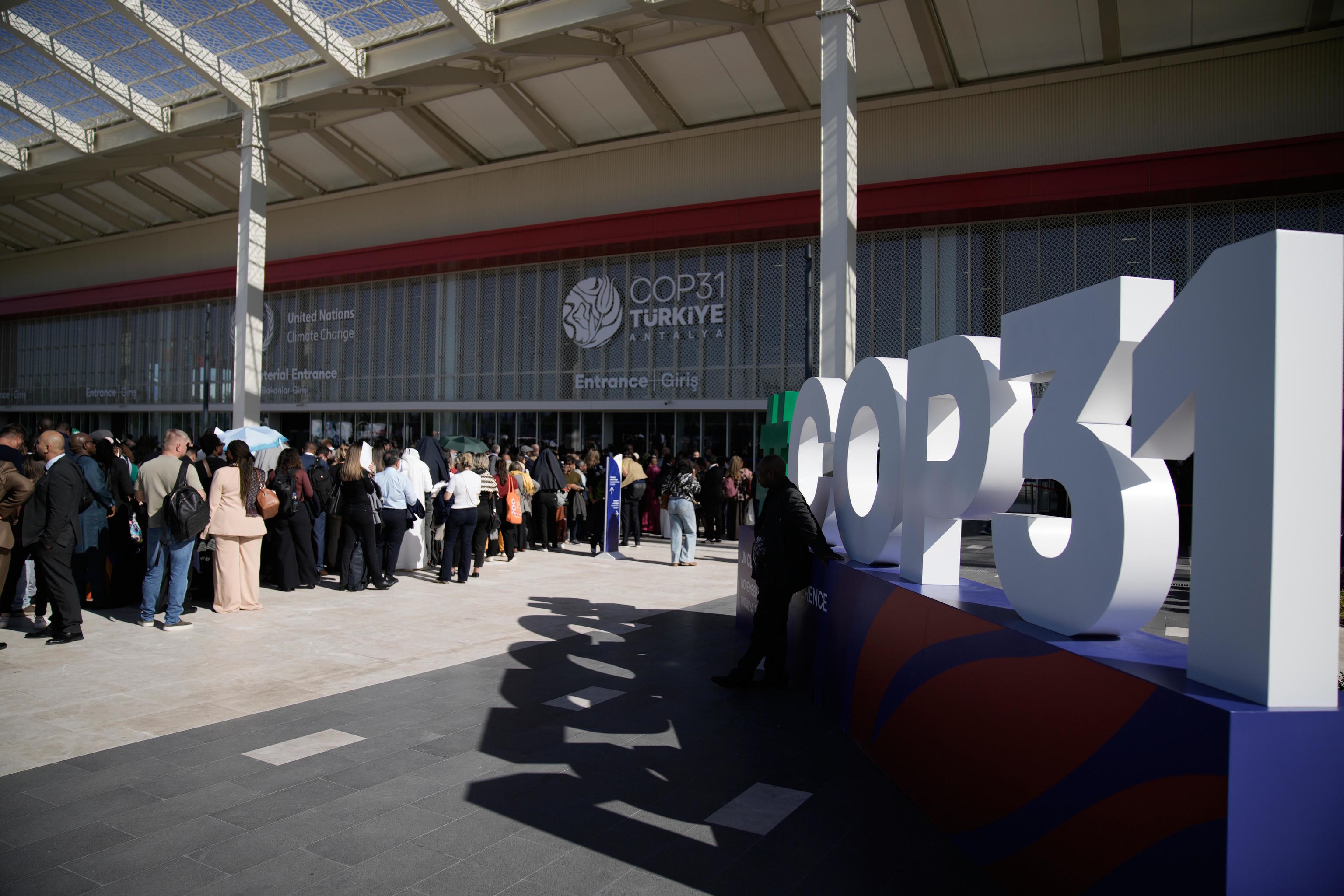
For a long decade, 1.5 degrees has been something like the sacred figure in the particular liturgy of climate summits. With the distant memory of the Paris Agreement, nearly 200 countries converge today at COP31 in Antalya (Turkey) to acknowledge for the first time the anathema: the exceedance is already "inevitable" and the Earth's average temperature will soon surpass one and a half degrees compared to the pre-industrial era.
"The window has closed," certifies Inger Andersen, head of the UN Environment Program (UNEP), with a certain anger bordering on resignation. "It is clear that the Herculean effort required has not been made... But it is not the time to throw in the towel. Every fraction of a degree we avoid raising will save lives, protect ecosystems, and prevent economic losses."
Limiting the exceedance will be the unspoken motto at COP31, knowing that we are moving - at best - towards 1.8 degrees by mid-century with current environmental policies, and with the certainty that greenhouse gas emissions should fall by 69% by 2040 to avoid overheating, a scenario that is unrealistic given the current trend.
As irrefutable proof of where we are headed, we have the scorching summer of 2026 in Europe, with a succession of heatwaves that caused over 50,000 more deaths than expected, with fires ravaging 680,000 hectares and major rivers like the Danube and the Rhine hitting their historical lows. The old continent is warming the most, at a rate nearly double that of the rest of the planet. Summer temperatures were 2.9 degrees above the average of the last 30 years across Europe, and Spain topped the charts with a 3.4-degree rise in the hottest September on record.
COPs are usually held in the fall with the falling leaves, but the cicadas of summer will sound louder than ever this year along the Mediterranean, at a summit that was initially set to take place in Adelaide, focusing on Pacific island countries. Australia will assume the presidency of the negotiations, although Turkey reserves "the final word", amid growing tensions over political control of the summit. Saudi Arabia is expected to once again play the villain, and the United States, despite Donald Trump's recent setback, will undermine the climate summit from the outside for the second consecutive year, in its dual role as the largest oil producer and the second-largest CO2 emitter in the world.
Antalya also takes on the not-so-flattering legacy of COP30 in Belém, which concluded with a minimal agreement, following the strong opposition of petro-states to the inclusion of a roadmap to move away from fossil fuels. A year later, on the eve of COP31, Brazil has redeemed itself by publishing a global roadmap for the gradual elimination of coal, oil, and gas, as a guiding framework for countries that want to join the effort.
Interestingly, the news coincided with Brazil setting a new record (the eighth-largest oil producer in the world) with 6.12 million barrels per day, a true reflection of the ambivalence in countries that should be clearing the path. All this occurred just days after Lula's notable reelection, who can boast - indeed - of having reduced Amazon deforestation by 41.8% in the last year, a hopeful statistic.
Brazil also birthed the embryo of the First Conference for the Transition Beyond Fossil Fuels, held last spring in Santa Marta (Colombia). More than 60 countries, including Spain, decided to create a "coalition of volunteers" to overcome the typical blockages of COPs, where agreements are approved and often diluted by consensus. The creation of this bloc reflects the growing divide between petro-states that aspire to prolong the fossil fuel era and electro-states that aim to accelerate the transition. Geopolitical tensions and the energy crisis, exacerbated this year by the war between the United States and Israel against Iran, have further complicated negotiations.
The frictions between the two blocs became evident at the recent technical meeting in Bangkok of the Intergovernmental Panel on Climate Change (IPCC). Saudi Arabia and India pressured to force a one-year delay of the seventh IPCC report, which should conclude and be made public in 2028. France and other countries criticized the maneuvers of the "blocking bloc" and reminded everyone of the importance of aligning the latest scientific assessment with the second global stocktake that will measure collective progress towards climate goals that same year.
The other dividing line, separating industrialized countries from developing countries, remains open due to the financing of climate action (with the collapse of the Langtang Lirung glacier in the Himalayas that caused over 1,400 deaths and missing persons as a tragic reminder). In Belém, it was decided to triple the aid allocated for adaptation to extreme climate events in vulnerable countries by 2035, and it is expected that Antalya will also make progress in this area, as well as in the implementation of the just transition mechanism in local communities.
The impact of climate change on health, its effect on agriculture and food, and the vital role of oceans will be other hot topics at COP31, with the "tropicalization of the Mediterranean" as a backdrop, after recording a historical maximum of 28.54 degrees surface temperature last August on our coasts, posing a threat to marine ecosystems and a high risk of torrential rains and cold air masses in contact with autumn air pockets.