Captain Oleksiy Sydoruk belonged - as his wife Natalia says - to "a lineage of sailors." In the family album photo, he is seen standing, resting on his father Viktor Sydoruk's shoulders, who is seated in a chair. His son, who shares his name, is also shown dressed as a sailor.
In the portrait that crowns the cross on his grave in the Odesa cemetery, he is also seen in his uniform.
The navigator's funeral was held on October 6. But Oleksiy died on September 23. "His body was trapped among the ruins of the command bridge. Russian drones continued to threaten the ship after the attack. The vessel was stranded at sea, delaying rescue efforts by 11 days," his widow states.
The incident that cost Sydoruk his life confirmed the determination - in this case with fatal consequences - of the captain of the tanker Mentor. "The drones had already attacked the ship several days earlier in the same port of Chornomorsk, causing a fire. Most of the crew refused to make the trip, but Oleksiy was always very responsible. He told me that if he didn't do it, no one would," the Ukrainian recalls.
Oleksiy managed to repair the ship, gather a new crew, and set sail towards the Romanian port of Constanta. The freighter was carrying 15,000 tons of sunflower oil.
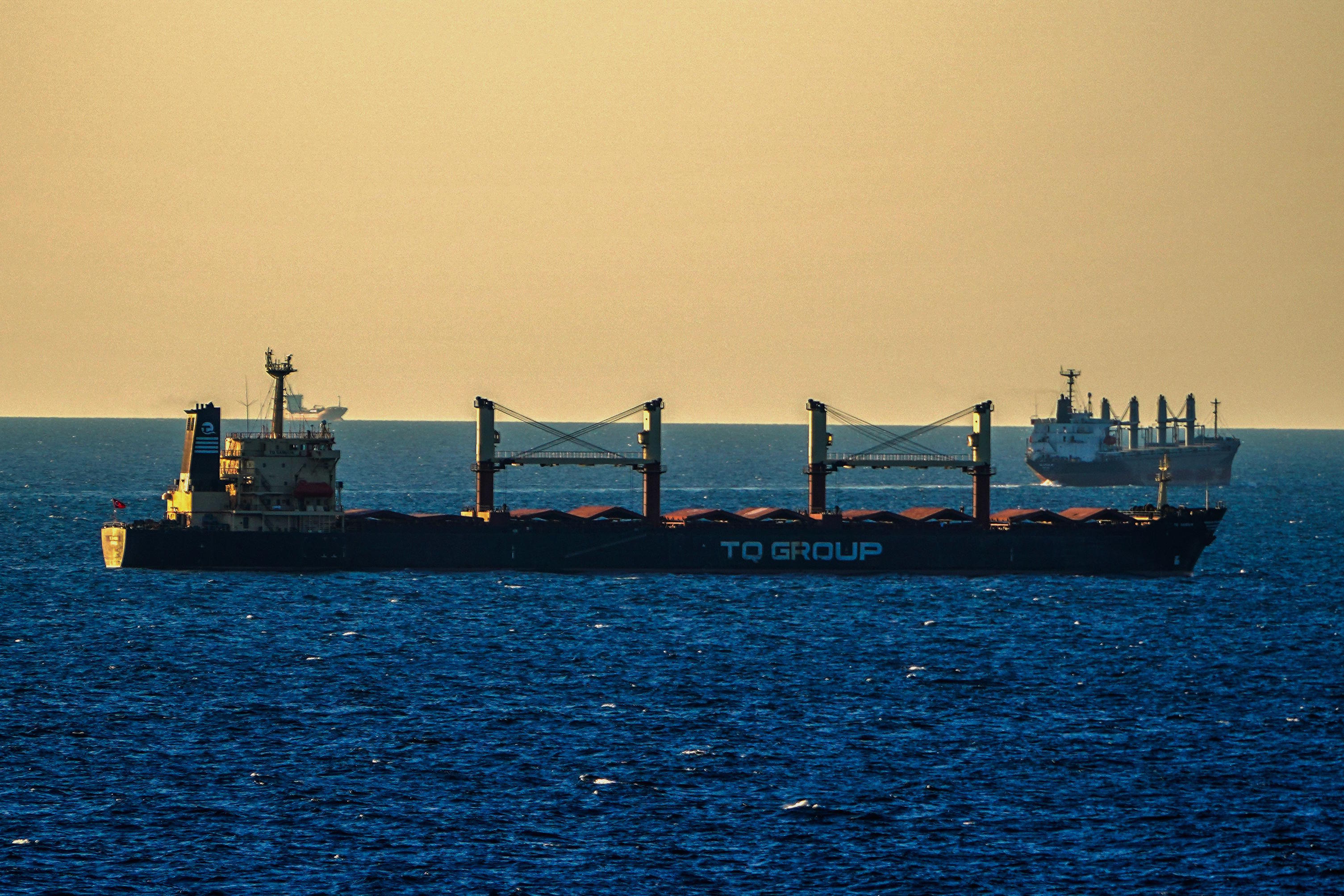
The Russian unmanned aerial vehicles (UAVs) returned at 2:30 AM. The Mentor - a vessel flying the flag of Antigua and Barbuda - had been sailing for just over two hours in the Black Sea and was not far from Chornomorsk, south of Odesa.
"I spoke with him an hour before the tragedy. When he learned there was a threat, he sent his crew to take refuge in the engine room and he returned to the bridge. If no one was in command, the ship could hit a sea mine (that maritime area is filled with those devices). That's where he died," Natalia adds.
Escalating conflict with more deaths than Ormuz
Sydoruk's death is part of the escalating conflict that the Black Sea has witnessed in recent months, which, as Andrej Klimenko, director of the Strategic Research Institute dedicated to that body of water, states, "has become the most dangerous maritime route in the world," resulting in more fatalities among crew members than any other route in the world, such as Ormuz or the Yemeni coast.
According to the maritime security firm Ambrey, over 570 ships have suffered attacks in this area in 2026, resulting in at least 40 sailors' deaths, compared to 24 who have died in Ormuz.
These recurring incidents are merely an extension of the offensive that Russia launched against the Odesa region starting last July, particularly targeting the port facilities in that area, which forced Ukraine to suspend all its maritime exports.
Kiev retaliated by attacking Russian port enclaves in the same area, also causing a significant reduction in the traffic of freighters destined for those locations.
The conflict escalated in October when drones began to target ships navigating near Bulgaria, Romania, and along the Danube River.
Both Ukraine and several Western countries and analysts specializing in the area have accused Moscow of all these actions, but Russia has only admitted to attacking two freighters that it claimed were transporting weapons destined for Ukrainian territory.
Recently, the unmanned aerial vehicles have executed their actions following a systematic pattern: they have struck their targets in the so-called exclusive economic zone of Bulgaria and Romania, an area that does not belong to their territorial waters, raising confusion about whether these two nations can request NATO assistance under Article 5, which could provoke a joint response from the alliance.
Recently, former US Colonel Jonathan Sweet opined in the Kyiv Post that these Russian actions have a dual objective: "To isolate Ukraine and intimidate NATO. The more concessions NATO and the European Union make, the more Moscow will take."
"Russia knew NATO would remain silent. Turkey and Bulgaria are afraid to point fingers at Russia, and Romania cannot act alone," Andrej Klimenko believes.
On October 28, the crisis reached a new turning point when the Liberian-flagged vessel 'Contship Jet' was rammed by three unmanned marine vehicles. Its crew managed to capture images of one of the aquatic drones moving parallel to the freighter. When the device turns left and heads toward the vessel, someone shouts in English and Russian: "Get inside! Come on, come on!" The explosions caused the transport to sink.
"We are in a black hole. There is no international legislation regulating possible drone attacks on merchant ships. It's a new phase of the war," Klimenko admits.
Russia is also facing a significant decline in its maritime trade in the Black Sea, as acknowledged by Arkady Zlochevsky, president of the Union of Grain Exporters of that country. The businessman explained days ago that shipments of these agricultural products via that route have decreased by 50% in October compared to the average recorded at this time.
Moscow has had to redirect its harvest to Baltic ports and even use the Arctic route for the first time.
Meanwhile, the blockade of Ukrainian ports has diverted its naval trade to the facilities it maintains on the Danube River, something that also occurred during the crisis that took place in 2022 in the same area.
Just like then, Russian UAVs have intensified their assault on these localities and the entire logistical framework linked to that southern region.
The border crossing at Starokozache, on the border with neighboring Moldova, still shows the severe damage it suffered during the airstrike in September, where two people died. The authorities at the crossing have piled up stacks of metal and charred vehicle carcasses on one side of the customs area. The debris left by the incident.
Increase in truck and freighter traffic
The destruction left by the impacts of the feared 'Shahid' (the Russian drones) is also a constant in Izmail. Both in warehouses and electrical facilities or in the buildings of its port, the most important in Ukraine along this river route.
According to the director of this complex, Vitalii Nikula, since July, "truck and freighter trade has increased two to three times in Izmail."
"The problem is that attacks and alarms have also increased, forcing us to interrupt work an average of 10 hours a day. Under this situation, we cannot meet the demands," he adds while sitting in a café by the riverside.
Russian UAVs have targeted nearly half a dozen vessels docked at this destination since last winter, including a freighter loaded with liquefied gas, "whose explosion could have devastated everything around it within a radius of 300 meters," he notes. "60% of the warehouses (in the port) have been destroyed", he adds.
The violence has unleashed a chaotic spiral that is driving an uncontrollable rise in cereal prices - Russia and Ukraine are two key countries in the global production of these products - and the cost of maritime trade in the Danube and the Black Sea.
"Before July, the freight for a ton that was to be sent to Italy, Turkey, or Egypt was about $30. Now it costs $100," Nikula indicates.
"The salaries of captains traveling through the Black Sea have skyrocketed from $20,000 to $100,000, and even then, it is not easy to find people willing to make that journey," comments Andrej Klimenko.
Viktor Kurtyev, a businessman from Izmail and a specialist in Ukraine's electrical grid, points to the row of gabions - those cages filled with earth and stones - that cordon off the transformers connected to the two power plants.
"We have also covered it with these metal structures to protect it from the explosion," he adds in front of the enormous alloy shell that encases the power station.
Some of the metal structures remain twisted, and many of the solar panels that powered them show the impact left by shrapnel.
Both complexes - one of which is majority-owned by the Spanish company Acciona - have been damaged since late last year, always following a defined strategy: "The port of Izmail cannot operate without electricity. The five electrical substations in Izmail have been attacked," Kurtyev indicates.
"Between November and last July, the facilities operated at a reduced capacity and thanks to the generators," Nikula agrees.
Andrej Klimenko believes that the "eye for an eye" mentality is undermining the finances of both nations, but doubts that any bilateral negotiation - like the one that has resumed in Abu Dhabi - can halt this absurd scenario. "Now no one thinks about making money. Only about hurting the enemy," he concludes.