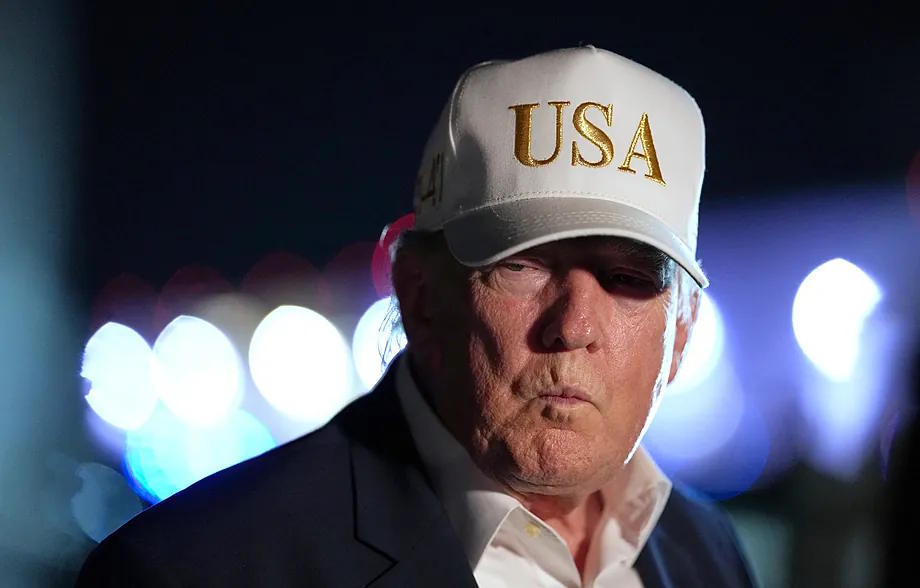
The Republican defeat in the legislative elections on November 3 has left wounded and exposed President Donald Trump. He turned the vote into a referendum on himself, his management, and his worldview, and Americans gave his rivals the biggest victory since the Nixon scandals and Watergate. The week since then, filled with contradictions and changes of mind, has highlighted the president's doubts and the internal struggle within the conservative world. Especially regarding immigration.
On the morning of last Wednesday, when it was already clear that both chambers of Congress would be in Democratic hands and that two years of investigations, hearings, and reproaches were looming, Trump dedicated his first appearance to discussing the renovation of the White House ballroom. Shortly after, the same president who had congratulated the opposition on their results, admitting it had been a surprise, pulled out the oldest trick from his hat: "Does anyone really believe these 'elections' were honest?", he wrote on social media, renewing his efforts to sow doubt about the results. "How is it possible that the polls were so wrong? Some early voting was so massive that it was impossible to win, no matter how many people showed up to vote. It all comes down to the machines, which are much more important than the voter!", he added.
There's more. Amid all the confusion, Trump wrote over the weekend that he had offered the White House spokesperson position to his friend Dana White, CEO of the UFC, the leading fighting organization, which held an event inside the White House in June. Trump's legacy is so strange that no one dared to say whether it was a joke or serious, especially after the failure of his last election, which lasted only four days. Speculation in Washington multiplied about the possibility that someone had mistakenly put another Dana White's name on a candidate list, a woman who was the Pentagon spokesperson during his first term. And that the president, upon seeing it, thought of his friend. The peculiar joke continued when on Monday the wrestling Dana White showed up at the White House and humorously answered some questions before publicly rejecting the job offer.
But undoubtedly, the main issue in this back-and-forth is immigration. There is some consensus in the U.S. that the Iran war, and its consequences on fuel prices, have been the main reason for the Republican defeat. Before the bombings began, polls already showed a Democratic advantage, but it was Iran that turned a correction into a tsunami. However, there are many more causes: blatant corruption, the persecution of political enemies, the tone of a leader acting like an absolute monarch, the waste on projects while people struggle to make ends meet. And of course, immigration policy, mass deportations, the cascade of scandals associated with ICE, the main agency that detains immigrants, the deaths of over 60 people in its custody since Trump returned to power. This has completely reversed the Hispanic vote and handed Democrats strongholds where they hadn't placed a senator in 20, 40, or even 100 years.
The president himself seemed to admit this just hours after the Midterms. In his first television interview, granted to CBS's 60 Minutes, Trump acknowledged that his deportation strategy had been too harsh and "had hurt his party electorally." "I think it was too aggressive", he admitted. Trump particularly took political responsibility for the expulsions of immigrants without criminal records, some of whom had stable jobs and had been living in the United States for ten, fifteen, or forty years and contributing to the economy. "Murderers and drug traffickers must be deported" he insisted, but opened the door to some form of regularization that would allow many people to stay "if they are good people working in a landscaping company, or in a hotel, or doing something, right? And in some cases, paying taxes."
The president even suggested a deal with the Democrats, who will take control of Congress. "I would love to do something on immigration", he assured. Quickly, the idea of "amnesty" became central to the debate, as we are potentially talking about millions of people. A drastic change from the mass deportation policy he had defended for the past ten years and implemented since his return to the White House. And something that caused an earthquake among his loyalists.
For that reason, the apparent shift lasted little. Just a day later, Trump backtracked and expressly ruled out any possibility of mass regularization for undocumented immigrants. "There will be no amnesty," he stated emphatically to reporters at the White House, insisting that his immigration policy had not changed and that deportations would continue.
The reversal came after his statements caused discomfort among sectors of his own electoral base, who interpreted the negotiating openness as a abandonment of one of the main promises of the MAGA movement. Even Vice President JD Vance publicly criticized the idea that was beginning to be discussed in the White House. Numerous congressmen, senators, and conservative think tanks, as well as commentators aligned with the president, immediately reacted attacking the idea of amnesty. Something that many of them would see as a betrayal even greater than starting a war in the Middle East after promising not to do so.
"This plan would absolutely guarantee that Texas will never vote Republican again", warned radio host Anthony Cumia, for example. "More states will permanently turn Democratic if amnesty is granted to undocumented immigrants. Reagan did the same and California became a Democratic state forever. Trump can repeat it with Texas. How disgusting!". "Someone needs to tell Trump: any amnesty deal with the Democrats will destroy the Republican Party. We voted against amnesty and for the mass deportation of all undocumented immigrants. No concessions. No exceptions," added conservative influencer Kelly McCarthy.
That Trump does not have a 180-degree turn in mind seems evident because Trump has chosen Stephen Miller, the most radical of all his advisors and the main architect of his immigration policy, both in this term and the previous one, to lead his team as the new chief of staff. A clear statement of intent, a bet to clash in the next two years and that eliminates any trace of self-criticism. When asked if he had spoken with Miller specifically about possible changes in immigration policy, Trump replied that he had not. "My policy has not changed, it is very firm", he stated, adding that the main goal will continue to be expelling "the worst criminals."
Hours earlier, his Secretary of Homeland Security, Markwayne Mullin, had already stated that although he had received calls from several Democratic congressmen and senators interested in working on other approaches to immigration policy, he was firmly opposed to any agreement that included amnesty. "I informed the president that those calls are coming in. And the president told me: 'Let's start working with them and meet somewhere in the middle. That's the whole conversation," Mullin said. "Now, if we want immigration reform that allows us to look at DACA and find a way for these people to become permanent legal citizens or something similar, that will depend on Congress," Mullin said, referring to the Deferred Action for Childhood Arrivals (DACA) program, created during the Obama era and which allows undocumented immigrants who arrived as children to remain in the country. Something that Trump has actually been suggesting since at least 2018.
It is evident that Trump seeks to send some kind of message, to the Democrats and to Hispanics, already thinking about the 2028 elections, but without renouncing the core of his worldview. According to AP data, from a survey of 100,000 voters, approximately 6 out of 10 stated that the actions of Trump's government regarding immigration control had gone too far. A similar percentage disapproved of how the Immigration and Customs Enforcement (ICE) was performing its duties. Likewise, according to a Reuters/Ipsos poll conducted between November 6 and 9, 48% of Americans want the new Congress to dedicate a lot or quite a bit of attention to immigration reform during its first hundred days. So something is likely to be achieved.
Congresswoman María Elvira Salazar, a Republican from Florida and a long-time advocate for granting legal status to undocumented immigrants, celebrated Trump's initial words showing a possible path. "Well done, Mr. President! What you described on 60 Minutes is the essence of the Dignity Act," she wrote in the post. The Dignity Act that Salazar advocates for would grant legal status to individuals who have continuously resided in the United States since 2020, as long as they have not committed other crimes and pay restitution and back taxes.