Several dozen friends and relatives had gathered in front of the two coffins. One belonged to Artem Zhukov and the other to his wife Daniela Zukhov. He was 37 years old. She was 30.
"This is a tragedy for the people and for the entire country. Everything has turned bleak and mornings are now cloudy. Today we say goodbye to them: their son, their daughter-in-law, their beloved mother, their father, the grandchildren, their brother."
The woman's speech continued uninterrupted even when alarms began to sound on phones. "Emergency alert! Attention! Threat of guided aerial bombs (KAB)!" read the messages that started arriving on mobile devices.
She continued her speech impassively despite the enormous blasts heard moments later. "It is extremely difficult to accept that we will never see these neighbors again." Each explosion shook the windows of the funeral home. But the cleric officiating the ceremony continued swinging the censer. "Hallelujah!" he was heard proclaiming.
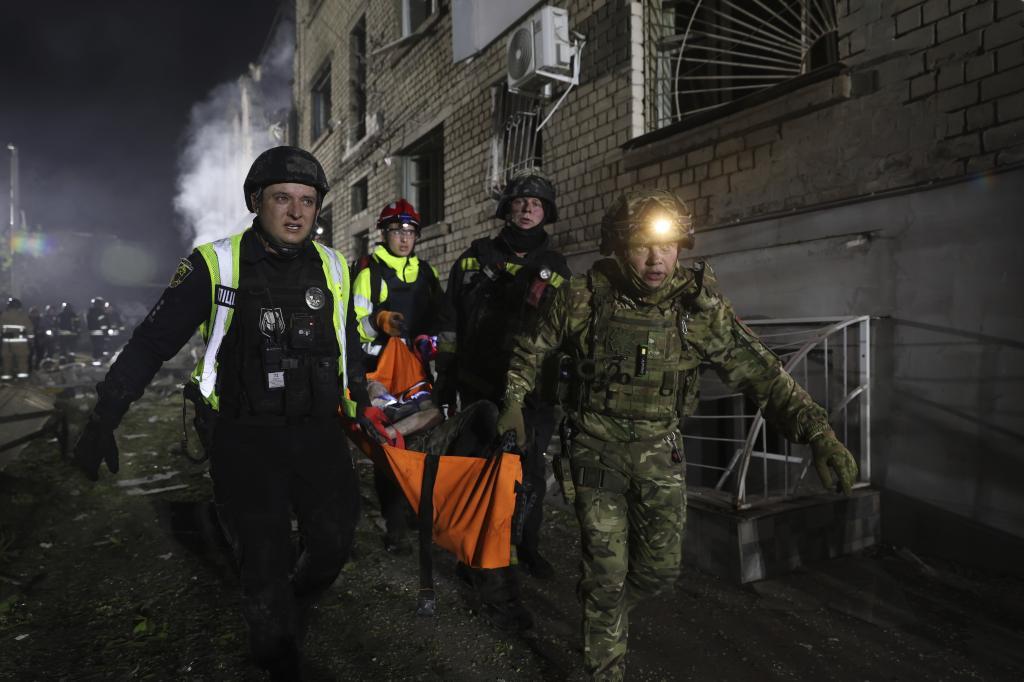
The families and friends of the victims of the Komyshuavakha massacre had gathered in the funeral home, as they have been doing since last weekend, when the funerals began for the dozens of victims left by the brutal Russian attack with a 3,000-kilogram bomb that crushed a shelter filled with displaced persons in that locality, located 30 kilometers from Zaporizhia.
According to Oleg Buriak, head of the military administration of Zaporizhia, 55 bodies have been recovered so far, but "we have only managed to identify 30." "There are still 45 missing," he added.
Rescue teams continue to operate on the ground amid the ongoing harassment from Russian unmanned aerial vehicles (UAVs). On Sunday, two rescue team members were injured, and one of the fire trucks was destroyed when hit by one of those drones.
"The Russians know they have committed a terrible war crime and do not want evidence to be collected. They know that once we recover all the bodies, it will be clear that they were all civilians," explains the mayor of Komyshuavakha, Yuri Karapetian.
Social media, encouraged by Moscow, has clung to statements made by a local figure from Zaporizhia, "who was never in Komyshuavakha, a mere charlatan," adds Buriak, who recorded a video claiming that the shelter was used by drone pilots.
"What pilots? They were all neighbors of the village. Old people and pensioners we all knew. Check all the names," adds another resident of Komyshuavakha.
The head of the municipality buried his own wife, Natalia Karapetian, on Saturday in a ceremony where two local businessmen and the four police officers guarding the underground school converted into a shelter and humanitarian aid center were also laid to rest.
Yuri saved his life by a matter of minutes. He had attended the underground school, which also served as a temporary office to deal with the usual paperwork related to his duties.
"I arrived at 8:00 AM and left 40 minutes before the tragedy. I had to go to Zaporizhia to deliver documents for those who had lost their homes, so the State would compensate them," he recounted.
Natalia stayed in Komyshuvakha. She even managed to communicate with him by phone when the first KAB bombs fell, those feared devices weighing hundreds of kilos. "She told me she had been bandaging some injured people and it was she who led all the residents to the shelter when the alarm sounded again for new bombings," adds Yuri.
The identification work is pure gore. Many of the human remains are charred or have been so mangled that Buriak says they have been forced to use sieves and nets to find the tiny "human pieces" that have been confused with rubble and dirt.
The burials have not been able to evade the violent air offensive that Moscow has launched against this metropolis, where nearly 700,000 inhabitants reside, tens of thousands of whom are displaced, like the residents of Komyshuavakha.
"The enemy, cruel and treacherous, does not even allow us to say goodbye properly", emphasized Oleg Buriak after the wave of blasts.
The procession with the two vans carrying the remains of Artem Gennadiyovich and Daniela Serhiivna headed toward the cemetery, leaving in the background a huge column of smoke rising into the sky, the result of the morning bombardment. Throughout Tuesday and into Wednesday morning, bombs and drones of all models rained down on the village. A jet-powered UAV fell near the city center, igniting several homes. The metal turbojet lay discarded next to a tree amid the blaze caused by the impact.
According to the local governor, Mykahilo Semikin, the Russians are attacking the region and the capital of the same name an average of "900 times a day." "Since the beginning of the large-scale invasion, they have killed nearly a thousand civilians, injured more than 5,000, and destroyed or damaged about 21,000 buildings," he specified in a public appearance.
The public transport company warned a few days ago that, since the beginning of this year, 30 buses and trams have been damaged due to the onslaught of FPV drones.
Entire neighborhoods of the city, such as Cosmos, have had to be covered by the sadly famous anti-drone nets as they are now part of the geography to which these small UAVs arrive, whose actions intertwine with those of larger ones - the jet-powered Shahed - and KAB bombs. In just 24 hours, this journalist witnessed more than a dozen attacks with these types of devices weighing over 250 kilos and with devastating effects. Little by little, the metropolis is forced to deal with the same scenario that has been repeated countless times in the eastern towns of the country.
For General Yevhen Lasiychuk, the top commander of the Air Assault forces fighting in this region, the Russian objective is to establish a logistical blockade of the locality and that is why they are bombing "bridges, dams, and destroying infrastructure, especially the electricity supply, within the city itself," he commented in an interview with a local media outlet.
"The initial phase [of the blockade] is already underway. There are FPV drones flying in the city center," he added.
"The Russians are bastards"
The funeral of Artem and Daniela concludes with attendees sharing pieces of bread, which they eat with salt. It is an ancient popular tradition of the Ukrainian people. They also distribute sweets.
Artem Gennadiyovich's brother, Pavlo, 37, is consumed by the anger generated by his relative's murder. "The Russians are bastards," he proclaims. He then asks for more words he has added to refer to them to be removed.
In response to Moscow's accusations, Pavlo replies: "Artem was a fisherman and had a small business."
It was the last store that remained open in the village. "They brought potatoes, bread, and cabbage. There were no more shops in Komyshuavakha," agrees Valentina, a friend of Daniela.
The tragic irony is that Artem and Daniela were about to move to Zaporizhia. This is recounted by Daniela's mother, Natalia Andryeva, 70. Before speaking with journalists, the woman caresses the coffin adorned with her daughter's photo.
"I was going to give them the key. I had already rented out the house. It took rescue teams three days to find my little girl [under the rubble]. And another day to find Artem," she says.
Local authorities plan to establish a memorial around the row of graves that continue to fill with the bodies of those who died in Komyshuavakha. For now, it is merely a dirt grave, but Oleg Buriak clarified that the idea is to create a place "so that our children will understand and remember, and so that these losses will not have been in vain," he explains.
"Perhaps this way we can ensure that such terrible acts never happen again in Ukraine," the official concluded.